Fact-checking the National Observer “Discount Frenzy” oil piece

On December 26th, 2018 the National Observer published an article Discount Frenzy: The dirt on discount oil by Wil Horter, the former Executive Director of the Dogwood Initiative. Given its subject matter, I read the piece and responded to Mr Horter online. Given the number of times this post reappeared on my social media feed; I thought a quick-take blog post would be a good way to respond. 

The report starts with a common error that Alberta heavy oils represent an inferior quality product. I have encountered this error so many times that I have already written a full post debunking this error. Activists seem to have this mistaken idea that for crude oil, light means good and heavy means bad. The truth is that they are different products with different markets and heavy crude oils are a highly desired product. As for the argument that heavier crude oil is more expensive to refine, In my blog post I point out that heavy crude, refined in a heavy crude refinery, gives higher margins and less waste than light crude refined in a light crude refinery. The heavy crude costs more to refine but recoups more per barrel, which results in higher returns…which is why it is so desirable.

The author then claims that the $10-$25 dollar discount between Alberta’s Western Canada Select (WCS) and Western Texas Intermediate (WTI a light crude) is due to a difference in quality. Anyone familiar with world oil prices knows that the difference between heavy and light crudes on the world market is almost always in the low dollar range one way or another. The trick is that the author uses the WCS (which is landlocked) for a comparison rather than a heavy crude that is not land-locked. Anyone familiar with oil pricing knows that Mexican crude Maya is the most comparable crude to WCS. They are both low API blends with about 5% sulfur. Looking at the Oilprices.com price chart we see that today (December 28th) the price of WTI was $45.33 while Maya for delivery to the US Gulf Coast was fetching $48.26 and for delivery to the US West Coast it was getting $48.01. If heavy crude is inferior why is it selling for more than light today? The difference in price is due to Alberta WCS being land-locked, plain and simple.

The next section of the article I want to debunk is the suggestion that the “Trans Mountain pipeline is no solution“. This represents a common argument made by the opponents of the Trans Mountain Pipeline expansion (TMX): that if there was really a market for oil in Asia then surely we would be selling there already. This trope can be easily debunked just by looking at where all the fuel has been going. Dr. Andrew Leach from the University of Alberta looked at the NEB data for all the oil that ran through the pipeline for the last decade. Virtually every barrel that ran through the pipeline was grabbed for use in BC and the Puget Sound, there was very little left over to sell elsewhere.
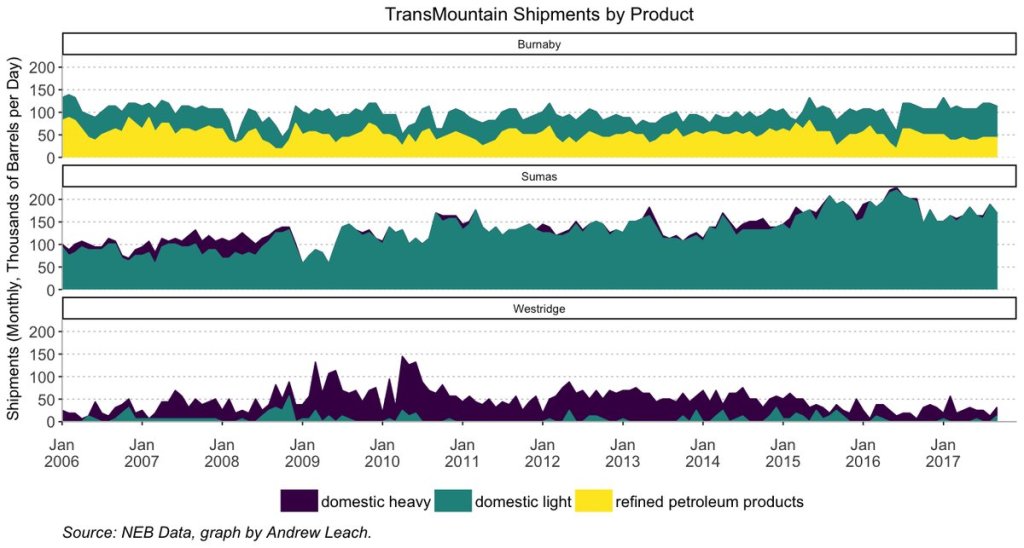
As for the oil that did make it to Westridge Terminal, it was all gobbled up by the Californians. I pointed this fact out online and Mr. Horter claimed that recent history contradicted my claims. Funny thing, he apparently hasn’t been talking to Greenpeace which wrote an entire report bemoaning all the Alberta crude going to California. Not that the Chinese don’t want to get into the act they just have to deal with higher transportation costs. But wait, the article claims:

“there is no price premium in Asia. In fact, former CIBC Chief Economist Jeff Rubin concludes “heavy oil … typically trade at more than US$8 a barrel less, not more, in Asian markets compared to the prices Gulf Coast refineries pay.”

No surprises here, that factoid is also suspect. The challenge was trying to figure out where that factoid came from. In the article it links to a paper by Jeff Rubin an economist who some have argued should not be listened to on this topic. The original citation links the claim to another paper by Mr. Rubin. When you go to that paper you find that it isn’t really something Mr. Rubin generated, this self-citation hides the fact that he actually got the number from a report at the “Price of oil” website. Go to that report and you discover that the number is not a general one (as suggested in the National Observer piece), rather it is a one-time result from a Reuters story. A convoluted route via which a one-day output by Reuters becomes a “typical” case in a National Observer article. So what is the truth? Well according to Oil Price.com Maya sells at a discount to the Far East. Why does it sell at a discount in that market? Well that is because oil prices have to account for transportation costs.

Maya is derived from the Cantarell and Ku Maloob Zaap oil fields in the Gulf of Mexico. The nautical distance between the Port of Vera Cruz in Mexico to Shanghai China is almost 10,020 nautical miles. The two ports are almost as far apart as you can put two ports. This incredible distance results in much higher transportation costs which explains the lower price for that market.

Going back to the West Coast, the nautical distance from the Port of Vancouver to Shanghai is 5110 nautical miles. By halving the distance the price to transport the oil goes down and the price Albertan producers can get for it goes up. Remember earlier when I talked about all that crude going to California. The trip from Vancouver to San Francisco is only 812 nautical miles and the cost to ship a barrel of oil from Vancouver to San Francisco is only $4/barrel. Given that short trip (and low transportation costs) the Californians can outbid the Chinese for Alberta oil because their shipping costs are so much lower. Given the limited volume of Alberta oil available, the Californians are going to win the battle for the limited supply. Given the transportation cost differential, the fact that any oil is getting to China is a sign of how robust that market is for Alberta oil.

Finally, in the article Mr. Horter claims: “In fact, Trans Mountain frequently operates at less than full capacity and, despite a blip last month“. According to Trans Mountain the Trans Mountain pipeline is almost always oversubscribed. When asked for back-up for his claim Mr. Horter provided a link to a story about the Enbridge pipeline which presents an irrelevant link to a web search of the NEB web site. Nothing in the back-up appears to says what the referencing article suggests it does.

Author’s Note 1:

For another take here is Markham Hislop who further debunks Mr. Horter’s piece.

Author’s Note 2:

In re-reading the post, I can see the effect of being tired in some of the language I used. I have revised the text to reduce the friction of the article and stick to the facts.

Posted in Canadian Politics, Pipelines, Trans Mountain, Uncategorized | 4 Comments

About that questionable IMF survey claiming $5.3 trillion in “subsidies” for fossil fuels

During the break I thought it would be nice to catch up on some blogging. The first topic I want to cover is that questionable International Monetary Fund (IMF) “subsidy” survey we constantly see quoted by anti-pipeline and climate change activists. The IMF Survey (authored by Coady, Parry, Sears and Shang) was mostly ignored in Canada when it came out in 2015, but has been used as cudgel by anti-pipeline activists since the Trudeau government bought the Trans Mountain Pipeline this year. The IMF survey web page claims that worldwide energy “subsidies” were $5.3 trillion in 2015 with Canadian “subsidies” being $46.04 Billion. As I will demonstrate in this blog post, these numbers are at best questionable and at worst designed to misinform presumably for political purposes.

A quick note: a lot of people have described this document as a formal IMF Report which represents the viewpoint of the IMF. This is not the case. The document is actually a working paper and the IMF is explicit about that fact. Here is the disclaimer they put right at the top:

IMF Working Papers describe research in progress by the author(s) and are published to elicit comments and to encourage debate.[bold is their emphasis not mine] The views expressed in IMF Working Papers are those of the author(s) and do not necessarily represent the views of the IMF, its Executive Board, or IMF management.

So the first thing to recognize is that this is not an IMF report, it is a survey produced by employees of the IMF for discussion purposes. Since the survey is about subsidies it seems obvious to first define a “subsidy“. The Google dictionary definition of a “subsidy” is:

a sum of money granted by the government or a public body to assist an industry or business so that the price of a commodity or service may remain low or competitive.

As you can see, traditionally subsidies are viewed as financial help from government either in the form of money or a reduced tax rate to encourage an activity. The IMF survey doesn’t use that definition of a subsidy. Here is how the IMF survey defines “subsidies” in this survey:

A key factor in estimating the magnitude of current subsidies is which definition of “subsidies” is used. Pre-tax consumer subsidies arise when the price paid by consumers (that is, firms and households) is below the cost of supplying energy. Post-tax consumer subsidies arise when the price paid by consumers is below the supply cost of energy plus an appropriate “Pigouvian” (or “corrective”) tax that reflects the environmental damage associated with energy consumption and an additional consumption tax that should be applied to all consumption goods for raising revenues. Some studies also include producer subsidies, which reflect the net subsidy given to energy producers (for example, through access to subsidized inputs, preferential tax treatment, or direct budget transfers) although these are typically much smaller than consumer subsidies (OECD 2013).

So they include traditional governmental subsidies but add what economists have traditionally referred to as “externalities” and as a bonus the “additional consumption tax” which is basically what the authors believe the tax rate should be versus the actual tax rate applied by government (a bonus fudge factor).

Externalities in Economics are social and environmental costs to the community associated with an activity. Economists spend a lot of time trying to establish the cost of externalities because those costs are not always evident (what is the cost to the community of spilling soap into a river as one example?).

Reasonably speaking we could probably end this blog post here. The report we keep reading about is not really the viewpoint of the IMF and it doesn’t address what an economist would recognize as a “subsidy”. Simply speaking we should simply ignore it when activists cite its results. But what would be the fun with that? Instead, let’s look at the choices made in this “survey”. Let’s do this by considering the Canada numbers. From the spreadsheet associated with the report we get these values (in billions of 2015 dollars). The total “subsidy” in 2015 was reported as $46.04 billion. The breakout was:

  • Pre-Tax subsidies – $1.4 billion – 3% of IMF total
  • Global Warming – $17.20 billion – 37.4% of IMF total
  • Local air pollution – $6.05 billion – 13.1% of IMF total
  • Congestion – $14.89 billion – 32.4% of IMF total
  • Accidents – $2.08 billion – 4.5% of IMF total
  • Road Damage – $0.88 billion – 1.9% of IMF total
  • Foregone Consumption Tax Revenue – $3.53 billion – 7.7% of IMF total

According to the spreadsheet the actual 2015 “subsidy” for the entire fossil fuel industry in Canada was about $1.4 billion made up mostly of preferential tax treatments.

The remainder of the total (97% of the IMF survey “subsidy”) consists 89.3% of externalities and 7.7% of that fudge factor for taxes. I don’t have the patience to deal with the tax side so let’s look at those externalities.

The real flaw in the IMF “subsidy” evaluation is the externalities it considers as being the responsibility of fossil fuels and then how it accounts for those numbers. Unfortunately, the IMF study doesn’t actually give details in this report of how they generate their numbers. The spreadsheet provides the conclusions not how they were generated. It appears that most of the numbers are derived from other reports; the most important being Getting Energy Prices Right from Principle to Practice. Not surprisingly this report was co-authored by one of the IMF survey’s co-authors Parry (with Heine, Lis and Li).

This secondary report provides some of the meat underlying the “subsidies” and some of them are pretty odd. Let’s look at that “Congestion” and “Accidents” values ($14.89 billion and $2.08 Billion for Canada in 2015, respectively). Here is what that report says about congestion and accidents:

Traffic congestion costs imposed by one driver on other vehicle occupants are approximated by using a city-level database to estimate relationships between travel delays and various transportation indicators and extrapolating the results using country-level measures of those same indicators. Travel delays are monetized using evidence about the relationship between wages and how people value travel time. Accident costs are estimated based on country-level fatality data and assumptions about which types of risks drivers themselves might take into account versus those they do not, and extrapolations of various other costs, such as those for medical expenses, property damage, and nonfatal injury.

The easiest way to dismiss this number is to do a simple thought experiment. Imagine if magically every internal combustion engine were converted to electric engines would the congestion or accident rates change? The answer is, of course, no. This tells us that the externalities are not associated with the engine that moves the vehicles but the vehicles themselves. The subsidy has to do with our transportation infrastructure and urban design policies not fossil fuels. The same argument can be made for road damage. All these costs will occur irrespective of the type of engine in our vehicles.

Now if you didn’t think this study was flawed already then take another quick look at the spreadsheet. Do you notice anything funny about the numbers? Look at the congestion, accidents and road damage values for most European countries? Apparently British drivers don’t have accidents because their “subsidy” for road accidents is zero. The same goes for Germany, Italy and Finland. But be careful not to cross the border into France because apparently they have car accidents in France. Oddly enough the supporting reports provide values for these countries, but for reasons unknown those costs didn’t get transferred to this survey.

While I have not been able to completely go through all the underlying supporting information for this study I have also noted what I would argue is another significant flaw. To the best of my ability (and if I am wrong I would encourage my readers to direct me to the research) the authors ignore the fact that the Canadian and provincial governments actually have excise taxes, surtaxes (and carbon taxes) on our fossil fuel consumption. In 2018, total taxes on gasoline were estimated at approximately $24 billion. That number does not appear to be applied against Canada’s “subsidies” (or our Foregone Consumption Tax Revenue”) in the IMF survey math. If this is the case that represents a pretty significant oversight in my mind.

To summarize, there is a reason why economists have different words for different concepts. Because the correct language allows for a better understanding of the concepts under consideration. Economists differentiate between “subsidies” and “externalities” and have defined both for the purposes of policy discussions. To put this into language my readers can understand let’s think of this in biological terms.

In biology, dogs and cats are both mammals but they are not the same species. If I looked at a Labrador Retriever and claimed it was a Persian cat virtually every person reading this blog post would know I was making things up. If I insisted that every reader should consider a Labrador Retriever to be a Persian cat readers might ask why I was making such an obvious misstatement. They would look for some other reason why I am trying to play with language and would suspect that there was some underlying reason I was making such a clear misrepresentation.

The challenge with topics like fossil fuels and climate change is that few Canadians have studied economics. Because of this fact few will recognize the significant difference between a subsidy and an externality. The IMF survey authors calling an externality a subsidy is just as valid as the IMF survey authors calling a Labrador Retriever a Persian cat. It is not the correct use of the language and no matter how many times they choose to do so a dog is not a cat. The simple fact is that by using the correct language of economics these activist scientists would not be able to make a persuasive or effective case for the political goals they seek to achieve and so have decided to re-define the language to better sell their agenda. So no, Canada does not provide a $46 billion “subsidy” and globally we don’t provide a $5.3 trillion “subsidy” for fossil fuels. There is a reason the IMF calls this a “Working Paper” and does not stand behind its results. Perhaps the activists should consider that when citing these numbers.

Posted in Canadian Politics, Climate Change, Climate Change Politics, Fossil Fuel Free Future, Uncategorized | Tagged , , , | 24 Comments

Let’s face it hypocrisy matters in the pipeline and climate change debates

As someone deeply interested in the pipeline and climate change debates I encounter the topic of hypocrisy every day. The discussion usually starts with a pipeline supporter pointing out that pipeline opponents who rely on fossil fuels are hypocrites. The standard activist response to the “hypocrite” label is to point out that it is a tu quoque argument and is therefore not valid (typically while posting the famous Mister Gotcha cartoon from Matt Bors). As someone who has studied logic, I understand how hollow the tu quoque response is and in this blog post I want to explain why hypocrisy matters in the pipeline and climate change debates.

Let’s start with an explainer. RationalWiki provides this definition:

Tu quoque is a form of ad hominem fallacy that occurs when it is assumed that an argument is wrong if the source making the claim has itself spoken or acted in a way inconsistent with it. The fallacy focuses on the perceived hypocrisy of the opponent rather than the merits of their argument.

As described the tu quoque argument represents a special type of ad hominem argument. An ad hominem (literally “to the man”) is a type of argument where you attack the messenger to avoid dealing with the message. That is why it is treated as a type of logical fallacy. Whether an activist relies on fossil fuels shouldn’t logically affect our evaluation of the activist’s position. But there is something very important to understand:

Tu quoque is only a fallacy when one uses it so as to divert attention from the issue at hand, or to avoid or fail to respond to an argument that non-fallaciously gave one the burden of proof.

What does this mean in simple language? Tu quoque protects a person’s argument not their reputation. There is no denying that an activist who claims that we should not use fossil fuels while wearing a gortex jacket and driving a car to the protest is indeed a hypocrite. However, that activist can have a strong argument (that we should reduce our reliance on fossil fuels to help fight climate change) and still be a hypocrite and the tu quoque response does nothing to mitigate either of those two truths.

Similarly, a First Nations right’s advocate whose family owns a gas station that relies on fossil fuels that are transported over other First Nations’ lands is truly a hypocrite to insist that a pipeline shouldn’t be allowed to travel freely over her First Nation’s lands.

Now let’s deal with the more important question:

Should hypocrisy matter in the pipeline and climate change debates?

My response is twofold:

  1. the science says it does matter from a credibility standpoint, and
  2. morally and logically it absolutely should as well. 

Let’s start with the first half of the answer.

Regardless of what activists may hope in presenting a tu quoque response, the truth is that their hypocrisy matters in the court of public opinion and thus in policy debates. The science is clear that statements about climate researchers’ carbon footprints affect their credibility and the impact of their advice.

The public has spoken and the public agrees that the personal behaviour of activists matter. If they behave in a manner inconsistent with their proposed policies their credibility suffers. Put another way, there is a reason their opponents want to label activists as hypocrites, because it works. This brings us to the second half of the question:

Should their hypocrisy matter?

In my opinion it absolutely should.

Climate change and pipelines represent global issues that require global solutions. Because they are such big issues a lot of activists claim that their personal efforts won’t make a difference and that any change will need to be implemented by governments and businesses. This response is a cop-out. In essence, these activists are off-loading the responsibility to show leadership and instead demanding that government force a change in behaviour on the population.

Because of the nature of the policies necessary to address climate change or to get off fossil fuels a lack of personal leadership from the activist community really matters. If the activists are successful in implementing their preferred policies then every citizen will be affected and the hardest hit will be the poorest among us. Isn’t it convenient that most activists come from upper middle-class backgrounds and have the means and the resources to insulate themselves from the policies they want imposed, through the coercive power of the state, on others? If the activists fighting for those policies aren’t willing to lead from the front what does that tell you about both them and their policies?

Another important consideration is that the activist class is mostly made up of people without applicable technical backgrounds. Instead, they are mostly political scientists, sociologists and communications and media studies graduates. I can’t count the number of activists I have heard making hollow claims bereft of scientific merit (see my last blog post) because they have no practical/technical understanding of what these types of policies will entail. Their absence of a technical understanding allows them to credulously make impossible demands. This explains why so many of them present the policies necessary to effectively fight climate change as relatively benign when they will be nothing of the sort. By showing leadership the activists can develop a personal understanding about how hard this transition really will be.

What is even worse are the activists who appear to be acting in bad faith. Any informed citizen knows that electricity and liquid fuels serve two distinct roles in our current society. Electricity cannot replace liquid fuels in our transportation system, so until the transportation system is converted over to electric drive engines and hydrogen-powered fleets we will still need liquid fuels to supply our trains, planes and trucks. Any activist arguing that electricity produced by solar panels can replace liquid fuels in our current transportation system is either ignorant or trying to take advantage of the ignorance of their followers. Neither alternative is terribly flattering.

The truth of the matter is that hypocrisy and bad-faith arguments are a feature of these debates and not a bug and when observed should be called out. There are too many professional activists out there making a living making impossible demands (ostensibly “to move the Overton Window“) and demanding that the government impose a cost on others that they are unwilling to voluntarily shoulder themselves. Their attempts to “change the conversation” actually flood the discussion with fake facts and makes it harder to generate the consensus necessary to make real and necessary changes to our energy systems.

Until these arbiters of others’ behaviour demonstrate their personal commitment to live the life they demands of others their opinions should be given no weight and their hypocrisy called out. Demanding that our government give up on developing means to safely transport liquid fuels and instead build more solar panels in a world where virtually all food is moved in fossil-fuel-reliant modes of transportation is simply a demonstration that the individual making that argument either has no clue or is deliberately spreading misinformation. In either case it should be called out for what it is: either propaganda intended to bring in donations from credulous supporters (and not to make a real change in our society), or virtue signalling from self-important hypocrites who are too ignorant to know any better. Climate leaders should lead from the front and that means being on the forefront of the battle against carbon. It is time they stop just talking the talk and start walking the walk.


Posted in Climate Change, Climate Change Politics, Pipelines, Renewable Energy, Uncategorized | Tagged , , | 11 Comments

When political scientists do environmental science the results are not always pretty

Anyone who has followed my social media feed knows I am regularly tagged by activists hoping I will amplify a post they have prepared. Sometimes I re-tweet those posts and sometimes I critique them. This week I had one that definitely fit in the “critique” file. I politely highlighted a couple errors to its author and he immediately blocked me. Normally, I just ignore these posts thereafter, but this one represents a type of argument I hear often from individuals who have spent too much time engrossed in political science and too little time learning environmental science.

The blog post, prepared by a political science grad student called Milan Ilnyckyj (Milan), is titled “Overcoming fossil dependence and building the world we want“. It represents his attempt to defend himself against the “hypocrite argument” used in the climate change/pipeline debate.

The reason the charge of hypocrisy is used so often in this debate is because it represents a valid concern. We live in a world full of hypocrites who will say one thing in public and do another in the privacy of their own lives. The problem is that until you have personally tried to go without fossil fuels you can’t really understand how hard it really will be. So a hypocrite is apt to make claims that are not founded on an understanding of the scope of the challenge, usually that doing so will be relatively easy

Hypocrisy is not the direct topic of this blog post so I will stop there. For a much more nuanced discussion of the hypocrisy argument in the fossil fuel debate see my previous post: On Seattle’s Kayaktivists: Are they really hypocrites? FYI, I am also preparing a post on the tu quoque fallacy which I will put online sometime soon.

Going back the article, Milan claims that his post has three parts/goals: 1) climate change makes it necessary to move on from fossil fuels, 2) we have alternatives to them as both sources of energy and feedstocks, and 3) system change happens at the political level and not at the level of individual choice.

We can all agree on point 1. We really do need to move on from fossil fuels. I have made that point repeatedly on this blog and in my other public discussions of the topic. As for points 2 and 3? The simple truth is we don’t have alternatives for most critical uses of fossil fuels (as I will explain later) and political changes are built on individual action. Individual action serves as the impetus for collective action. So to suggest that we can make massive global political changes without anyone making individual changes represents magical thinking.

The blog post starts with a reasonable recitation of the political arguments underlying the science of climate change. The initial introduction demonstrates that, like a good grad student, Milan is capable of correctly regurgitating basic facts as long as you avoid the complex science. But even early in this section it becomes clear that the author is unclear of the science he is regurgitating. As an example, the post demonstrates confusion about the topic of sea level rise claiming that “sea level is always at more or less the same height“. That claim would come as a big surprise to the scientists at NOAA:

Similarly, the author apparently does not understand what the Representative Concentration Pathways (RCPs) used in the IPCC Fifth Assessment Report actually represent. The blog’s claim that RCP8.5 is a “business as usual” scenario is a common error for activists but not one I would expect from someone who claims to understand the topic.

The blogs technical failings are truly exposed in the first interpretive section: “2. We have alternatives for both energy and raw materials“. The section starts with some pablum about solar energy and switches to citing a popular book by “Cambridge physicist David MacKay”: “Sustainable Energy – Without the Hot Air“. The book is a must-read for energy types but only from an electricity generation perspective. Unfortunately, the author passed away before he was able to move from the big picture theoretical discussions to address the nuts and bolts of replacing fossil fuels in the transportation industry (where it really matters to make the cuts we need). It doesn’t say HOW we replace current airliners with hydrogen-powered airliners, it simply asserts it must be done. To suggest that it provides a pathway to a fossil fuel-free future oversells what the author was able to achieve.

The next section of the blog was the one that really caught my eye. Milan asserts that we don’t need petrochemicals because “fossil fuels aren’t made of anything special chemically. We can get carbon and hydrogen from all sorts of carbon-neutral sources.” Such abject ignorance of organic chemistry simply left me stunned. To imagine that we can replace all our complex petrochemicals using carbon dioxide and hydrogen leaves me wondering whether Milan has taken a single chemistry course in his life? Admittedly, we could certainly go back to natural rubber, as long as we were willing to destroy ecosystems to grow massive rubber tree plantations but that wouldn’t be ecosystem-friendly.

The special advantage of petrochemicals is that they provide us with the benefits of millions of years of Mother Nature’s synthetic organic chemistry expertise combined with the input of millions of years of solar energy all captured in the compounds themselves. Petrochemicals represent a treasure trove of stored chemical energy that simply cannot be replaced given our current scientific knowledge and energy systems. So yes, fossil fuels are made of something special and at this point in our technological progress they are simply irreplaceable.

The author also imagines that generations of scientists missed really obvious discoveries and that our current scientific expertise can suddenly make all the huge breakthroughs we failed to make in the last 200 years. He explains we need to find “new ways to make agricultural fertilizer without natural gas, run farming equipment without diesel, manufacture steel without coke, and make low-carbon concrete or concrete substitutes.” Apparently he is not aware that generations of chemists have worked on methods to fix nitrogen and simply waving his hands won’t suddenly allow modern chemists to replace the Haber process with a new approach. But that is only the start. He imagines that all we need to do is make a wish to create new ways to generate synthetic rubbers and plastics, pharmaceuticals, polymers and chemical feedstocks. To imagine this can be done easily is the sign of a political scientist with no awareness of what complex organic chemistry really entails.

The final section of the blog is the topping on the cake. It is called “3. How change happens” and it really needs to be read to be appreciated. It starts with a bad analogy and then proceeds to magical thinking, never once explaining how we can accomplish what the author claims is necessary. It assumes some deus ex machina scenario where all the challenges we face simply melt away. It skips over technological restrictions and imagines that simply by wishing hard enough that we can make airliners that don’t emit carbon and can create a more equitable global system (apparently the Chinese Communist Party and Russia’s Vladimir Putin will simply bow out to make it all work).

The most bizarre part of the entire piece is that this is the only place in the entire blog that attempts to address the hypocrisy argument directly and in response the author simply says that since climate change is such a big problem individual actions don’t really matter. He argues that instead we should rely on some big government to make the changes for us. Since our current governments aren’t doing it fast enough he argues our current system should be replaced by a completely new, never-before-seen, form of government that can ignore the wishes of the populace and impose its will on the planet. Except environmental history shows us that change only happens when a groundswell of individual action makes it politically palatable to institute larger changes.

Honestly while I hate to push eyeballs to his website you really do have to read this last section, because reading it really helps you understand the mindset of the people fighting against things like pipelines. There is simply no connection to reality in this section and this is supposed to be the practical “how do we get it done” part of the post.

Going back to the intention of Milan’s post: we both agree that we need to wean ourselves off fossil fuels, but the post fails in any way to explain how we can do so for our most important uses (transportation and petrochemicals) and why people who live a profligate lifestyle while demanding austerity in others shouldn’t be called out as hypocrites. Most importantly, its plan on making the change happen simply involves wishful thinking. In essence the blog post doesn’t do anything the author says it does. What it does do, however, is display the author’s fundamental misunderstanding about environmental science for all to read.

As a pragmatic environmentalist I can’t emphasize how hard getting off fossil fuels will be. Part of understanding the challenges involves trying to live a low-carbon lifestyle yourself. When you haven’t walked the walk it becomes clear when you try to talk the talk. When activists claim it will be an easy task they make it harder to build up the will to fight the battles that need to be fought.

Addendum

So Milan replied in a blog post. Amusingly the reply demonstrated that he simply doesn’t understand the underlying science. He Misunderstands what the IPCC said about future scenarios (i.e what is business as usual); misunderstands my critique of Dr. MacKay’s work (electricity and energy are not the same thing) and continue to demonstrate that he has no sense of what is involved in organic chemistry. My major complaint is that he simply doesn’t understand the science and his reply is to provide more proof of my point.

The funniest part is his discussion about blocking me. To be clear his block came immediately after I responded to a post where he tagged me. Let’s say that again, he went out of his way to tag me and then blocked me when I responded politely. He initiated the discussion and then metaphorically held his hands to his ears when I responded. Simple suggestion here, if you don’t want someone to reply, then don’t tag them….see how simple that can be?

Posted in Canadian Politics, Climate Change, Climate Change Politics, Uncategorized | 6 Comments

Revisiting 100% Wind, Water and Sunlight for Canada – an ill-advised approach to fight climate change

Dr. Marc Z. Jacobson, the lead scientist of the 100% Wind, Water and Sunlight (100% WWS) movement, was in Vancouver last week for a presentation. Dr. Jacobson is a proponent of relying solely on wind, water and sunlight to meet our future energy needs (although that is not strictly true since his model relies on hydroelectric facilities and lots of energy storage to make his math work). Dr. Jacobson can be something of a divisive character as he known, in some corners, for blocking people who ask him tough questions on Twitter and for suing his scientific criticsThe Tyee was on hand and prepared a summary of his presentation (his slide package is here).

I have written a lot about 100% WWS, especially as it applies to the Leap Manifesto and most of my analyses have not been positive. The repeated issue I have identified is that the model appears possible from a big-picture perspective, but it quickly becomes unglued when you look carefully at the details. This was demonstrated by Dr. Clack and his colleagues in their reply to one of his papers and more amusingly by a physicist from Finland who addressed specific instances where the model struggles.

Given the popularity of this model domestically, I want to re-look at the plan (my earlier analysis of the draft plan is here) now that a final version has been released. Specifically, I want to carefully unpack the numbers for Canada because I feel these numbers really speak for themselves. In my view, the reason the 100% WWS crew have been able to successfully promulgate their theories has been that few people have had the tenacity to crawl through the supplementary information and spreadsheets to see what the model actually entails. I’m confident when readers are exposed to the plan’s details they will see how impractical (and unnecessarily expensive) it would be.

Let’s be clear at the outset. I agree that we need to decarbonize our energy system to fight climate change. But I believe that 100% WWS is the wrong approach to achieve that goal. I believe 100% WWS’ requirement that we exclude numerous low-carbon alternatives (like nuclear and run-of-river hydro) adds significantly to the expense of the plan while providing few real benefits.

The 100% WWS worldwide plan is presented in a paper by Dr. Jacobson (and an extensive list of co-authors) titled 100% Clean and Renewable Wind, Water, and Sunlight All-Sector Energy Roadmaps for 139 Countries of the World. The paper provides a detailed break-out of what it would take for each country in the world to achieve 100% renewable energy (excluding nuclear power and any new hydro) by 2050. You note that big proviso. The Solutions Project is strongly anti-nuclear energy and argues against large reservoir or run-of-the-river hydro so they are excluded from the mix. In the web site associated with 100% WWS a breakdown of energy sources by 2050 in Canada is presented:

  • Onshore wind 27.5%
  • Offshore wind 22.9%
  • Solar PV plant 9.8%
  • Hydroelectric 14.5%
  • Wave energy 2.2%
  • Residential rooftop solar 5.3%
  • Commercial/govt rooftop solar 9.1%
  • Geothermal 1.7%
  • Tidal turbine 0.2%

At the outset the numbers look challenging, but not necessarily impossible. Being a practical guy, I dug a bit deeper to find the details. These are presented in an associated spreadsheet. In “Table for GATOR-GCMON” of that spreadsheet is the list of units necessary by 2050 to achieve the 100% WWS goal for Canada:

  • Onshore wind: 34,993 – 5 MW units ( 2240 units currently installed)
  • Offshore wind: 27,242 – 5 MW units (currently no units in Canada)
  • Solar PV plant: 1690 – 50 MW facilities (currently 13 similar facilities)
  • Solar CSP plants 450 – 100 MW facilities (currently 1 in operation)
  • Solar CSP plants for storage 275 – 100 MW facilities
  • Hydroelectric: Uses currently built facilities with efficiency gains
  • Wave energy: 26,227 – 0.75 MW installations (currently no unit in Canada)
  • Residential rooftop solar: 12,992,080 units (currently <2% of units installed)
  • Commercial/govt rooftop solar: 1,383,183 units (currently <2% of units installed)
  • Geothermal: 50 – 100 MW facilities (currently no such facility in Canada)
  • Tidal turbine: 2000 – 1 MW units (currently no units in Canada)

Looking at these requirements you can see why I am unsettled. That is a LOT of construction to be completed in the 32 years between 2018 and 2050. To make it clear how far we have to go to meet this challenge, consider that as of August 2018 British Columbia had 698 MW of installed onshore wind capacity consisting of 288 wind turbines. Since the 100% WWS model calls for about 62,235 MW of wind capacity by 2050, we are still 61,537 MW away from this goal. We would need to install 1923 MW/year to achieve that goal. This is twice the capacity we have installed to date and that would be required each and every year until 2050.

Lets look at the offshore wind platforms. As one of the two southern coasts, British Columbia would be responsible for close to half of the 27, 242 offshore units needed to achieve our national 100% WWS goal.  As of today, we have zero offshore wind facilities. According to BC Hydro they have up to 300 potential wind energy sites being investigated for project development. Of that group, offshore represents 43 project with an installed capacity of 14,688 MW. This represents about 10% of the 136,000 MW of nameplate capacity called for in 100% WWS by 2050. All the plans in the works only gets us to 10% of our 2050 goal. 

As a British Columbian, I recognize a pretty obvious concern about this offshore number and looking more deeply into the spreadsheet I see an oversight. The reason the model imagines we can put all these offshore facilities in place is that the model imagines Canada has over 200,000 km of useful coastline (presented in the “population density” tab) on which to place those facilities. Admittedly, Canada’s coastline is vast (over 200,00 km) but the majority of that coastline is in the north (mostly in the Arctic) where weather and ice preclude the construction of offshore wind turbines.

Thus, when the model calculated how much offshore wind potential was available it missed the fact that much of the area described is not practical for offshore wind turbines. Anyone familiar with BC geography also knows that the Pacific Continental Shelf abuts much of the West Coast of Canada. The sea floor drops precipitously very close to the coast and as such over most of our coast it would not be affordable to install offshore wind platforms (even tethered floating ones) as the foundation of such installations would need to be 100s of meters deep. Alternatively, this would mean trying to shoe-horn 13,500 of these units in the narrow area of relatively shallow water near Haida Gwaii which is both unlikely and eliminates the geographic dispersion necessary to provide balance to the system.

Moreover, according to the model, to meet our goal we will need 26,227 wave devices (covering a physical footprint of about 14 km2) and 2000 tidal turbines. Be aware,  we still do not have a design for a fully-functional industrial scale wave installation suitable for the stormy west coast. There are lots of pilot projects and one unit in Australia looks promising but before we can even start the planning processes, a design needs to be identified. Absent even a design for a unit it is unclear how we are going to meet our goal in the time frame provided.

The other consideration not readily mentioned is that all that new infrastructure is going to cost a lot of money. Using their numbers (from the draft report as I was unable to reconstruct the costs in the new document) it would cost Canada $1.8 trillion of investment by 2050 just for the basic energy generation installations. Assuming we spread the costs evenly between 2018 and 2050 (32 years) that comes out to $56 billion per year to build that infrastructure. Remember we haven’t considered the infrastructure necessary to build that infrastructure (roads etc…) or the costs to do the environmental assessments on all those projects, we are simply talking about the capital costs of the actual units themselves.

Talking about environmental assessments, given Canada’s history of welcoming large industrial power facilities, I am quite certain there will be no delays in initiating the construction of all these facilities…just look at how smoothly Site C and the Trans-Mountain have been progressing in BC.

As noted, even if we spent $1.8 trillion to build all those turbines etc.. we still wouldn’t have a way to get that power to the people who need it. To achieve 100% clean energy in 2050 virtually every community in Canada will need to be connected to a national grid since cities like Yellowknife will need to import a lot of power in order to continue to exist. Under 100% WWS the citizens of Inuvik won’t be allowed to use diesel generators during the 6 month winter, when the ice has blocked up the coast and the wind can disappear for days at a time. They will thus have to import electricity from the south. Now I admit to having picked a couple extreme cases to make my point, but recognize that Canada’s vast and challenging geography has limited our ability to create a nationally integrated power grid. Even the most optimistic view has a new grid costing $25 billion and taking a couple decades to build. A more realistic appraisal puts the cost of a national backbone of 735 kV transmission lines at around $104 billion and taking 20 years to complete.

Only after the national backbone has been built can we then start work on all the feeder lines that will have to go to every city, town and hamlet. Building transmission lines in Canada can be intensely expensive. Consider that the Northwest Transmission Line project in BC cost over $2 million a kilometer to build. Yet in order to work, the 100% WWS model requires that these lines be built. As for the costs? If your single main line is $104 billion and we will need 10’s of thousands of kms of feeder lines then even taking into account the existing infrastructure we are talking in the low trillions to connect all our communities.

Not only will this construction be ruinously expensive, it would be ecologically devastating. Let’s imagine that we somehow manage to get permits to fill every inlet and fjord on the west coast with some form of electricity generating device, you still need to cut down tens of thousands of acres of forests to create the transmission corridors to get that power to the people. The biologists out there continually warn about linear developments that cut openings into pristine habitats, now imagine the number of linear developments necessary to connect 26,227 tidal units to the power grid. I find it particularly amusing that the same groups who fight a hydroelectric dam in the Peace because of its footprint would demand we build a electricity generating system and grid that would decimate the last protected areas of our coast.

As I have said more times that I would care to admit in this blog, I am a pragmatist. As a pragmatist I tend to live by the credo “moderation in all things”. The 100% WWS model fails because it does not believe in moderation. It places tight, and questionable, restrictions on a number of important baseline clean energy technologies and in doing so results in a proposal that is ruinously expensive consuming over $100 billion per year. Can you imagine the legacy of debt we would place on our children, our grand-children and our great-grandchildren if we suggested borrowing $100 billion+ a year for the foreseeable future to fund this infrastructure? Admittedly we live in an era of low interest rates but they will not last forever. Adding several trillion dollars to our national debt is simply a non-starter.

To close this post let’s reiterate a few facts: fighting climate change is going to be a very expensive, electricity-intensive project that will take a huge political will; the expenditures of massive financial resources; and cooperation between the private and public sectors. I agree we should work hard to develop a power system with a strong renewable component, but I believe in regionally-appropriate renewables. The problem with the proposal pushed in 100% WWS is that it is hobbled by some of the personal views of its creators. It omits some pretty obvious energy solutions like further large-reservoir hydro in Quebec, Labrador, Ontario and BC, run-of-the-river hydro across Canada and, of course, further nuclear power in Ontario and on the prairies.

A country like Canada that is blessed with an abundance of hydropower and nuclear opportunities should not ignore those opportunities because a team of engineers from California don’t particularly like that technology. Put simply, we cannot ignore the potential of nuclear and hydro energy in a post-fossil fuel energy mix. Researchers have enumerated the costs savings to incorporating nuclear and other alternatives into our mix and they are substantial. It is already going to be a tough battle to achieve a low-carbon grid. Let’s not make it impossible just because 100% WWS sounds good as a catch-phrase.


Posted in Climate Change, Climate Change Politics, Fossil Fuel Free Future, Leap Manifesto, Renewable Energy, Uncategorized | 17 Comments

A primer on Professional Governance in the Natural Resources Sector

On October 22, 2018, George Heyman tabled Bill 49 – 2018: the Professional Governance Act (the PGA) which will establish the “Office of the Superintendent of Professional Governance” as well as change other elements of professional governance affecting how select professionals are governed in BC. On November 22 this bill completed third reading and is now awaiting Royal Assent.  The new legislation “will establish a single centralized statutory authority focused on governance which will cover professionals working in the Natural Resource sector.” The new “Office of the Superintendent of Professional Governance” will be administered by the Ministry of Justice and Attorney General.

As a Registered Professional Biologist and a Professional Chemist, this new legislation will have a significant effect on my professional life and I think it is important for the public to understand what it will mean for them. In this blog post I want to point out some important information about professionals in the natural resources sector in BC. For simplicity when referring to professionals I will rely on resources from the College of Applied Biology rather than jumping between organizations. 

What does it mean to be a “Professional” in the natural resources sector in BC

Professionals are highly-trained specialists who do the basic science in the natural resources sector. They design the investigations; collect and compile the data; write the reports; and make the recommendations to government. The first thing you need to understand is that a revocable professional designation is THE critical tool available to ensure that professionals behave in an appropriate and ethical manner. To explain, I earned a PhD from UVic and short of them determining I did something wrong during my studies they cannot revoke that PhD. No professional error is justification for them withdrawing my PhD. But my professional designations (I am a Registered Professional Biologist and a Professional Chemist) can be revoked for any number of reasons. As an example, if I act contrary to the College of Applied Biology’s ethical code I can lose my R.P. Bio. 

Most professional organizations provide their members with an individualized professional stamp. This allows professionals to indicate on official documents when they are acting in the role of a professional. Any critical document is stamped and signed by the professional as an attestation that the work has been completed in accordance with professional guidelines. The stamp is proof to a regulator, or an outside third party, that the professional is staking their reputation on that document. Misuse of the stamp is grounds for removal of the stamp.

The critical feature of a revocable professional designation is that it give regulators confidence that the identified professionals are appropriately qualified and monitored for their behaviour. This allows the government to appoint the individuals as Qualified Persons (QP) under various Acts and Regulations. From a professional perspective being a QP is a big thing in the natural resources sector and is something you definitely want to protect. 

How do you get a Professional Designation in BC?

To get a professional designation you need a combination of education and professional experience to satisfy the regulator of your professional body that you are qualified to be a member. The College of Applied Biology as an example requires you have an appropriate degree and professional experience and in addition you have to agree to be bound by a set of rules of Professional Ethics.

Not all organizations have professional designations and not all professional designations are equal. The PGA recognizes five Professional Governing bodies. These are:

  • The British Columbia Institute of Agrologists, 
  • The Applied Science Technologists and Technicians of British Columbia 
  • The College of Applied Biology
  • The Association of Professional Engineers and Geoscientists 
  • The Association of British Columbia Forest Professionals 

You will notice that some other groups are missing. The Association of the Chemical Profession of BC is not in that list because BC never passed a Chemists Act. Professional Chemists have a right to title (more on that later) under the Societies Act but will have to be eventually added to the list of professionals under the PGA.

Some groups of individuals with specific degrees (like geographers) don’t even have a professional organization. This leaves students with a geography degree out in the cold when it comes to working as professionals in the natural resources sector in BC. Absent recognition under an Act they can’t earn a revocable professional designation and find it very difficult (and sometimes impossible) to become a QP. This severely limits their ability to work in the field as they would need another professional to sign and stamp critical documents for submission to the regulator. Ultimately, they hit a glass ceiling and they can’t rise any higher. 

Role of the College

The College (some groups use different names) is the body that governs each professional organization and serves, and this is the important part, primarily to protect the public interest. They do so by making sure that their members are competent and act in accordance with the rules. They operate the discipline committees and the oversight committees and respond to, and investigate, complaints about members. To serve its roles correctly the College cannot be an advocate for its members but rather an advocate for the public. As presented by the College of Applied Biology

As a governance body, the College does not engage in issue-oriented advocacy, and maintains an apolitical stance, meeting the public interest requirement of the Act through holding its members accountable for their actions.

Serious problems arise when a College forgets its role and tries to be an advocate for its members instead of a protector of the public good. The B.C. College of Teachers can tell you what happens in that case. 

The entire impetus for the new Professional Reliance Review can actually be tracked back to a few instances where public confidence was shaken in the effectiveness of various governing bodies to protect the public interest. The new Office of the Superintendent of Professional Governance is specifically intended to restore the public’s faith in these professional bodies when it comes to the natural resources sector in Canada.

The college is tasked with ensuring that professionals act within professional standards; they don’t act outside their specific area of expertise; they don’t have undisclosed conflicts-of-interest and they act and operate independently of their client and/or government. You may be paid to do a task by your clients and/or you may work for the government but as a professional you have a responsibility to the public good and to behave ethically and the College has to be there to ensure that every professional measures up to that heady standard.

This entire concept is one outsiders often don’t understand. They imagine that environmental consultants act as advocates for their clients. Nothing could be further from the truth. A consultant who advocates solely for their client will soon cease to be able to operate as a consultant once their professionals lose their revocable professional designations and the government refuses to accept their submissions.  

Right to Title and Right to Practice

There are two critical features in the new PGA, the “right to title” and the “right to practice” although under the new PGA they refer to it as “exclusivity of reserved titles and right of practice of reserved practice”. What “reserved title” means for a biologist is that once the Act is in force in BC you won’t be allowed to wander around calling yourself an “Independent Biologist” unless you are Registered with the College of Applied Biology. Similarly, the practice of Biology, in a professional sense, will be restricted to those who are deemed qualified by the College to practice biology.

This exclusive right to title and practice is intended to restore faith in the public by preventing people from claiming expertise that they cannot back up. It has long been understood that you can’t wander around acting as a doctor or a lawyer without a license, but there are lots of individuals, often with few or no credentials, who actively go around calling themselves Biologists because they took a biology class or two in university. This Act will end that practice. 

As a Professional Biologist, I will be glad when these self-named “Biologists” are required to get registered to continue their activities. I will be glad that they will be held accountable to a code of ethics and must demonstrate that they are conflict-of-interest free. Finally, I won’t have to cringe when I see a “Biologist” on television making statements that are demonstrably false with no one is able to hold them professionally responsible for their misinformation.

Under the new rules all biologists will have to play by the same set of ethical rules. I know it will be a big shock for the free-lancers out there but it certainly serves the public interest to have fully trained and vetted biologists as the ones supplying biological inputs to environmental policy processes. For too long activists, on both sides, have been able to counter facts with rhetoric and hyperbole and it will be nice when we have an even playing field to work with.    

As you can probably tell, I am a fan of the new model because as the government press release points out

The B.C. government has introduced legislation aimed at making sure decisions affecting the province’s natural resources are science-based, transparent and protect B.C.’s unique environment for future generations.

The first step in effective evidence-based decision-making is obtaining defensible and reliable data. Transparent and conflict-of-interest free professionals should serve as the source of that data.

Posted in Canadian Politics, Environmentalism and Ecomodernism, Uncategorized | 2 Comments

On garbage politics about ocean plastics

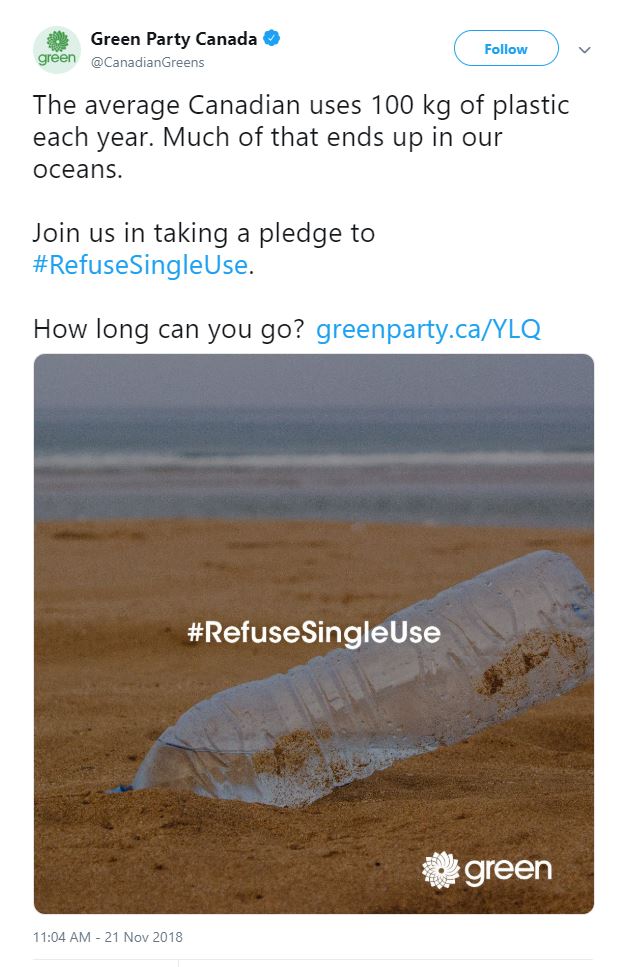
This morning on my Twitter feed I came across a ridiculous Tweet by the Green Party of Canada about their #RefuseSingleUse campaign against single use plastics. 

As an environmental policy type, I was offended by this tweet because it is so insulting to the intelligence of Canadians. Honestly, what were they thinking when they wrote this tweet and what was Ms. May thinking when she retweeted it on her Titter feed? The rest of this blog post will discuss this tweet and how the good policy intentions of the #RefuseSingleUse program can be spoiled by linking it to a narrative that is easily disproved. This is important because this sort of misinformation undermines attempts to address real policy challenges in the environmental field and undermines the credibility of the people making a good case about single-use plastics. 

Let’s start with the obvious. There is simply no way that the tweet from the Green Party represents anything approaching the truth. Consider that there are 40 million Canadians and only about 25% of them live on a coastline. If the tweet is true that means the 75% of Canadians living inland somehow are still significantly polluting the oceans with their plastic. Doing the math let’s consider what this means for Ontario. 

Virtually the entire population of Ontario is separated from the oceans with the vast majority of Ontarians living in the south with all those rivers flowing towards the Great Lakes or the St. Lawrence River. If 14 million Canadians live in Ontario and, according to the Green Party, use 100 kg of plastic a year that represents 1.4 billion kg of plastic a year. Let’s assume the “much” in the tweet represents 20% – 40%. That would mean that if “much of that ends in the ocean” then over a million kg/day from Ontario alone would be expected to be flowing down the St. Lawrence River to the Atlantic Ocean. Add to that unobserved mound of Ontario plastic the plastic from the 8 million of so Quebecois who live near the St. Lawrence River and for that tweet to be correct we would need a daily float of plastic with a mass of over 1.5 million kg flowing down the St. Lawrence to the Atlantic.

I live in the lower mainland along with 2.76 million of my peers. I simply can’t see about 110 million kg of plastic flowing from the Lower Mainland into the Salish Sea every year either.  

So when the Green Party of Canada says “much of that ends in the ocean” what they really mean is an infinitesimal percentage of the plastic used by Canadians ends in the oceans. Admittedly, that line doesn’t make good copy, so they decided instead to say something they must know is not strictly true in order to create a buzz. This completely undermines their credibility among thinking Canadians. Do they honestly think an Albertan or reading that tweet will do anything but laugh at the idea that they are contributing significantly to ocean plastic by using a straw in Strathmore?

The reality of oceans plastic is that it is mostly an issue caused by developing nations. A recent study identified that 93% of the trash from 57 Rivers studied comes from only 10 rivers, with the biggest of those being the Yangtze. So if you really want to clean up ocean pollution, a reasonable way to do so would be to invest money in improving waste management programs in these identified watersheds. Another thing we understand is that a lot of that plastic comes from single-use water containers. The reason these communities use so many disposable water bottles is that they don’t have clean and safe potable water supplies. If you really want to reduce the number of single-use water bottles in Asia and Africa then helping supply safe, potable water to thirsty communities would be a great start. 

Now supplying Asia and Africa with clean water and improved waste management facilities might be a hard sell so what else could we do? Well 46% of the plastic in the Great Pacific Garbage patch is from fishing fleets abandoning old nets. If you want to protect sea turtles then setting up a program to prevent fishers from dumping their old nets at sea would make a huge change to our oceans as well.  

Let’s be absolutely clear here. Canadians can still do better. On World Cleanup Day clean-up crews found thousands of coffee cups and water bottles on Canadian beaches. That demonstrates that Canadians have to work harder to keep our own backyard clean. However, concerns about turtles should not be argued as a reason to ban plastic straws in Alberta. 

To go back to the #RefuseSingleUse program. There are lots of really good arguments against single-use plastics. A lot of the time they are unnecessary and wasteful. Personally, our family has bought a number of reusable straws to allow my kids to drink their fun drinks with less mess. We also bring our own reusable cups to the coffee shop and use reusable water bottles when we are out-and-about. The only single use water bottles in our house are in our earthquake readiness kit where I have enough bottles of water to keep my family alive for a week because I live in an earthquake zone. That being said, should we end up at Tim Horton’s on a sunny Sunday I don’t begrudge my kids a smoothie out of a one-use cup with a straw.

To summarize, no British Columbians aren’t killing our oceans with plastics, nor are Albertans, or other Canadians. Rather, Canadian solid waste practices are some of the best in the world and our single-use plastics issue is more of a solid waste and waste of resources challenge. If the Green Party wants to do a #RefuseSingleUse campaign, then that is a great idea. But do so because single-use plastics are a bad use of resources or an unacceptable stress on our waste management systems. They shouldn’t pretend that doing so in Canada will have a significant effect on protecting our shared oceans, because making that claim undermines their credibility and sets back their ability to make good environmental arguments.

Posted in Uncategorized | 8 Comments

Once again a group of health professionals gets the science wrong on diluted bitumen and the Trans Mountain Pipeline Expansion project

By now, my opinion of physicians and health care professionals wandering into the field of environmental policy are well known. As I have written previously:

While I trust MDs on matters relating to my health and wellness, I will stick with subject matter experts on topics that are not related to medicine.

Well another band of well-meaning, but ill-informed, health professionals are at it again. This time with a letter to the Prime Minister where they absolutely mangle the science behind the Trans Mountain Pipeline Expansion (TMX) project. While I could really go after their entire letter, I lack the time or the enthusiasm to do so. Therefore, this blog post will address the egregious errors from their sections on diluted bitumen. For simplicity here is the section of the letter I intend to debunk.

Specific to TMX, diluted bitumen is dangerous and considerably more toxic than crude oil. It behaves unpredictably in aquatic environments, sometimes floating, sometimes sinking. The marine spill scenario in the NEB review was very optimistic. It was set far away from any population center despite the clear hazards of a seven-fold increase in tankers through Vancouver’s busy harbour with three bridges and two dangerous narrows adjacent to downtown with over a million people, a population which includes Indigenous communities whose close connection to the land makes them particularly vulnerable to environmental contamination. We need to know the health impacts of a worst-case spill in the most populated area of the project, e.g. a large tanker spill, close to shore and under poor air quality and high temperature conditions prominent in the past several summers in British Columbia. We must additionally acknowledge that even best-case scenario clean-up of crude oil results in only 5-15% oil recovery, with spilled bitumen likely to have even lower levels of recovery.

Finally, the health impacts assessment did not adequately consider the extremely high risk from benzene, one of the most toxic components of the pipeline product diluted bitumen (dilbit). The increased risk of childhood leukemia was ignored by the review as was consideration of genetic and other special population vulnerabilities. 

Toxicity of Diluted Bitumen

The authors start the section by making a demonstrably false claim about the toxicity of diluted bitumen saying it is “considerably more toxic than crude oil”. They later take special notice of the benzene composition of diluted bitumen and the risk it poses to children and indigenous communities.

As most informed observers know, diluted bitumen, due to its chemical nature, is less toxic to humans than most refined fuels and most other crude oils. To explain, the most toxic components in petroleum hydrocarbon mixtures are their monoaromatic hydrocarbon constituents (like benzene, toluene, ethylbenzene and xylenes or BTEX). One of the features of bitumen is that, like other heavy oils, it has relatively low BTEX concentrations. Geochemically, bitumen is a type of crude oil where virtually all of the most toxic volatiles have been biodegraded in the subsurface. That is why the material is so viscous and why they have to add condensate to make it flow.

Relatively speaking diluted bitumen has some of the lowest BTEX concentrations of all crude oils. As detailed by in the US National Academies of Science (NAS) report on the subject:

The average BTEX in diluted bitumen at 0.89 % vol [reported in % by volume] was similar to the heavy crude oils at 0.84 % vol, whereas light and medium crude oils were 2.56 and 2.80 % vol respectively.

With special regard to benzene, both bitumen and condensate have some benzene (the five year average for benzene concentration in Cold Lake Blend is 0.23% +/- 0.03 %) but West Texas Intermediate crude has twice the benzene while low-benzene gasoline has almost 4 times as much.

What this means is that while diluted bitumen is toxic so are gasoline, aviation fuel, light crudes, medium crudes and West Texas Intermediate crude. All of which are substantially more toxic to humans than diluted bitumen. So when the ill-informed health professionals make the claim that diluted bitumen is “considerably more toxic than crude oil” they are absolutely and categorically wrong. Similarly, when they warn of the risks of benzene in diluted bitumen, they are once again barking up the wrong tree because any replacement for diluted bitumen will have considerably higher benzene concentrations than diluted bitumen and would thus pose a higher risk to human and ecological health.

Marine Risks

The topic of marine risks is also raised by the health professionals. I have written extensively on the topic of the marine risks of the TMX and my research shows that once again the their arguments are not consistent with the current research.

Their tired argument about “seven-fold increase in tankers through Vancouver’s busy harbour with three bridges and two dangerous narrows” completely ignores the added precautions associated with the TMX project. The NEB required a detailed risk analysis of the TMX. The critical document on this topic is the report Termpol 3.15 – General Risk Analysis and intended methods of reducing risk which evaluated the risks of the project. It concluded that “with effective implementation of risk reducing measures most of the incremental risk resulting from the project can be eliminated”.

To put a number on it:

  • Without the project the risk of a credible worst case oil spill is estimated in 1 in every 3093 years….If all the risk reducing measures discussed in this report are implemented the frequency will be one in every 2366 years.
  • This means that after the Project is implemented, provided all current and future proposed risk control measures are implemented, the increased risk of a credible worst case oil spill in the study area from the Trans Mountain tanker traffic will be only 30% higher than the risk of such an occurrence if the Project did not take place.

By increasing the number of tankers by 7 times, but also implementing the changes that were ultimately mandated by the NEB, the risk of a spill is less than one event every 2000 years. So no, the risk does not increase by 7 times, it increases by barely 30%. Moreover, remember that 30% is multiplied by a near-zero number. 30% more of near-zero remains almost-zero. Essentially, the experts have established that the project provides no significant increase in risk over those risks we accept every day.

In exchange for that negligible increase in risk we get economic prosperity and the economic health and goodwill of our neighbouring provinces. The dollars generated by this project are what pay for our health care system, which coincidentally pays all these physicians, nurses and health professionals.

Moreover, as I have noted previously, any cold-eyed analysis of the relative risks shows that the TMX reduces our regional risks of oil spills. Blocking the TMX will increase the likelihood of a disastrous rail spill that could spell the end of a major fishery or result in the deaths of dozens of innocents. It also increases the likelihood of a marine spill from a foreign-flagged tanker.

Spill Recovery

The authors also repeat that worn out quote about diluted bitumen spill recovery “even best-case scenario clean-up of crude oil results in only 5-15% oil recovery“. That factoid is, not surprisingly, based on an out-of-date study.

The federal government has spent millions of dollars researching the behaviour of diluted bitumen in an oil spill and has summarized the results at Transport Canada. The conclusion of the research is that diluted bitumen is somewhat easier to clean than heavy crude and can be much easier to clean than a light oil spill. As for that 5%-15% number the health professionals trot out. The 5% -15% number involves open ocean spills far away from spill response facilities not spills in a well-managed port. In the one example of a marine spill, in the Burrard Inlet, they were able to recover 95% of the spilled material.

Fisheries and Oceans Canada modeled an oil spill in the Salish Sea and concluded that the majority of the oil would stay on the surface rather than dispersing into the water column. That would mean that the floating oil would be recoverable using current spill response technologies. As for the sinking scenario, that scenario only applies in a tiny bit of the Salish Sea, in what is the widest sea lanes in the entire route.

Conclusion

So once again we have well-intentioned health practitioners demonstrating my father’s adage quite effectively: “never trust an MD on any topic that is not related to medicine”. In that short 214 word snippet from their letter we were able to find appeals to sentiment, wild exaggerations and outright errors. It simply amazes me how a bunch of Emergency Room Physicians, Family Doctors and other non-specialists can get so much air play on their ill-founded concerns and that no one else appears to call them on it when they do.


Addendum:

Here is a breakdown of the BTEX in every significant blend of Canadian diluted bitumen

BTEX dilbit

Source: Federal Government Technical Report: Properties, Composition and Marine Spill  Behaviour, Fate and Transport of Two Diluted Bitumen Products from the Canadian Oil Sands – ISBN 978-1-100-23004-7 Cat. No.: En84-96/2013E-PDF


As for crude oils – from Characteristics of spilled oils, fuels, and petroleum products : 1. composition and properties of selected oils.

Benzene – µg/g BTEX – µg/g
Alaska North Slope Crude Oil (2002) 2866 16300
Alberta Sweet Mixed Blend (ASMB, Reference #5) 2261 18170
Arabian Light (2000) 979 10950
Sockeye (2000) 1343 8230
South Louisiana (2001) 1598 12210
West Texas Intermediate (2002) 4026 23370

If you want to look up the value for every major oil out there Environment Canada maintains an oil properties database


Posted in Oil Sands, Pipelines, Trans Mountain, Uncategorized | 5 Comments

Looking at the science on cannabis, kids and addiction

Last week the Canadian government finally legalized and regulated the production, distribution, and use of cannabis. Like many of my peers, this change in the law didn’t have a serious effect on my life. I didn’t ingest cannabis before legalization and I have no strong desire to do so now. It is not that I have any moral qualms about the stuff, I have just always worked in fields where post-incident drug testing is a reality and knowing my analytical chemistry have been aware that casual use can stay in your system far longer than most recognize. I have also had a lifetime of lung problems and being around people smoking anything leaves me searching for my inhaler. That being said, I have read a lot of misinformation by “cannabis experts” and so wanted to write a brief blog post highlighting some research that some of the activists would prefer you not understand. Specifically, that cannabis can indeed be addictive and it is very much something that you want to keep well away from young people. Let’s start with the second point first.

Cannabis and youth.

I can’t count the number of cannabis activists I have seen in the last few weeks proclaiming that cannabis is harmless and there shouldn’t be any serious limitations on its distribution and use. The simple fact is that cannabis is a psychoactive substance. Put another way, if cannabis was not a psychoactive substance there would be no particular reason why so many people would be interested in using it. As described in a science dictionary, cannabis

affects both the cardiovascular and central nervous systems. The major psychoactive component in marijuana is delta-9-tetrahydrocannabinol, or THC. After entering the bloodstream through blood-gas exchanges associated with smoking, THC combines with receptor sites in the human brain to cause drowsiness, increased appetite, giddiness, hallucinations, and other psychoactive effects.

One thing I was taught early in my study of toxicology is that the brains of adults and those of children react differently to the same compounds. That is why so many medicines that are fine for adults are not recommended for children. Cannabis fits into that class. While cannabis can, quite rightly, be recommended to children by doctors to treat specific maladies, it should be carefully avoided for most youth. The science is clear that cannabis use, and particularly heavy cannabis use:

All this makes it clear that cannabis is not the harmless substance for youth that some of its more ardent proponents claim and strongly supports the government’s decision to limit the use of the substance to adults.

Many activists have pointed to a recent Journal of the American Medical Association (JAMA) study on cannabis and cognition: Association of Cannabis With Cognitive Functioning in Adolescents and Young Adults, A Systematic Review and Meta-analysis. Let’s be clear that study did not deal with depression, schizophrenia or other anxiety disorders, but rather to cognitive function which involves things like reasoning, memory and attention. Moreover, the study didn’t actually say that cannabis was harmless. Rather, the JAMA study concluded:

Associations between cannabis use and cognitive functioning in cross-sectional studies of adolescents and young adults are small and may be of questionable clinical importance for most individuals. Furthermore, abstinence of longer than 72 hours diminishes cognitive deficits associated with cannabis use.

What do they say this means in plain English? That continued cannabis use may be associated with small reductions in your child’s cognitive ability but results suggest the cognitive deficits are substantially diminished with abstinence. Read that last line again carefully. They aren’t saying that kids won’t see a reduction of cognitive ability, only that following abstinence the loss won’t have a clinical effect on your kids. Put in a way parents will understand: if your kid uses cannabis regularly they likely won’t have cognitive deficits they just may lose a few IQ points over the long term. Not exactly a ringing endorsement in my mind.

An article in Scientific American put it best:

Repetitive or high doses of psychoactive drugs like cannabis, alcohol and hallucinogens interfere with the normal development of the brain. Not a good thing, and cause for controls on the access youth can have to substances.

Cannabis and addiction

As for addiction, the research is equally clear, cannabis is not as addictive as many other “drugs of abuse” but “it appears to conform to the general patterns of changes described in the Koob and Volkow model of addiction.  In non-science-speak what this means is that it creates a biochemical change in users’ brains…it is addictive. That is why cannabis use disorder is included in the Diagnostic and Statistical Manual of Mental Disorders Fifth Edition (DSM-5). Biochemically, the neurochemical basis of cannabis addiction is described:

The psychoactive compounds contained in cannabis induce their pharmacological effects by the activation of at least two different receptors, CB1 and CB2 cannabinoid receptors. Multiple studies have demonstrated the specific involvement of CB1 cannabinoid receptors in the addictive properties of cannabinoids. Several neurotransmitter systems involved in the addictive effects of other prototypical drugs of abuse, such as the dopaminergic and the opioid system are also involved in cannabis addiction.

What does this mean for users? Well for most casual adult users there is little need for concern. Cannabis is less addictive than alcohol and a lot less addictive than nicotine or many other “drugs of abuse”. As for it being a “gateway drug” that is also not strongly supported. Rather, the research appears to indicate that those who are predisposed to drug addiction often start with pot rather than pot making you predisposed to other drugs. That being said if you are a heavy daily user of cannabis you can develop a neurochemical dependence, which is the clinical definition of addiction. So when the government says that regular users of cannabis can become addicted, they are neither lying nor are they wrong.

Conclusion

To conclude, cannabis is a psychoactive substance that the research appears to indicate can be enjoyed in private by consenting adults with little long-term harm as long as it is enjoyed in moderation. Like many other psychoactive compounds it causes neurological changes in the brains of users and when used regularly can result in addiction. Moreover, those neurological changes while minor and usually temporary in adults, can have long-term consequences in youth and children. Thus, like alcohol, cannabis use by youth should be avoided except when prescribed by a medical practitioner for a recognized medical condition.

Posted in Canadian Politics, Uncategorized | 2 Comments

An Open Letter to Fraser Health about a miserable visit to your ER made worse by a lack of communication, price-gouging, and lousy amenities

This blog post is a bit of a change of pace from my normal fare. On Sunday (Oct 14th) I spent over six hours in the waiting room of Langley Memorial Hospital with my 6-year-old daughter waiting to determine whether she had broken her arm. I tweeted about my experience during the odyssey and Fraser Health asked me to send an email to provide them with details. This blog post is intended to describe the miserable service at the facility and highlight some simple changes that could possibly help improve Langley Memorial ER’s horrible reputation in our community.

Let’s start with a qualifier, all three of my kids were born in Langley Memorial Hospital and the service we got in their maternity ward was first rate. This is a common sentiment in our community. It is the place to go to have a baby. That being said, every family I have talked to on the subject agrees that taking a child to the Langley ER is a virtual guarantee of a bad experience. One I plan on never voluntarily repeating.

The day started well, a fun Sunday birthday party attended by my six-year-old daughter. However, at the end of the party she had a bad fall and complained that her arm hurt a lot. An hour later, her hand was badly swollen, and her wrist and lower arm were very tender to the touch. Moreover, our normally happy girl was complaining of the pain. This is something our rough-and tumble youngest of three never does. It being a Sunday, with no walk-in clinics available with x-ray units, we made a decision that we had better make sure she had not broken her wrist/arm and so I packed her up and we headed to the hospital.

As a resident of Langley, we have three obvious choices for emergency rooms: Abbotsford (which has had a LOT of bad press in the last few months), Langley (our closest hospital) and Surrey (quite a bit longer drive). Before leaving the house my wife phoned Langley Memorial ER to ask if they had any issues or delays. The person on the other end informed my wife that they were not allowed to relay that type of information over the phone. A policy that makes exactly zero sense to me. Lacking any information to make an informed decision we headed down to Langley Memorial ER.

Arriving at the ER, I paid the $9 for two hours of parking, after all how long should it take to get an x-ray on a sunny Sunday?  Walking in the waiting room it didn’t look bad at all. There were a handful of people waiting and lots of available seats. They took my daughter’s information and asked us to sit to wait for the triage nurse. All pretty typical. The problem was, unbeknownst to us, a serious car accident had occurred earlier in the day that had turned the waiting room from a place where patients are seen and treated into a room where people would pile up, sitting for hours suffering in silence.

Shortly after we arrived a second family arrived with a daughter (eight years old) who had fallen the day before. Her parents were afraid of the lines at the hospital so decided to wait overnight to see if she felt better. I’m told this is a pretty common decision my fellow Langley parents make. We ended up being processed together so our stories are linked. The dad was at work so mom was there with her injured eight-year-old and a very bored four-year-old.

An hour after our arrival (clearly a bad sign) the triage nurse finally announced my daughter’s name. My daughter was whimpering (as she had not received any pain medication) and the triage nurse confirmed that she needed to see a doctor. So back to the chairs we went.

Almost two hours after we arrived the nurse called my daughter’s name and brought us back to “waiting area 3” inside the ER itself. There we mistakenly thought we might get some quick help. By this time the ER proper had filled up and my parking was about to expire so I left my daughter with the other child’s mom (they were also called in with us) while I went to re-up my parking. Recognizing that this was not going to be a quick trip after all, I moved my car to the longer-term lot (another $8.50 in parking fees).

Three hours into our wait, with still zero communication or further acknowledgement of our existence, my daughter needed a drink and a snack. Since we had seen no nurses or help of any sort, I went to the vending machine to buy a $2.50 bottle of water. You have to appreciate Fraser Health, charging double what every other machine charges for water in their ER. I suppose when you have a captive market you may as well milk them for all they are worth. Since my daughter was hungry and I hadn’t eaten since early in the day I decided to buy us snacks. Anyone want to guess what happened? Yes, I got my snack and then the machine took my money and my daughter’s snack got caught in the mechanism. While I really wanted to kick the machine into submission, instead I chose to pay for a second treat to get them both to fall. Honestly it is the little things that really infuriate. So three hours in and Fraser Health had soaked me for parking; over-charged us for water; and forced me to double-pay for their over-priced snacks while providing exactly zero help with for my deeply unhappy, whimpering daughter.

Remember how I said we thought we were going to get help when we moved out of the waiting room into the interior waiting area? Well it took another three hours in the back (five hours after our arrival) to finally SEE a doctor. Our daughter wasn’t taken to beds or anything like that, instead she (and the other girl) were both examined in the waiting room in area 3, where to no one’s surprise the doctor decided she needed an x-ray. Something either I or the triage nurse could have told them four+ hours earlier.

So after waiting five hours in chairs they finally sent us to the x-ray department. Needless to say, after all that time you can guess what happened. Yes, the one x-ray technician on duty was on a break. So, our two families (the other family joined us a few minutes after we arrived in the x-ray department) waited for a half-hour (once again without one single person telling us what was happening) for the x-ray that any cogent professional could have made clear was needed four hours earlier. Once the x-ray technician got back she quickly, and efficiently, took the pictures and we were sent back to area 3 where, in our absence, all the seats had been re-filled and we were left to stand to wait some more. Thankfully, a nice gentleman, desperately in need of stitches, gave us his seat as my daughter curled herself into the smallest ball she could, clinging onto the teddy bear she brought to comfort herself, on my lap.

45 minutes later the doctor came back to inform us that the arm wasn’t broken and that we should ice her arm and give her Advil for the pain and we were sent on our way. We had spent over 6 hours in the ER and our total face time was:

  • Less than 2 minutes with a triage nurse
  • Less than 5 minutes (in total) with an ER doctor
  • A couple x-rays

No food, no water, no nurses (except the nurses that rushed by careful to never meet our eyes), no pain killers but almost $20 in parking, plus over-priced water and a couple over-priced snacks. Most frustratingly there was not a spare word more than the absolute minimum needed to pass simple instructions to us.

As for that family that spent six of those hours with us? Their daughter did indeed have a broken arm and she was off for another wait, this time at the cast clinic. By this point the mom had switched with the dad as mom had to go to work. Thankfully, she was able to take their four-year-old with her as he had gone from bored to really angry and very tired. Six hours in an emergency room has that effect on very small children.

I finally got my daughter home just before 9 pm. For six hours I had held her curled up on my lap with no painkillers and no communication from the ER staff. As we left we could see the ER was absolutely full, with every seat filled and patients overflowing out the doorway. One particularly telling sight was a woman holding a hand that looked clearly broken in a wheelchair in the entrance-way.  Likely none had a clue, when they headed to their local Emergency Room, that the Langley ER was backed up and that they would likely spend the better part of their night waiting for treatment.

To be clear, during the minimal time we spent with a doctor, she was very kind, but it is simply ridiculous that a hospital in the modern age can’t supply families with a guesstimate about wait times. Vancouver Coastal Health operates a wait time app that helps their patients make informed choices. Even the blood donor clinic has a little sign that tells you that you will have to wait 45, 60, or 90 minutes to give a donation. But somehow Fraser Health doesn’t think that families should be allowed to make informed choices. Even in cases like ours where the person on the other end of the phone knew full well that that they were handling a major accident that would leave our little girl sitting untreated in pain for hours before being seen; they told us nothing. Had we known we could have re-directed to another, less busy, ER in the area.

The saddest part of our entire story (besides the fact an eight-yer-old girl spent 36 hours with a broken arm because her parents rightly feared the wait at the Langley ER) is the response I got from EVERY family I spoke with today at my kids’ school.

EVERY family that had used the facility had a nightmare story about Langley Memorial ER. All agreed that taking a child to the Langley Memorial ER is a virtual guarantee, a virtual guarantee, of a bad experience.

Think about that. It seems like our entire community agrees that they simply can’t trust their local hospital ER with their kids’ well-being. That is such an incredible indictment of your organization. An organization where patients are treated like mushrooms, with bottomless wallets, who are expected to sit quietly and not complain because the ER is literally plastered with signs warning that they can kick you out for raising a fuss. Frankly, if you want to build a connection with your community don’t play that ridiculous PR video (running on a loop) on the one television in the waiting room. Give us the information we need to make informed decisions about the health and treatment of our kids by posting wait times. Charge a fair price for parking and don’t soak us at the vending machines. Set up a water fountain where families who can’t afford it can get water for their sick kids. These are such simple things you can do. Other facilities and organizations seem able to make a bad experience a better one, why can’t yours?


Cover photo from Wikimedia Commons, the free media repository 

Posted in Uncategorized | 6 Comments