The implication of "Professionalism" in Climate Change discussions.

 I had a fascinating discussion today with an anonymous academic who reports himself (my bias? the commentor may be female but for the purposes of this discussion I will use male pronouns) as being “a professional and active scientist who teaches and carries out research at a university“. During the course of the discussion I was reminded about a very important difference between members of the academic community and those of us referred to as “professionals” in the private sector (ignoring tenure which is another kettle of wax). In the private sector, the use of the word “Professional” includes a requirement for a revocable professional designation.

For those of you not familiar with the topic let me provide some detail. I attended university, completed and successfully defended my thesis and was awarded a PhD. Once awarded a PhD, it is mine for life and can only be removed through processes that take the word “onerous” to another level. In essence a PhD is an irrevocable designation, and mine, regardless of any further achievements or infamies. The essentially irrevocable nature of a PhD makes it a pretty useless degree for compliance and regulatory purposes.

As described elsewhere, I have an Interdisciplinary PhD in Chemistry and Environmental Studies and an undergraduate degree in Biology and Chemistry. If, I meet someone on the street and they ask me what I do, based on my degrees I can reasonably refer to myself as a “chemist”, a “biologist” or an “environmental scientist” and not be too far off-side. However, in British Columbia (where I live and work) the College of Applied Biology Act reserves the right to award the titles “Professional Biologist” and “Registered Professional Biologist” to the College of Applied Biology (CAB). Similarly, the “right to title” for a “Professional Chemist” has been awarded to the Association of the Chemical Profession of British Columbia (ACPBC). If I were to try and sell my services as a Professional Biologist (R.P.Bio) or a Professional Chemist (P.Chem) without having been authorized by the CAB or ACPBC, respectively I could be prosecuted and risk serious legal and financial consequences. Under the Act, the CAB is a self-regulating body. As described by the College:

(s)elf-regulation requires the establishment of an organization, governed by elected members and supported by a professional staff complement, who set standards for entrance into the profession and for the conduct of members and their practice. Membership confers title and the status that the title affords. It is also an assurance of accountability to their peers and the public for their actions.

In order to become an R.P.Bio., I was required to demonstrate my professional qualifications via a process that examined my academic training, work experience and professional reporting. In order to maintain my status, I am required to meet a requirement to take ongoing ethics training and to read and understand the Code of Ethics for the College. On a yearly basis, I am required to demonstrate that I have met the College’s continued professional development requirements and attest that I have read, and agree to be governed by, our Code of Ethics. One component of the Code of Ethics is a proactive requirement to protect the reputation of the College. Of particular interest to my discussion is item 9 of the Code, which states that as an R.P.Bio, I:

(r)ecognize the duty to address poor conduct and/or practice of another member in order to protect the public interest, the profession, and the reputation of the College.

This proactive requirement means that not only am I accountable for my actions as an R.P.Bio (and as a P.Chem), I am also accountable for those of my peers. This positive obligation recognizes the fact that as an organization our reputation is only as good as the reputation of our ethically weakest members. A failure to maintain the highest ethical standards of the organization hurts not only the individual involved but every individual certified by the organization. As such a single ethical lapse can be enough to cause the loss of one’s professional designation and often one’s ability to earn a living. This is consistent with the expression: a chain is only as strong as its weakest link.

So how does this relate to my discussion? Well when I questioned the Physicist about hypothetical ethical lapses in his field, his responses were very telling:

Me: hypothetical question: How would you, in your peer community, address failings like those identified during “climategate”?

Me: because in my peer community we are governed by an enforceable code of ethics. To fail to meet the code results in expulsion

He… I’m not responsible for the behaviour of someone at a different university or from a different country.

Me: you are responsible for the behaviour of the members of your peer community. That is how Professional organizations work!

He: I don’t belong to a formal professional organization. That’s kind of the point I was getting at. So, no, I’m not responsible!

Me: That is where you are so wrong. You are part of a bigger more important organization. That of academic science.

Me: you are responsible for molding the minds of our next gen. and you appear to not understand the basic ethics of your calling

He: I’m neither a priest nor a politician.

Apparently, I had made two mistakes. My first mistake was to assume that when a scientist describes himself as a “professional” in his “About Me” that he/she might not actually be a “Professional” but simply someone who is paid to carry out a job. My second mistake was that until this discussion I had completely forgotten that academics can choose, if they wish, to live in an ethical void. Historically, academics considered themselves bound by the nature of the collegial endeavour. After all the etymology of the word “collegial” pretty much describes the behaviours one would expect from academics. Unfortunately, in recent years the bonds of collegiality have disappeared. There is no group capable of controlling the bad actors. I recognize that the limitations of the tenure system precludes enforcing ethical behaviours, but I am horrified to realize that for some modern academics what was once considered typical ethical behavior is now considered a thing reserved for a “priest or politician”. On a lighter note, I can’t help but notice that in a battle of ethics this academic views politicians as more ethical than academics?

Once again, I have written a long discussion and it appears to be hanging there, waiting for a conclusion. Well in this case the conclusion is simple. In a field where there is no mechanism (nor apparently desire) to enforce ethical behavior, no enforceable codes of ethics and no revocable professional designations it is contingent on outsiders to not blindly trust what you are told. In the wake of “Climategate” that chain I talked about earlier, appears to be mighty weak for some groups.

Please note, as, I have written elsewhere, two of the most ethical academics I have had the pleasure to work/study under are considered “climate scientists”. I also recognize that the vast majority of the community are highly ethical. I remain amazed, however, that bad actors in their midst can continue to behave like they have with so few repercussions.

As an addendum to my last post, I would like to remind readers to read what I write not what you want to believe I wrote. In my previous posting I was careful to not use the word sceptic (or skeptic) nor do I discuss any “skepticism” in the post. There is a good reason for that, it is simply because that is not what the posting was about. I deliberately chose the term “trust” in my discussion. I indicate that following “Climategate” I ceased to “trust” the actors involved. I no longer trusted that they had the best interests of the scientific endeavour in their minds. I am careful not to conflate “trust” and “skepticism”. Like all trained scientists, I try to maintain a healthy level of skepticism typical of scientific norms. Following “Climategate” I did not suddenly become “skeptical”, I specifically indicated that I became “less trusting”. I no longer “trust” that the actors involved are behaving in a manner consistent with the ideals of the scientific endeavour. This is not about skepticism, this is about trust.
Posted in Climate Change, Climate Change Politics | 43 Comments

On Appeals to Authority, “Climategate” and the Wizard of Oz: a Personal Journey from "Trust Me" to "Show Me"

In the comments section of an earlier posting I have been in discussion with a prominent former modeller (Dr. Michael Tobis) and the author of a blog on climate science (…and Then There’s Physics). My initial posting included the following line

The show me crowd looks at the “good science” and points out that many historical predictions of doom and gloom (that previously met the test of good science) have been shown to be overheated or just plain wrong.

Dr. Tobis responded by suggesting that:

I read the assertion implictly as a claim that **formal predictions** were made by in **peer reviewed articles** regarding **physical climatology** climate that have **proven false** [his emphasis].

In reading his words I can see that my language could have been cleaner in that it could be inferred that the “doom and gloom” refers only to the very distinct field of climate modelling rather than to my intended target, the more generalized field of activist scientists who have made a living predicting doom and gloom in the climate and/or human ecology fields. I am talking about well-known scientists like Dr. Paul Ehrlich who has made a career of predicting disaster 10 -15 years down the road. For a really detailed look at the general condition, I can recommend two truly excellent books by a Canadian journalist with a strongly scientific bent named Dan Gardner. His two books Future Babble: Why Expert Predictions Fail – and Why We Believe Them Anyway and Risk: The Science and Politics of Fear are must reading for anyone interested in science policy and how we currently communicate science and complexity to the public. Both emphasize how important it is not to torque your message if you want an effective long-term (rather than immediate and temporary) response.

So you may ask why I concern myself with the failure of good scientists to renounce bad behaviours by activist scientists and to correct poor messaging? Well on a personal level, it is what drove me away from a trust in the peer reviewed science to my currently more nuanced (read less-trusting) mode. Essentially it was responsible for my transition from the community of “trust me” to the community of “show me”.

To recount my personal journey we start with me in the early 1990’s when I was a firmly in the “trust me” camp with regards to the field of climate change. As I have mentioned elsewhere, while a graduate student I was required to take courses in the School of Earth and Ocean Sciences at the University of Victoria. Due to their location on campus (at that time they still did not have offices on the campus proper but rather outside the main science block) I was temporarily assigned desk space in an office area shared with the grad students and post-docs working on one of the first generation climate models. I drank coffee with them, drank beer with them and listened as they worked out how to take complex natural systems and convert them to computer code. This was in the mid 1990s when computer power and memory were at a premium and the models were necessarily primitive. I was impressed by the dedication and intelligence of the people working in the field. While there the professors I met were of the highest quality and unimpeachably ethical (and to my mind still are). Meanwhile in my home department I watched my professors diligently working on their role as peer-reviewers. Each peer-review took hours and showed a dedication to an unpaid and unheralded task that I found noble.

My doubts, like those of many of my colleagues, were sown in the fall of 2009 with the release of the “Climategate” emails. Like many of my colleagues I was intrigued by their release and read avidly about and into them. The best analogy I can see for before and after the Climategate email release is the perception, through the course of the movie, of the character of the Wizard from the Wizard of Oz. At the start of the movie the Wizard is a glorious figure, trusted by all and believed to be virtually omnipotent and working for the good of the people of Oz. Based on their faith in his wisdom and honour, Dorothy and her friends were willing to go on a perilous quest and take ridiculous risks. It was only when Toto pulled back the curtain to reveal the real Wizard that impressions changed. The Wizard went from being a mystical demi-god to a badly flawed man, certainly skilled and knowledgeable in his way, but flawed and human after all. At first the viewer is angered by the flaws in the Wizard and that he put the characters through such terrible ordeals for no real reason. But by the end of the film the Wizard is, to some extent, redeemed. At the conclusion he is viewed as a flawed man, no better than any other and no worse than many. Most importantly, the story taught viewers not to trust the voice from on high but to look for the man in the corner speaking into the microphone.

So how are the two related? Well I am not going to discuss “Mike’s Nature Trick” or “hide the decline” or any of the other catch-phrases that can be argued about based on their context. Rather what got to me were the (in my opinion) egregious examples of behaviour outside the norms of science:

I can’t see either of these papers being in the next IPCC report. Kevin and I will keep them out somehow – even if we have to redefine what the peer-review literature is!

If they ever hear there is a Freedom of Information Act now in the UK, I think I’ll delete the file rather than send to anyone.

Can you delete any emails you may have had with Keith re AR4? Keith will do likewise.

and the general attempt get Chris de Freitas fired from his position at the University of Auckland.

These behaviours struck at the very core of my ideas of “good science”, where information is shared, colleagues are collegial, replication is the goal and the drive exists for incremental improvements on the knowledge-base by building on the works of others. This release was a seminal moment for the burgeoning climate field and an opportunity for the leaders of the field to demonstrate their mettle. Unfortunately, instead of renouncing the bad behaviour, they ignored it, made excuses for it or condemned Toto for pulling open the curtain. I cannot condone the actions of “the hacker” but it is not possible to go back to before the curtain was opened and Oz revealed. To completely mash up my analogies, much like Nixon at Watergate, the actions of the small number of miscreants named in the Climategate emails didn’t crush my faith in the system of “good science”; rather the attempt to cover-up their actions by the people, most trusted with protecting the integrity of the system, was what drove me fully into the “show me” community.

Having seen behind the curtain, my innocence has been lost and I no longer accept appeals to authority in this field. I need to be convinced every time a new paper comes out and that convincing means releasing enough information so that work can be replicated. What seems unclear to good people like Dr. Tobis and …and Then There’s Physics is that the only way to recover from a hit like the Climategate emails is to be cleaner than clean. To form a truth and reconciliation committee to clean out the bad and highlight the good work that has been, and is being, done. Instead, the bright lights in the field have doubled-down on their bad behaviours. A prominent scientist call his academic colleagues “anti-science” and “delayers” and I read not one person challenging him on it? I hear a lot of people say that “Climategate was in 2009″ and it is time to “get over it”. But it is hard to get over something that the perpetrators won’t even admit took place? A faith once lost is hard to find again and the leaders of this field have done nothing to help me regain my faith.

Posted in Climate Change, Climate Change Politics | 81 Comments

Climate Science: The “pause”, the “warmest year”, the “picnic” and where do we go from here?

Those of you who have been following me from the beginning know that this is not a climate science blog. To this point most of my posts have involved energy use, energy supply and renewable energy. I started this blog because of an interest in the battles in my home province of British Columbia over how (and whether) we should be transporting oil (and bitumen). I acknowledged that in order for our system to continue we need to maintain a supply of hydrocarbons for industrial and energy uses and my primary concerns were the environmental consequences of differing modes of transporting those hydrocarbons to market. I, personally, maintain a strong interest in weaning our system off fossil fuels. Firstly, because fossil fuels represent too valuable a resource to waste as energy sources when alternatives exist and secondly because while I am a “lukewamer”, I acknowledge that I might be wrong. If we can come up with a way to reduce our carbon footprint without starving or freezing a substantial proportion of our population then that would seem to be a win-win scenario.

My blog evolved through online discussions with what I describe as “science-blind” activists who informed me that renewable energy sources represented a magic bullet. In my next posts, I described the strengths, and particularly the concerns, associated with various renewable energy technologies. My intention was to explain why these technologies don’t actually represent magic bullets. I pointed out that political intransigence is strangling geothermal power in BC. That by out-sourcing our rare earth metal needs we were failing in our global environmental responsibilities. That in some cases biofuels might actually be worse for the environment than fossil fuels. My emphasis has been to demonstrate that in order to advance the development of renewable energies we need to make compromises.

My blog was initially intended to serve as a sounding board and an information hub to encourage discussion and that being said I figure I should continue the task, this time by clarifying some further misconceptions about the two most popular “memes” in the climate debate:  the “pause” and the “warmest year”. What a lot of my non-climate science readers may not understand is that these two climate memes are not mutually exclusive, both can be, and appear to be, applicable at the same time. As an analogy imagine humanity is my family having a picnic in a northern park. Anthropogenic global warming meanwhile is a very large dog that my family sees walking towards the picnic. The family watches the dog as it advances but after a while the dog appears to stop, lay down and appears to take a nap. The dog is no longer moving towards us, he has “paused” his advance. However, the dog is much closer to us than before, in fact he is the “closest” (warmest year) to us he has ever been.

Now my family is a bit of a mixed bag, which is why I chose this analogy. My eldest daughter is terrified of dogs so at this point she would be staring at the dog in horror sure that any second it was going to wake with a start and come tearing at her with the sole intention of ripping her to pieces. In this case she is our “alarmist”. My younger daughter is indifferent to dogs and as long as she has a doll in her hands would not even notice the dog. She also doesn’t really care what goes on in the minds of dogs and would assume that when the dog wakes up it will do what it wants and most likely wander away. In this analogy she is our “sceptic” (Author’s note, I despise the term denier due to its obvious link to Holocaust denial and so in this analogy use the term sceptic for people who do not accept the premise of AGW). My son recognizes that dogs will swipe food from picnics but he also knows that most dogs are trained and he is sure he can handle the dog, should it wake up, and continue its advance. The dog will probably end up costing us some sandwiches and will want a place on our blanket but a little dog fur won’t ruin his day and he is willing to give up some food rather than abandoning a perfectly good picnic. He is our lukewarmer (not the perfect analogy but play along). My wife knows a lot about dogs. She knows which breeds are more dangerous than others and that some dogs are good some dogs are bad. She got a good enough view to see that it was a big dog and figures it is some form of husky-mix but knows that we are camping in an area frequented by wolves. She thinks that at best this dog is going to ruin our picnic (since it has already terrified one child) and at worst (if it is a wolf) it could seriously hurt or kill a family member. That makes her our “warmist”. For the purpose of this scenario I end up representing the policy-maker. I was too busy setting up the picnic to look around and so did not notice as the dog was approaching and can only see what appears to be a bundle of fur asleep in the grass.

So what do I do? My eldest daughter thinks we have a dire-wolf on our hands and that we should abandon everything and run for our lives even if it means leaving our picnic (and frankly her sister) behind in the rush. My younger daughter thinks we are wasting her time and that she would really like a glass of milk. My son says that it is not a big deal, the dog could sleep all day or even if it wakes up we can mitigate the problem by offering the dog a sandwich and adapt to having it around. My wife is pretty unhappy that we are ignoring her concerns. Things are already problematic (as we have a terrified daughter ruining the picnic) and if the dog does wake and it is hungry then at best it is going to want a lot more than a sandwich and if it is a wolf then we are in serious trouble. As a policy-maker I can’t ignore a terrified child but getting this picnic set up took a lot of planning and preparation and eventually everyone is going to need to eat. I certainly can’t ignore the person most able to judge the risks (my wife) but I also know that my son has a way with dogs. Moreover, there is a chance that if it sleeps long enough we can have our meal, clean up and be on our way before it becomes an issue? So I ask again what am I to do?

So if you have read this far, I’m going to guess that you think I have the answer to this problem. Unfortunately, I do not. Like many observers the only thing I know for sure is that the two extreme choices are likely the most wrong. The suggestion of the activists, like 350.org, that we essentially abandon fossil fuels immediately will cause real, immediate harm to real people both in the developed and the developing world and will cause untold harm to our natural environment. The suggestion that we ignore the problem is not an option, at least for me. My belief that Tyndall gases have an effect on the environment forces me to recognize that a laissez-faire attitude won’t cut it as well. As an observer of policy and politics, I can also suggest that any heavy-handed program run by national governments (or worse yet by pan-governmental organizations) will fail. I really think this is a “think globally act locally” sort of problem. The free market needs to be involved with incentives from government but government by decree will not get the job done.

In BC, I see us moving towards an emphasis on more geothermal and run-of-the-river power projects while using monies from our existing carbon tax to fund research into ways to move our vehicle fleets off fossil fuels.  I leave it up to my economist friends to tell me if there is a method better than a carbon tax to acknowledge the environmental costs that our carbon-dominated energy places on our planet. In other parts of the world the mix will likely include more solar and nuclear energy (an energy source I feel has been unfairly maligned). In the transition, I ask readers not to ignore the costs of renewable to the environment. Most importantly, I implore readers not to off-shore the environmental costs of your energy needs onto economies and environments that cannot handle those costs. If you want renewable energy technologies then it is contingent on you to take on the environmental challenges associated with all phases of the energy generation process, from mining and refining the natural resources to building and housing the generation units. We live on one planet and cannot destroy one part of the planet (and its peoples) in order to make it easier on ourselves.

Posted in Climate Change, Climate Change Politics | 8 Comments

Does the Climate Change Debate Come Down to Trust Me versus Show Me? – Further thoughts on Error Avoidance

Author’s Note: This post represents a follow-up to an earlier post on Type I and Type II Error Avoidance and its Possible Role in the Climate Change Debate. For those of you returning to this posting you will note that I have removed several technical paragraphs discussing Type I and Type II errors. In the comments thread, here and elsewhere, it has been pointed out that the introduction was overlong, potentially had issues and most importantly distracted from the topic at hand. The critical point being made was simply that Type I and Type II errors do not operate strictly in an “or” relationship because they address different hypotheses (null versus alternative) and that the tools used to avoid making Type I and Type II errors differ significantly.

The tools used in Type I error avoidance are centered around an understanding of the nature and characteristics of the populations under study and a general acceptance (by the scientific community) of what represents an acceptable risk of making an error with respect to hypotheses about those populations. The current gold standard in science is the 95% confidence level with a p-value of 0.05. In order to derive an acceptable p-value, certain characteristic of the population must be understood. Is the population best described using the normal distribution? the lognormal distribution? is the population dynamic insufficiently well understood that nonparametric statistics are necessary to generate a p-value? I know at this point of the discussion my statistician friends are pretty much writhing on the floor in agony and for that I apologize. The details of how statisticians evaluate populations involve mathematics that make my eyes bleed and for the purposes of this blog posting are excessive to the task.

The tools of Type II error avoidance are less well-refined (but are getting better every day). They depend more on process knowledge which can include providing a clearer separation between the null and alternative hypotheses and improving our understanding of the nature of the distribution that is being tested. Lacking good process knowledge an increase in sample size will increase the power of an analysis. In order to avoid a Type II error one needs to understand the nature of the problem being investigated and must have developed some reasonable body of process knowledge that allows one to be sure one is looking in the right places. Lacking detailed process knowledge Type II error avoidance depends on the brute force of replication and increased sampling density. As an analogy to my business, while not pretty, if you punch enough holes in the ground you can pretty much find any contamination that is out there.

So how does this explanation relate to my original thesis? It comes down to the nature of the communities under discussion. My initial hypothesis was not about how hypotheses are tested but rather about the nature of individuals who live and work in a world where the differing modes of error avoidance dominate risk-evaluation and resource allocation decisions.

As noted previously, the scientifically acceptable p-value is a feature of a scientific consensus. It involves a degree of cooperation and acceptance of scientific norms that is a part of the DNA of the academic community. In the general academic community there is an inherent trust in the process. Academics trust that the scientific process, when carried out according to the norms of science, will result in the most reliable outcome/predictions. Perfection is not possible but once you reach a certain level of certainty, perfection is not necessary. This level of internal trust (trust that has been tested through peer review) results in a habit of trusting in a group consensus and, some might argue, insular thinking. It unfortunately also can accommodate individuals who take on the mantle of authority from the group to make predictions, even when the predictions may not be fully supported by the findings of the group. In essence the group will often protect their own and keep their arguments behind closed doors (or between the editor and writer). I readily admit that I am painting with a very broad brush and there are mavericks in every group but my observations are based on general characteristics of the community.

Sceptics, on the other hand, work on the underlying Type II error avoidance ethos that says that until you have a good grasp of process knowledge then you had better have a lot of data to back up your pronouncements. They are averse to trusting any process where they cannot see the sausages being made. They need to be able to test the ingredients and even then will want to evaluate the outputs. They view global climate models as “black boxes” into which data are fed and out of which predictions are made. Not being able to assess the contents of the black boxes they demand “more data” in the form of outputs that reflect actual conditions in the world. As we know, in the recent past the models’ predictions have been on increasingly shaky ground. This has triggered a risk-aversion response in the Type II community to ask for the collection of more data and not to act precipitously.

A colleague at work describes the difference as roughly the “trust me crowd” versus the “show me crowd”. The trust me crowd can show that some anthropogenic climate change has happened in the past and that models suggest that future conditions are going to get worse. They produce their documentation via the peer reviewed press and in doing so address all the touchstones of the scientific method. Having met the high bar of “good science” they anticipate that their word will be taken as good.

The show me crowd looks at the “good science” and points out that many historical predictions of doom and gloom (that previously met the test of good science) have been shown to be overheated or just plain wrong. They also point out that the best models have not done a very good job with respect to the “pause”. Given this they ask for a demonstration that the next prediction is going to be better than the last one. This does not mean that they deny the reality of anthropogenic global warming. Rather they are not comfortable with cataclysmic predictions and calls for immediate action prior to a demonstration that those predictions can be supported with something approaching real data.

So once again it comes down to communication. The groups have to step out of their comfort zones and start re-learning how to communicate with each other. Warmists have to emerge from their back rooms and acknowledge publicly what they have been acknowledging privately all along. That these predictions represent just that: predictions. The best predictions possible given the limitations of the system and tools available, but not the certain outcomes suggested by many. They have to make a case why in a world with finite resources, that substantial resources should be allocated to prevent low-probability, high-cost outcomes. Sceptics on the other hand have to trust that fairly reasonable predictions can be made of a complex and chaotic system. They have to listen to the case made by the warmists and maybe even give them the benefit of the doubt. Having read the comments at a number of blogs, that last part may well be the hardest but it is necessary if we are going to re-establish a reasonable dialogue and seek to address this impasse.

Posted in Climate Change, Climate Change Politics | 33 Comments

Type I and Type II Error Avoidance and its Possible Role in the Climate Change Debate

As I mention in my “about me” section, I have been reading the climate change literature since the early 1990’s. In doing so I have developed my personal views on the topic that are loosely defined as those of a “lukewarmer”. It has been pointed out to me that my definition may miss a large community of lukewarmers but that is the source material for a whole new post. Instead, having worked both in the academic sector and the private sector (for both communities so to speak) I would like to write today about the divide between the skeptical community (mostly made up of engineers and non-academic scientists) and the warmists (primarily made up of academic scientists). I am deliberately not addressing activists for either side as their motivations are not cogent to this discussion. In this post I will consider whether cultural tendencies associated with efforts to avoid Type I versus Type II errors might be a consideration in this inability to communicate effectively.

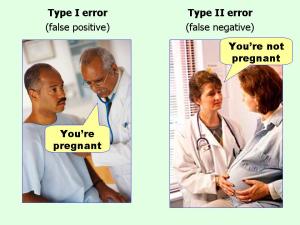
For those of you who are not familiar with the language, science identifies two major potential types of errors (okay there are at least three types but I will not go that deep today). A Type I error, which represents a false positive, involves claiming that an observed hypothesis is correct, when in reality it is false. A Type II error, which represents a false negative, involves claiming that an observed hypothesis is incorrect when it is actually correct. In my opinion, the best visualization of the difference between the two is this graphic: (which I have seen in numerous locations and whose origin I have been unable to confirm although I believe it comes from the “Effect Size FAQ“).

type-i-and-type-ii-errors

In the academic community a Type I error is a very big deal. Making an incorrect claim is the sort of thing that gets academics in very hot water. A Type I error leads to retractions of academic papers and a significant loss of prestige. As a consequence, the academic community has developed an extremely detailed process to avoid Type I errors involving confidence limits, acceptable p-values, peer review etc.. In the academic community a Type II error is by far less an important concern. Since science is theoretically a collegial affair (many colleagues are working on similar problems at the same time) all a Type II error represents is that you didn’t identify the effect “this time” which means you still have another shot tomorrow, no mess no worry.

In the private sector, it is almost completely reversed. Consider my personal area of expertise “contaminated sites”. If I am leading an investigation at a contaminated site and make a Type I error, all that means is that I have inferred the presence of contamination where it doesn’t actually exist. The outcome of this error involves the need for further investigation to characterize and/or delineate the contamination. The further work will either confirm the contamination exists or provide further data to rule it out. This may entail some additional cost, and if wrong some minor loss of face, but it is not the sort of thing that gets one fired (if it is an isolated event). A false negative, on the other hand, is a much more serious issue as private sector scientists typically work in smaller groups with less cooperation within the wider community on individual project (there is limited oversight due to the the limited scopes of the problems and issues around sharing of proprietary information). Thus errors are less likely to be caught before the consequences become critical.

Imagine telling a property owner that a property is clean when it isn’t. The owner, acting on your advice, then sells the property to be developed for another use. If, in the course of the development, the contamination is found then the development stops. The new owner will need to clean the contamination and the costs associated with the clean-up and delays in the development (mortgage cost, permitting, subcontractor costs, etc..) will get passed on to your client. Lawsuits almost always ensue and someone (usually the consultant who missed the contamination) is going to pay a heavy cost. An even worse scenario happens if the contamination is not uncovered until after the development has been built because then human and ecological health could be put at risk. The term “Love Canal“, or some similar local example, is burned in the memory of every environmental consultant early in their careers to avoid any repeats. The only effective ways to avoid Type II errors consists of either increasing your sampling data density or developing additional “process knowledge”. Process knowledge in this case is an understanding of the sources of the contamination and the processes that govern the movement of the contaminants in the subsurface. Without detailed process knowledge (or a good conceptual site plan) an effective investigation plan cannot be accomplished.

So why is this difference important? Well as discussed, the vast majority of the warmist community have a worldview that stresses Type I error avoidance while most skeptics work in a community that stresses Type II error avoidance. Skeptics look at the global climate models and note that the models have a real difficulty in making accurate predictions. To explain, global climate models are complex computer programs filled with calculations based on science’s best understanding of climate processes (geochemistry, global circulation patterns etc) with best guesses used to address holes in the knowledge base. The models are “trained” by looking at historical data and seeing whether they can replicate what has occurred in the past. In a simplistic description they are trained to interpolate data and once they get good enough at interpolating data they are then used to extrapolate future conditions. Since the global climate models are works in progress they still do not do a great job at extrapolating, yet. In particular, these models have failed to predict the “pause” in the surface temperature data that has lasted for (depending with whom you talk) somewhere around 15 – 18 years. Essentially the model predictions and the measured temperatures have diverged.

Skeptics see the poor extrapolations and suggest a need to refine the models to address the divergence. From a Type II error avoidance viewpoint, given the relatively poor quality of the model predictions, putting limited resources into addressing potentially faulty predictions seems like a poor choice. Instead, resources should be allocated to improving the models and any additional monies spent on other “demonstrably real” problems out in the world. Warmists, on the other hand, point out that the models are the best tools we have to date and to ignore their predictions, just because they are imperfect, is a big mistake. Warmists point out there is a real risk that a lack of action now could result in a low-probability, high-cost outcome (a fat tail on the uncertainty distribution of the outcomes). So monies should be spent on avoidance immediately while we continue to refine the models.

So where are we today? In 1990’s parlance, skeptics are from Mars and warmists are from Venus. Like in the book, the two sides are not speaking to each other but rather are speaking past each other. Until the two communities can learn to speak each other’s language and acknowledge the underlying differences, but ultimate validity, in both world views, we are not going to advance the discussion. The frustrating part, from someone who has worked on both sides of this intellectual chasm, is that neither side is “wrong”. Each lives in a world where risk avoidance decisions are made and feel their approach is “right”. We need to develop a “consensus” that acknowledges that both sides have legitimate concerns and that any acceptable compromise has to recognize the validity of differing points of view.

Posted in Climate Change, Climate Change Politics | 23 Comments

Thoughts on blogging about renewable energy alternatives, Energiewende and how BC can do better

So I have been writing this blog for about three weeks and have been both pleased and surprised by the positive and negative reviews. The most fascinating responses have been, not unexpectedly, from non-scientists of the progressive ilk. The number of activists who, when confronted with data, have responded with innuendo and assumptions of bad faith was disconcerting. The common viewpoint among some crowds appears to be that the climate change debate is a team sport and if you fail to support the team, in all things, then you are necessarily an enemy and a stooge (either witting or unwitting) of big oil. The level of debate appears to be: agree with me in all things or don’t talk to me. The most striking example of this was on Twitter where I politely asked the famous Dr. Mann why he was conflating “lukewarmers” with “deniers” and was immediately blocked. Irrespective of my detailed discussion of the IPCC report, I am informed that I am out of touch with the “consensus” and any number of shallow talking points have been directed my way. My most entertaining comment came from Ms. Sandy Garossino who insisted that:

Pointing out all the probs [of renewable energy] today is like heckling JFK in 1962 that a moon landing’s a nutty dream.

Similar sentiments have been expressed by many. It appears that the general consensus of activists is that renewable energy technologies have some magical property that means that none deserve any criticism or that the worst criticisms are merely “quibbles”. When used in renewable energy technologies, rare earths extracted from open pits in China apparently don’t cause cancer nor do they poison local waterways or groundwater supplies. Some hypothetical future destruction of boreal forests is far more important that grinding up real boreal forests. The decimation of lowland hardwood forests in the southeast United States don’t isolate biological communities and put them at risk from the effects of climate change as long as the wood is used to power German iron mills and German automobile facilities. The redirection of food crops to biofuel use and the indiscriminate destruction of tropical rainforests don’t create a 400 year biofuel carbon debt if used to run cars on the autobahns. Those endangered species will understand the destruction of their habitat because, after all, we had the best of intentions and, you know, climate change. Unfortunately, that is not how it really works. Real world policy decisions have real world environmental consequences. Slogans, loudspeakers and placards do not change the results of investigations nor do they erase critical data. If climate change is going to affect our ecosphere, then we have to allow that ecosphere some ability to adapt and that means preserving habitat.

I can’t say how many people directed me to details of Germany’s Energiewende. Germany is very much a success story in that they have developed policies to encourage solar and wind energy and to facilitate the connection of renewable energy to the power grid. Good government policies have aided in the movement to more wind and solar energy but bad policies are pulling nuclear power, with its extremely low carbon footprint and high reliability, off the table. Having read deeply on the subject, let me point out some lesser-discussed features of that program. In order to address the low power density of renewables, Germany has needed to off-shore its energy needs. It is relying on natural gas from Russia and high-carbon electricity from its neighbours to supplement its power grid when the wind is not blowing and the sun not shining. It projects using more coal for baseline power needs (as it retires its nuclear plants) and importing wood from the US and Canada (often virgin material in wood pellet form) as a “renewable, carbon neutral” fuel for biomass burning. Germany is importing biofuels from south and central American biofuel plantations, carved out of the rainforests, to run their automobiles. Most interestingly, the research indicates that the programs and policies of Energiewende to enhance energy efficiency did not significantly improve the energy efficiency from existing firms in some of its most energy intensive industries. “Innovation was observed to take place via new entrants in the market, rendering standard policies targeted at firm-level energy efficiency ineffective” (ref).

Even with all those downsides, the Germans definitely have a number of policies that Canadians have to take to heart. Our governments have to take back some control of our state-owned power utilities if only to force the utilities to simplify the inclusion of renewables into the power grid. I have communicated with the CEO of one former wind and wave renewable power company who claims that his company finally had to give up on BC due to the combined efforts of BC Hydro and the Environmental Assessment Office. While I am not in a position to confirm his claims, he has suggested that entrenched corporate policies are holding back the development of renewables in BC, which frankly, is not unbelievable. A streamlined permitting process needs to be put into place to allow for the implementation of pilot projects and the development of newer, technologies. Similarly, I believe that the government has a role to play in providing more incentives for renewable technology development. Dare I say perhaps even by redirecting some small proportion of carbon tax revenue to fund research into renewables. A revision of the tenure system for geothermal power development also might represent a reasonable policy approach. NGOs and activists, meanwhile, have to work to assist the development of renewables and acknowledge that sometimes the government might be going in the right direction and working with the government when it does.

Throughout my writing on the topic, I have not yet discussed the most important way to address our power needs: reducing energy demand and increasing energy efficiency. The best way to increase your power supply is not to build more power plants but to ensure that people use existing power more efficiently. BC Hydro has done a good start with its PowerSmart program but further policies/programs to reduce and/or redistribute our power usage would go a long way to helping us meet our goal of reducing our power usage and thus our use of fossil fuels. My next suggestion is not going to win me any friends but one of the features of the Smart Meter program in British Columbia is the possibility for time-of-use billing. I realize that even mentioning this topic is going to upset my libertarian friends who fear the “big brother” idea of the smart meter, but I disagree. Smart meters are simply a natural extension of free-market economics. No one resents a hotel-owner giving discounts in the off-season to encourage visitors but set the base power rate higher and then give a discount for using power during off-peak hours is somehow viewed as social engineering. My argument is: if you trust the market then what is more market-driven than power prices based on supply and demand? By reducing peak power needs we can avoid having to switch on Burnaby Thermal which goes a long way to reducing our local greenhouse gas emissions.

On a personal level, I think those concerned by climate change should do much more to address their personal use before going after others. The whole “do as I say not as I do” approach really turns me off. I have spent the last couple decades working to reduce my personal carbon footprint and thanks to a combination of good planning and good fortune have been able to live a very low carbon lifestyle. Perhaps some of the more famous activists could well do to reduce theirs. Using private buses to travel the country and living jet-setting lifestyles seem to represent the antithesis of the green message.

Finally, I think it is imperative that we need a clear break from the very recent belief that only progressives can be environmentally aware. Progressives clearly have strong environmental awareness, but their desire to socially engineer us all to meet their ideals turn off many mainstream families. As long as environmentalism is seen merely as an offshoot of progressive politics, we will never reach the consensus we need to make the important changes. While I am certainly not an expert on Green politics, I welcome the move by the Green Party to diversify its base and move to a more mainstream market-based economic platform.

There is a lot more to say on renewable energy alternatives and I will continue to beaver away at this blog on that and other topics, but as I do I would like to make these suggestions. When in doubt, assume that people who disagree with you are still good people and give them the benefit of the doubt. We don’t always have to agree but we do have to live with each other so we need to make it work. We live in a pluralistic society with a democratically elected government and sometimes other people’s priorities should be considered in the mix. Disagree with government policies all you like but recognize, that the current government was elected by your friends and neighbours and maybe there is a reason you are not in charge. If you can’t convince the majority in the rightness of your cause, then maybe it is not the majority that is to blame, maybe it is your message?

Posted in Environmentalism and Ecomodernism, Renewable Energy | 8 Comments

On Renewables and compromises, Intermission: Energy Density and Power Density

So I want to get to the obvious next steps in the world of renewables: solar, wind and tide. Don’t get excited though because before I do I have to introduce you to a couple important topics in any discussion of renewable energy: the difference between power and energy. The reason I need to do this is that in order to talk about the strengths and limitations of various renewable energy technologies we need to understand the difference between power density and energy density.

Energy is defined as the ability to do work. It is power integrated over time. Power is the rate at which work is done (energy is transmitted). The difference is that energy can be stored/transmitted while power cannot. The reason I make this distinction is that confusing the two is so surprisingly easy. I do it all the time. In the SI system energy is measured in joules and power is measured in joules/sec which is called a watt. In the units we are used to seeing 1 Megajoule (MJ) can generate 0.28 kilowatt hours (kWh) (source Wikipedia).

So why am I wasting your time talking about power versus energy? Because our society is power-hungry and we supply that power using energy sources. In order to power our appliances, hospitals and automobiles, we need energy. Ultimately all our energy is sourced either from the sun (solar energy, biological and fossil fuels – which represent historical solar energy stored in chemical form), from the earth (geothermal and radioisotopes) or from physical phenomena (gravity, wind and tide). You probably think I missed hydro, but hydro is simply the effect of gravity on water. Technically, both hydro and wind are partially derived from solar (and we will ignore raw chemical power) because for the purposes of this discussion we are not going that deep.

So now that we understand the difference between energy and power we need to understand energy density. Energy density is defined as the amount of energy stored in a unit of mass or volume. The thing that makes fossil fuels so attractive to our society is that they represent a very dense energy source. Ignoring radioisotopes, fossil fuels represent one of the most energy dense power sources out there. The reason that fossil fuels are so energy dense is that mother nature has done the all-important job of converting solar power into this easily transportable power source. Consider that gasoline has an approximate energy density of 45 MJ/kg. Natural gas has a higher energy density (about 56 MJ/kg) but due to its form (it is a gas) its use is limited to places where it can be shipped via pipelines, also its density in its natural form is much lower (its per liter energy density is much lower than gasoline 0.036 Mj/L versus 37 Mj/L). Alternatively, it can be liquified (LNG) but the cooling process uses a lot of power and the product must be transported in specially equipped rail cars/transport trucks/transport ships.

Wait, wait, I hear some of you suggesting that hydrogen is a better power source than fossil fuels, but I would beg to differ. Hydrogen is extremely energy dense 142 MJ/kg but unlike fossil fuels we have to input a tremendous amount of power to create that energy. In order to get hydrogen in a form that can be combusted it must be converted from a source material (like methane or water). That takes a major input of power, which typically comes from whatever power grid in which the hydrogen generation unit is located. When coupled with a nuclear power plant (which produces power regardless of demand) hydrogen is a useful fuel but most of the time hydrogen is a lot more trouble than one would expect. See the attached link for a detailed discussion (hydrogen article).

When it comes to renewables the issue is power density. Most renewable power sources are very diffuse (they have a low power density). An article prepared by Robert Wilson of theenergycollective.com provides some useful numbers, specifically, he reports that solar, the highest density renewable, has a theoretical power density of up to 200 W/m2 but that the best solar collection systems seldom do better than 20 W/m2 (in desert solar photovoltaic farms). The further north (or south) you go the lower the theoretical maximum, and thus the lower the resultant systems. A truly exceptional visualization of this is presented by David Mackay. As for the remaining renewables, the best biofuels can achieve about 2 W/m2  while wind can achieve a maximum of about 3 W/m2. As Dr. Wilson points out, since Germany and the United Kingdom consume energy at a rate of approximately 1 W/m2 in order to supply either country with power using wind they would need to cover half of their total land mass with wind turbines which is not a realistic option in a country with cities, farms and forests. Similarly, no combination of biomass, wind, solar and tide has the power density to supply a developed country like Germany with its entire power supply. At best a countries like Germany and the United Kingdom may be able to supply a proportion of the power they need through these sources while importing power and energy from other areas/regions. Germany does this through the importation of wood pellets and also uses offshore wind (which effectively expands its power base) and supplements it all with fossil fuels (notably coal). For political, not scientific, reasons the Germans have forsaken nuclear which in a world of climate change represents the least carbon intensive power source out there.

Portability is a particularly important feature for energy products. Airplanes and transport ships need energy dense power sources that are relatively light. Batteries can store tremendous amounts of energy but at a very steep cost in weight. Thus a battery powered car is a possibility but a battery powered jumbo jet is not. The problem with solar, wind and tidal power is that they are not sufficiently portable. The power is typically generated at a distance from where it is consumed, but that is a topic for another post.


Posted in Renewable Energy | 4 Comments

Fukushima “fallout”: issues in reporting scientific research in the popular media

I had other articles planned but a news report just popped up on my twitter feed that just begs to be discussed in the context of issues in reporting scientific research in the popular media. The article appeared in our local paper under the title: Fallout from radioactive Fukushima rising in west coast waters. The article represents an attempt to describe the results from an original research paper in the Proceedings of the National Academy of Sciences by Smith et al. but suffers from the writer’s difficulties relating (or issues with) the scientific data; the inability to get the paper’s author on the record to clarify the science and a poor headline.

In order to really understand the issues, you have to read the original paper. Happily for you, I have done that for you and will summarize: the Smith (et al.) paper presents the results of a survey. Surveys form the most basic research reports. They allow for the collection of baseline data to either test hypotheses or to get enough information to develop hypotheses. Most importantly, in this age of research needing to show a “purpose” or a “link to a private sector partner” they are notoriously hard to get funded. Yet surveys are absolutely necessary if we want to build our understanding of our world. In this case the research hook was the Fukushima reactor release. The research involved sampling seawater at various locations, depths and times across the Pacific in order to establish cesium isotope concentrations in the seawater. Cesium isotopes are used because, thanks to the half-life of the isotope, 134 Cs represent a clear human “fingerprint” of contamination from the nuclear release at Fukushima. The article then takes the results from the survey and uses it for global circulation model calibration. To explain, after the release, various modeling exercises were carried out and estimates of rates of movement of the plume were generated. The results presented in the paper help demonstrate that most of the models were insufficiently conservative and also uncovered some interesting features of global circulation patterns in the Pacific. The article represents a technical success and its only downside is that in order to justify its hook it included an attempt to relate the results of the survey to levels of radioisotopes in food fish, specifically the Bluefin Tuna.

Relating radiation risks to the public is an inherently challenging task as most non-scientists have been trained to fear radiation and few have a sense of naturally occurring background radiation levels. The classic xkcd radiation dose chart is a useful tool to relay this information, in doing so it helped introduce the “Banana Equivalent Dose”. For those of you not familiar with the unit, bananas are rich in potassium which has a radioactive isotope 40K. Thus bananas are mildly (and I mean really mildly) radioactive. This level of radioactivity has been calculated at being about 14 – 15 Becquerels (Bq) per banana.If you assume that an average banana weighs about 125 g, bananas have a level of approximately 115 Bq/kg (wet weight). Since we feed bananas to babies it provides a clear “safe” level of radioisotopes for discussions. After saying all this I can get back to the Smith (et al.) paper, which in an attempt to relate their findings to human health spend their final paragraph establishing that Bluefin tuna exposed to the plume are expected to reach a whopping 6 Bq/kg from 134Cs from Fukushima. That is to say about a 5% banana equivalent dose?

Let us return to the newspaper item. Let’s start by saying that the article is very poorly served by whoever wrote the headline. I have been told many times that writers do not get to write the headlines for their articles but someone has to take responsibility when a headline writer does such an egregious job. The headline starts by misusing a term from the report: “fallout”. The word has a lot of baggage and the Smith (et al.) paper explicitly distinguishes between the Fukushima plume and radioactive fallout, but don’t tell that to the headline writer. This headline immediately sets the reader in the wrong direction. This misdirection is continued in the first paragraph which manages to frighten the reader by (accidentally?) conflating nuclear reactors (scary) with a “nuclear plume”. The plume being “nuclear” in that radioactive 134Cs in seawater marginally exceeds the detection limit (and historic background levels) while not being at all risky. The concentrations of 134Cs are so low that in order to get readings for the survey, methods more detailed than those used in Health Canada testing methodologies were required (which means not just safe but incredibly safe).

The article itself is a real mish-mash. The writer repeatedly assures readers that the plume does not represent a risk to human health but does so in a less than convincing manner. In particular there is a liberal, but inconsistent, use of quotation marks throughout the article. Sometimes quotation marks are used around a somewhat technical terms like “Fukushima signal” sometimes they are used correctly around direct quotations from the paper “an unequivocal fingerprint indicator of contamination from Fukushima,” but they are also used around common words like “are critical” and “background” which I view as classic scare quote mode. Consider the following line from the article:

The level of Cesium-137 in the water is far below levels seen in the 1960s and 1970s from nuclear weapons testing and “well below Canadian guidelines for drinking water quality,” they say.

I may be wrong but the quotation followed by the “they say” essentially tells me that the writer does not believe what she is writing. The report continues this way until the end which reassures readers one more time, but since research indicates that a large proportion of people reading an article don’t get to the end, the extra reassurances were likely missed by many/most readers.

I cannot say for sure whether the writer does or does not believe the paper (or possibly the press release) but access to Dr. Smith would have helped the article tremendously. I have read that the federal government is restricting reporter access to researchers. If they did so in this case then it certainly backfired. Instead of providing an informed researcher who could provide helpful analysis, press-friendly quotes and less technically analogies, the writer had to rely on a dry paper designed to appeal to a technical audience. Science of this quality deserves to be supported by a measure to ensure it is explained to the public effectively and not mistranslated because the one person best able to explain it to the public is not available to do so. Instead, for the next couple weeks people will be discussing the “not dangerous” “nuclear plume” that definitely does not threaten our seafood supply or the health of West Coast residents.

In reading the research paper and the ensuing newspaper article it is easy to see the pitfalls associated with informing the public about useful science. The journal put out a press release because the paper is of clear interest to the technical audience and even readers like myself might have missed it (the journal is a general interest one not on my reading list). Unfortunately, by not providing someone to speak to the paper, the reporter tasked with reporting the paper was left on her own. At that point it falls to the luck of the draw. If the reporter covering the beat has the knowledge to translate the research then the public may be well served. Unfortunately, due to the nature of modern journalism, very few journalists have the knowledge-base to effectively translate scientific papers in numerous disciplines to the public. At that point we get articles like this one that appear to honestly attempt to inform the public but don’t always get the job done right.

Posted in Canadian Politics | 2 Comments

On renewables and the need for compromise Part IV: biofuels – just bad or really bad?

So I have threatened you all with a post on biofuels for a while and I suppose it is time to actually give it to you. A quick look at the post title gives you a hint of my personal take on the topic, but a take unsupported by fact is a prejudice and I try not to be prejudiced so let me explain the basis for my opinion.

Before I go into details, I will point out once again that I am very much a pragmatist on many topics but am something of a sentimentalist with respect to preserving nature. Some people believe that “man was given dominion over nature”; I am not one of those people. I believe that nature has an inherent value and that the preservation of ecological diversity is a duty of humanity. A pragmatist would point out that some of our most important medical advances were based on compounds refined from ecological inputs but I would argue that even if we never got another drug from the rainforests, preserving their existence and genetic diversity is a duty humankind owes the planet. My initial education was in the field of ecology and I recognize that the preservation of habitat is one of the most important ways of protecting ecosystems and genetic diversity. So while I readily admit that on the surface biofuels sound promising “fuel that grows itself” “a great use for wood wastes” etc.. as I will describe herein, biofuels place too much stress on our environment for the gain they may provide in fighting climate change, their production pulls too many calories from the human food chain resulting in human misery and in many cases the productions of these biofuels actually exacerbates climate change.

The sad part is that in almost every case biofuels start out sounding like a good idea. The argument goes that biofuels made from waste biomass can give power without incurring an environmental cost and would be carbon neutral. The problem is that there is only so much waste biomass out there and power plants need a steady source of fuel. So in almost every case power producers need to rely not only on waste biomass but on virgin materials. As described in the linked Economist article, in Poland and Finland, wood meets more than 80% of renewable-energy demand and in Germany, wood makes up 38% of non-fossil fuel power consumption. So where is this wood coming from? As described in the web posting at FSC-Watch in the southern US, NGOs have shown that the biggest US pellet producer, Enviva, is sourcing a high proportion of wood from the clear cutting of bottomland hardwood forests – some of the most biodiverse temperate forests and freshwater ecosystems worldwide. As for Canada we export about 1.3 million tons of wood pellets, most of it from boreal forests, to Europe every year. As for being “carbon neutral”, boreal forests grow slowly and model simulations reported in the journal Climate Change indicate that harvest of a boreal forest will create a “biofuel carbon debt” that takes 190–340 years to repay. So boreal forest wood is carbon neutral as long as you wait 3 centuries or so. To put it in perspective, in order to provide power for the factories and electric cars in Europe, Canadian and US forests are being cut down, often at an unsustainable rate, resulting in the destruction of valuable habitat and loss of ecosystem diversity. What is most ironic is that the power used by Greenpeace in Europe to fight the “tar sand’s” theoretical destruction of boreal forests is provided by the cutting down and grinding up of actual Canadian boreal forests.

So we have now established that power from biomass is a case of good intentions gone awry let’s look at ethanol in fuel. So much has been written on the topic that I will only present some highlights here. In the US they have a requirement for ethanol in fuel. This has resulted in pulling corn (the biggest source of US ethanol) out of the food chain. Specifically, as recounted in Forbes, in 2000 over 90% of the U.S. corn crop went to feed people and livestock, many in undeveloped countries, with less than 5% used to produce ethanol. In 2013, however, 40% went to produce ethanol, 45% was used to feed livestock, and only 15% was used for food and beverage. Put another way, enough calories to feed 500 million people were pulled out of the human food chain to run our vehicles? Let me say that again so it sinks in, the ethanol the US burns in its cars each year would feed 500 million people. The same Forbes article points out that Brazil is clear-cutting almost a million acres of tropical forest per year to produce biofuel and shipping much of the fuel all the way to Europe. The net effect is about 50% more carbon emitted by using these biofuels than using petroleum fuels. As for the argument that the ethanol helps reduce greenhouse gas emissions, a recent article in Science disputes that point. The article points out that corn-based ethanol, instead of producing a 20% savings in greenhouse gases, nearly doubles greenhouse emissions over 30 years and increases greenhouse gases for 167 years (so it will be carbon neutral in 167 years or so). The same article indicates that biofuels from switchgrass, if grown on U.S. corn lands, increase emissions by 50%. Another article in Science indicates that converting rainforests, peatlands, savannas, or grasslands to produce food crop–based biofuels in Brazil, Southeast Asia, and the United States creates a “biofuel carbon debt” by releasing 17 to 420 times more CO2 than the annual greenhouse gas reductions that these biofuels would provide by displacing fossil fuels.

I don’t have the space to discuss palm oil here but suffice it to point out that an article at Ensia reports that in 1985, Indonesia had less than 2,500 square miles of palm oil plantation, 20 years later, they covered 21,621 square miles, and by 2025 the Indonesian government projects plantations will cover at least 100,000 square miles. As reported in another article at Ensia a typical palm oil lagoon (a necessary component of the oil palm extraction process) has the same annual climate impact as driving 22,000 passenger cars. Since there are upwards of 1000 of these plantations in Indonesia we are talking the equivalent of 220,000 passenger cars a year, this is in addition to the palm oil plantation’s biofuel carbon debt of almost a century.

Going back to my introduction, I care about maintaining the integrity of our shared ecological inheritance. Biofuels, when used in the manner they have been used to date, are destroying that inheritance. Each year hundreds of thousands of hectares of forests in South and Central America and Southeast Asia are being clear-cut or burned in order to free up space for the production of these supposedly “carbon neutral” fuels. Yet these fuels can only be considered carbon neutral if you look at them in century timescales. Unfortunately, very few organisms live lives marked by century timescales. In order to survive climate change, ecosystems need resiliency and the destruction of habitat reduces resiliency and increases the likelihood of ecological collapse in degraded ecosystems. Moreover, moving the calories used in biofuels out of the human food-chain has resulted in food scarcity, increased costs for food and a reduction in the availability of inexpensive food available for food aid. Once again well-meaning, but scence-blind, activists need to be educated on what their slogans are actually accomplishing, because it is neither ecologically sustainable nor does it decrease Tyndall gas concentrations in our atmosphere.

Posted in Renewable Energy | 18 Comments

On renewables and the need for compromise, Part III: Geothermal redux

So after preparing my first post on geothermal energy and the need for compromise, I was challenged by the Executive Director of DeSmogCanada who asked “Who has actually opposed geothermal? I haven’t heard any backlash“. My response was muted as my work schedule precluded me doing a detailed response but now that the Christmas break is upon us let’s illuminate the problem for the purposes of those who don’t seem to get what I am talking about.

As I discussed in my post, exclusive of the tenure issue (which clearly still needs to be addressed by government) two issues need to be addressed prior to any program to enhance the development of geothermal resources in British Columbia: enhancing the ability to do intrusive testing to identify locations for geothermal facilities and creating transmission line access to connect the geothermal resources to the power grid. Early in 2014, the British Columbia government proposed a tool to address these two bottlenecks. The tool was an update to the Park Act. This update provided a legislative mechanism by which both the geotechnical studies and expansions to the power transmission grid would be facilitated. Does anyone want to guess how the environmental movement viewed the bill? Here are some highlights:

I could go on, but you get the picture. Virtually every progressive media outlet and environmental group in BC came out against the idea. Certainly the move would marginally simplify the process of developing pipelines in BC, but anyone familiar with the process knows that inter-provincial pipelines are a federal jurisdiction and the federal government doesn’t need to consult with the Province to run a pipeline through a provincial park. A second complaint was the potential for oil and gas drilling? This environmentalist response appeared to be purely reflexive and another example of the science-blind nature of the opposition in BC.

Anyone who has spent any time looking at resource maps of BC will recognize how ridiculous this concern is. Oil and gas in BC is almost exclusively found in the Peace District and as my post pointed out, most of the parkland in question is not in the Peace but rather in southern mountains. The geothermal map from my earlier post shows that this represents the hot zone for geothermal energy. The government in their press release even suggested that geotechnical studies (absolutely necessary for geothermal) were one of the major reasons for the revision but for the progressives, if the Liberals wanted it, then it must be bad and it must be opposed. But don’t worry, because they (the progressives) really support geothermal, just don’t suggest a rational and practical method to develop the energy source in BC.

So I’ve started with geothermal, but let’s look at another case of cognitive dissonance on the renewable energy front. Everyone agrees that as renewables go, hydro is one of the greenest and lowest carbon sources out there. I am conflicted on the Site C Dam proposal but have no such conflicts on run-of-the-river projects which seem like an obvious way to provide clean, localized power.

Once again, run-of-the-river is loved until someone tries to develop a facility. It would appear that run-of-the-river is good unless an investor makes money, the facility needs to connect to the power grid, or it just “threatens rivers“.

I must say the biggest example of congnitive dissonance is the suggestion that there is no “compelling need for it“. Yes, you read right, the same people who want to wean us off fossil fuels; want us to move to electrical vehicles and alternative energy sources; do no want us to develop a readily available power source that would provide a means to address the electricity needs because there is no immediate “compelling need” for the power?

Ask yourself, if reduction of our dependence on fossil fuels is a necessary goal, shouldn’t we be able to drop our partisan blinkers and work together towards achieving that goal?

Posted in Renewable Energy | 7 Comments