The Leap Manifesto: Good Intentions Mixed with Bad Science

As regular readers of this blog know, I first encountered the Leap Manifesto when it was released in September of 2015. At the time I wrote a couple pieces. The first: A Chemist looks at the Leap Manifesto and finds it wanting briefly went over my initial concerns with Demands #2 (100% renewables), #3 (infrastructure) and #6 (high-speed rail). By popular demand, I followed it up with a post on Demand #9: Debunking the Leap Manifesto – Demand #9: Local agriculture is not always better. Unfortunately, for the authors of the Manifesto, the Manifesto sailed like a lead balloon and was out of the headlines in less than a week. Lacking the enthusiasm to go any further into what I (wrongly) believed was a dead topic I let sleeping dogs lay. It was only with the New Democrat vote, at their Edmonton convention, that I have been convinced to continue my discussions of the topic.

Now let me get something straight right at the start, when I wrote my first posts on the Manifesto, the link to the actually Manifesto was not yet active. Going back using the Wayback Machine I discover that I simply lacked patience, because by September 16, 2015 (ironically the date I published my first post on the topic) the link had been fixed. As a consequence I did not get a chance to read the Manifesto in all its glory at that time and had to rely on the 15 Demands on the “sign the manifesto” page. I am saddened by this as it means I missed a lot of good content. I will attempt to partially address that oversight tonight.

Now I am going to admit something that will earn me some raspberries. I like a lot of the ideas in the Manifesto. Admittedly, the text itself reads like it came off the typewriter of a first-year philosophy student with its occasional dip into socialist claptrap like: “higher income taxes on corporations and wealthy people” and “cuts to military spending”. What is it about cuts to military spending anyways? We spend less per capita on the military than virtually every other G20 nation and at the same time the progressives are constantly demanding that we intervene to protect one group or another via the U.N. You simply can’t do that with the resources we currently provide the military. So demanding cuts while demanding they do more seems a lot like blowing and sucking at the same time. Okay let’s get back to my point, the only thing missing in that part of the Manifeto is a demand to “privatise the banks” and “seize the means of production” as that would fill up my bingo card, quite nicely.

Returning to the positives, I recognize that we, as a nation, have not done right by our indigenous cousins. We need to do more and some of the suggestions in the Manifesto would work towards that admirable goal. That being said it is odd how a paragraph that starts on indigenous people somehow shifts in mid-gear to end discussing 100% renewable energy.

Renewable energy is a cornerstone of this blog and the reliance of the writers of the Manifesto on Jacobson (et. al.) and the 100% Wind, Water and Sunlight (100% WWS) crew is where this piece starts to fall off the rails. I have written over 15,000 words on the 100% WWS plans in 8 separate posts so won’t do try and re-cover all the topics tonight. To summarize my views, the 100% WWS renewable plan places tight, and poorly-supported restrictions on a number of important baseline clean energy technologies and in doing so results in a proposal that is ruinously expensive and doomed to failure. It depends heavily on untested technologies; it assumes unlimited supplies of demonstrably limited raw resources (like rare earths and Lithium); it ignores Canada’s size while showing a childlike understanding of how Canada’s coastline is laid out; and completely ignores northern energy needs.

The next paragraph in the Manifesto on extraction demonstrates the authors’ abject ignorance about our needs for raw resources and how they are extracted. As I’ve written before, the Achilles heel of renewable energy technologies is their reliance on steel, aluminum, concrete and rare earth metals. None of these technologies are amenable to being located in an average person’s backyard. As I have written elsewhere, NIMBY only works if you are rich enough to be able to import your raw materials from somewhere else.

The problem with off-shoring our natural resource needs is that we place undue stress on the developing world with the existing facilities leaving a legacy of environmental degradation in their wake. The legacy of our rare earth extraction will affect the health of tens of thousands of people in Western China (Mongolia) and leave huge swathes of that country uninhabitable for generations to come. It is a funny activist who says that we should rely on lesser developed countries, with lax or nonexistent environmental regulations and no worker protections, to supply us with the raw materials necessary to create our renewable future.

The next section of the Manifesto is actually quite good. The energy efficiency and house retrofitting ideas are quite excellent and should be part of any plan to advance us to our carbon energy-free future. Sadly, the paragraph slides over to the biggest white elephant of the Manifesto the “high-speed rail powered by just renewables”. Consider that the electrically-powered, high-speed rail link between London Ontario and Toronto was priced at $500 million dollars. That is for 320 km of rail. That works out to $1.56 million dollars per kilometer. The Trans-Canada Highway is 7821 kilometers. Translated up that comes out to a rough cost of $12,220,000,000 just for a single railway line across Canada. That per kilometer price was for a line in a population-dense location with few or no significant geographical limitations (no mountains or bogs). That cost does not include a single spur line to a single town off the main line (sorry about that Prince George) and we have only crossed the country in one straight, narrow line. I can’t even begin to guess how much it would actually cost to link the entire country with high-speed rail (run on renewables no less). Remember, that number was only the cost to build one piece of infrastructure, it doesn’t include the costs to build the power lines to power the rail line, the high-tech, high-speed renewable energy rail cars or anything like that.

The section on agriculture is another example of urbanized, social activists who simply know nothing about how the world actually works. The “smaller is better,” “local is better,” “organic is better” memes in agriculture are some of the most pernicious myths to come out of the modern environmental movement and show a profound lack of understanding of how food is grown and energy is used as I discuss in detail at Debunking the Leap Manifesto – Demand #9: Local agriculture is not always better.

Now I am not an Economist but the section about shifting the economy to “low carbon: caregiving, teaching, social work, the arts and public-interest media” sounds a lot like an Escherian Stairwell. I simply don’t know where the money to pay for it all is going to come from? As a Chemist I relate it to the Second Law of Thermodynamics: “In any closed cyclic process the entropy will either increase or remain the same.” Translated in monetary terms, you can’t keep paying for service industry jobs if you don’t have a steady input of cash from somewhere that is not in the service industry. Some money will have to leave the service economy to pay for things we do not produce and so if we don’t add to the pot, it will gradually get smaller. In Canada that pot is re-filled by industry and by exploiting our raw natural resources. If we stop doing that we won’t be able to pay for those jobs in the low-carbon service industries.

Ultimately costs are where the Manifesto will surely collapse under its own weight. Besides the trillions for that high-speed rail we also need to build our renewable energy infrastructure. I did some simple math in my post More on 100% Wind, Water and Sunlight and the Council of Canadians “100% Clean economy” by 2050 goal. In that post I calculated that the onshore windmills necessary to meet the plan would cost over $250 billion on their own, all by the year 2050 no less. That number doesn’t address the offshore wind turbines, the solar facilities, the (still not technically available) tidal and wave power plants, the geothermal facilities or the electrical grid backbone to connect it all together. Sure they suggest a few cash sources but we aren’t talking a few million or even a few billion dollars here, we are talking in the trillions. If we aimed to do this in a century and were willing to put a significant percentage of our gross national product into the task, it would be doable. It simply cannot be accomplished by 2050. Anyone who says otherwise is simply dreaming in Technicolor.

Several times this week I have been told that the Manifesto represents a good start and “contains many ideas that deserve to be considered”. I agree that the Leap Manifesto has many positive points. The problem is that when you are asked to sign the Manifesto you are not being asked to agree to one part or another, you are being asked to agree to it all. There are some good parts, some questionable parts and some parts that are simply ridiculous to anyone with any scientific training or an understanding of how energy is generated and transmitted. Ultimately, the problem with the Leap Manifesto is that when you make ice tea with bathwater, no matter how sweet the ice tea component, you get a drink I am unwilling to swallow. So even though I agree with parts of the Manifesto, I am about as likely to sign it as I am to drink ice tea made with bathwater.
Posted in Canadian Politics, Climate Change Politics, General Politics, Leap Manifesto | 6 Comments

On Carbon Dioxide Toxicity

The other evening I became engaged in a fascinating discussion (for me) with a climate skeptic on the topic of carbon dioxide, specifically whether it was “toxic” or not. After that discussion I committed to do a write-up on the toxicology of carbon dioxide so here we go.

One of the first things my skeptic colleague did was to try and convince me that carbon dioxide was not “toxic”. He did so by citing the Wikipedia article on the topic. Now I know you are going to laugh, but Wikipedia is actually a very good place to go to for basic information about chemical compounds. I often use it to get basic information because it almost always gets the basics right. In this case it got the basics right but fell down in explaining the details [which explains why we have blogs 🙂 ]. Specifically, Wikipedia had this to say about carbon dioxide toxicity:

CO2 is an asphyxiant gas and not classified as toxic or harmful in accordance with Globally Harmonized System of Classification and Labelling of Chemicals standards of United Nations Economic Commission for Europe by using the OECD Guidelines for the Testing of Chemicals. In concentrations up to 1% (10,000 ppm), it will make some people feel drowsy and give the lungs a stuffy feeling.

A person reading this paragraph may, incorrectly, believe that carbon dioxide was not toxic because that is how the text reads; but that is not what the text actually says. The text correctly points out that carbon dioxide is an asphyxiant gas. That, in and of itself, does not preclude it from being toxic (more on that later). It also points out that the Globally Harmonized System of Classification and Labelling of Chemicals (GHS) does not classify it as toxic. Admittedly, it incorrectly includes the term “harmful” which is absolutely wrong. Unfortunately the GHS isn’t in the business of assessing chemical toxicity per se and says nothing about whether a compound is harmful.

You may ask: what is the GHS? Well, most of you out there were probably forced to take a Workplace Hazardous Materials Information System (WHMIS) course in your day. GHS is the new global standard replacing WHMIS. The GHS has a mandate for labeling chemicals during transportation and for use in non-household environments. The target audiences for GHS include workers, transport workers, emergency responders and consumers.

GHS has a relatively complicated method for establishing whether a chemical is “toxic” for the purposes of labeling. Here is a link to the document saying how to do it and here is a link to a GHS-compliant SDS for carbon dioxide. Scroll down the sheet to the “Acute Toxicity” section and you will see a note:

Based on a LC50 value of 470000 ppm/0.5h (167857 ppm/4h) (PATTY (5th, 2001)), this substance was classified as “Not classified”

For those of you who don’t read SDS what this says is that carbon dioxide kills half of the test subjects who encounter a concentration of 470,000 parts per million for a half hour. So while, it is not considered toxic for the purposes of the labeling system, it certainly kills people (and is absolutely “harmful”). The thing to understand is that since it doesn’t do so in the course of normal industrial and commercial use it is not necessary to label it as “toxic” for the purposes of the labeling system. What this might also say is that, yes carbon dioxide is toxic, just not toxic in a standard work environment, so don’t worry about it too much.

Remember the first argument my colleague noted above was that carbon dioxide was not toxic because it was an asphyxiant. This is a common misconception based on a misunderstanding of the difference between the two terms since a chemical can be both toxic and an asphyxiant. As an asphyxiant, it will displace oxygen and at high enough concentrations it will kill. Specifically the Bureau of Land Management Health Risk Evaluation for Carbon Dioxide points out:

A value of 40,000 ppm is considered immediately dangerous to life and health based on the fact that a 30-minute exposure to 50,000 ppm produces intoxication, and concentrations greater than that (7-10%) produce unconsciousness (NIOSH 1996; Tox. Review 2005). Additionally, acute toxicity data show the lethal concentration low (LCLo) for CO2 is 90,000 ppm (9%) over 5 minutes (NIOSH 1996).

But carbon dioxide is not just an asphyxiant, as described above, it is also toxic. Now remember from my earlier post on the subject, the toxicity of a chemical is based on the dose. A compound that is harmless, or even beneficial, at low concentrations can be toxic at higher concentrations. Consider that water is toxic at high concentrations; the effect is called hyponatremia. So technically water can be called “toxic” as well.

A detailed discussion of the toxicity of carbon dioxide is presented in the article Toxicity of Carbon Dioxide: A Review by Guais et al. A review study by MIT and NASA (prepared for among other things the space program) also presents a very good overview of the effects of carbon dioxide, especially at lower doses. As described in the two reports, the initial physiology of carbon dioxide toxicity is based on the perturbation of the acid/base balance in your blood resulting in acidosis. The human body is able to handle this sort of thing. Our initial response is cellular buffering that occurs within minutes-to-hours. In the continued presence of elevated carbon dioxide renal compensation occurs over around 35 days. What this means is that your body will adapt to higher concentrations, over time. Carbon dioxide is also a potent vasodilator and as anyone who has migraines knows, vasodilators are also associated with headaches. Reading the literature, the following is clear:

  • At high concentrations carbon dioxide is an asphyxiant that displaces oxygen and kills affected individuals.
  • At moderately high concentrations it has both short-term and long-term toxic effects.
  • At moderate concentrations it is tolerable as your body will adapt to the exposure.

What we have not discussed is the effect at lower concentrations. We all know that at atmospheric concentrations it is essentially harmless, but what about concentrations between atmospheric (400 ppm) and the problematic doses (over 10,000 ppm). Well the answer is that it varies. The literature is clear that your body will adapt to those concentrations and will quickly adapt back once the exposure is reversed. As for what happens in the meantime, well there is an entire academic field on “sick building syndrome” that gives a pretty clear indication of what happens. The following references all discuss how elevated carbon dioxide concentrations (Apte et al, 2000, Wargocki et al, 2000, Seppanen, Fisk and Mendall, 1999) effect human health. All point out that a proportion of the human population reacts poorly to daily variations in carbon dioxide concentrations. This is understandable since, as a vasodilator, it would be expected to have particular effects on people prone to migraines or headaches.

By far the most interesting new study comes from Satish (et al, 2012) and suggests that even moderately elevated carbon dioxide concentrations have the potential to affect decision-making. This study has not yet been replicated but certainly opens a new level of discussion.

I will end this post on that thought, but since I have been asked to write them down, please find below a quick break-out of some of the numbers I found while doing my research.

Critical Concentrations for Carbon Dioxide:

300,000 ppm (30%) – Immediate coma, convulsions and death (BLM)

100,000 ppm (10%) – Unconscious in one minute and unless prompt action is taken, further exposure to these high levels will eventually result in death (BLM and CDC)

40,000 ppm (4%) – NIOSH Immediately Dangerous to Life or Health Concentration – CDC

30,000 ppm (3%) – OSHA short-term exposure limit (15 – minute STEL) to protect against metabolic and respiratory changes CDC

10,000 ppm – 30,000 ppm (1.5% – 3%) – electrolyte imbalances and other metabolic changes have been associated with prolonged exposures (CDC)

10,000 ppm (1%) – US OSHA 8-hour permissible exposure limit (PEL) to protect against metabolic and respiratory changes CDC

5,000 ppm (0.5%) – British Columbia Occupational Health and Safety Regulation, 8-hour Time Weighted Average exposure limit (OH&S Reg)

2,000 ppm – 5,000 ppm – level associated with headaches, sleepiness, and stagnant, stale, stuffy air.  Poor concentration, loss of attention, increased heart rate and slight nausea may also be present. (WDHS)

2,500 ppm (0.25%) Satish et al 2012 observed large and statistically significant reductions occurred in seven scales of decision-making performance in office workers

1,000 ppm – 2,000  Levels associated with complaints of drowsiness and poor air (WDHS)

1,000 – 1,100 ppm – The American Society of Heating, Refrigerating and Air-Conditioning Engineers (ASHRAE) Standard 62-2007 Ventilation for Acceptable Indoor Air Quality provides standards for ventilation based on surface area and occupancy, “a surrogate for human comfort (odour)” but “not considered a health risk.” (National Collaborating Centre for Environmental Health)

1,000 ppm (0.1%) Satish et al 2012 observed moderate and statistically significant reductions occurred in seven scales of decision-making performance in office workers

400 ppm – 1,000 ppm – Typical levels found in occupied spaces with good ventilation (WDHS)

400 ppm (0.04%) Approximate current atmospheric concentration

Author’s note:

I’ve had numerous people note that submariners etc.. live in conditions with elevated carbon dioxide concentrations. That is both true and doesn’t take away from what I have written. As I noted, the body adapts to higher carbon dioxide concentrations and so if you are put in a cylinder with 8,000 ppm carbon dioxide for a month you will adapt admirably. What causes the human health complaints is rapid shifts from areas of high to low concentrations which leave your body trying to adapt. The results can be, as described, uncomfortable but not life-threatening. Most sick building reports identify occupants as showing effects after being exposed for hours at a time, just long enough for your body to respond but not long enough to reach a stable condition.

Posted in Chemistry and Toxicology, Risk, Uncategorized | 18 Comments

On chemical scare-mongering and science communication, it’s BPA’s turn this time

I have written numerous blog posts describing the miscommunication of human health risks posed by chemistry and chemicals; covering topics from gypsy-moth spray to synthetic soccer fields. Frankly the fact that I have an entire section of this blog dedicated to the topic of “Toxicity and Risk” saddens me. What saddens me even more is how easily our media allow themselves to be drafted to serve as the publicity arms of various environmental activist groups’ fundraising campaigns. Well it happened again this week with some pretty poor reporting, and some egregious headlines, about a study called Buyer Beware: Toxic BPA & Regrettable Substitutes in the Linings of Canned Food prepared by a laundry list of activist organizations spearheaded by that stalwart bastion of objective, evidence-based policy and science: Environmental Defence.

As most readers probably know BPA (Bisphenol A) is an industrial chemical used to make hard plastics called polycarbonates as well as epoxy resins. As described by Health Canada, polycarbonates are used in a number of household products (notably baby bottles and other water storage containers) while epoxy resins are used as protective coatings in metal-based food and beverage cans. As almost everyone on the planet knows (or rather thinks they know) BPA is also a dangerous endocrine disruptor (not).

Endocrine disruptors are chemicals that can interfere with the body’s endocrine system by mimicking certain developmental, neurological and reproductive hormones (notably affecting estrogen and androgen receptors). They were first studied in depth in the mid-1990’s when a series of publications started exploring the effect of man-made chemicals on wildlife. It was generally recognized that these chemicals had very similar chemical characteristics. They almost invariably had two or more 5 or 6 carbon rings with the most effective endocrine disruptors being co-planar (that is the rings were in the same geometric plane like two plates lying next to each other on the same table). We all know that dioxins, PCBs and certain pesticides act as endocrine disruptors and what kid hasn’t heard about the frogs with the misshapen legs and alligators with stunted genitals.

Back in the early 2000’s, when not a lot was known about endocrine disruptors, BPA got labelled as one of the worst of the bunch. It became one of the poster-boys for the problem and as such the internet is absolutely filled with stories citing it as an endocrine disruptor. There is one minor problem with this narrative. It is wrong. As the poster-boy for endocrine disruptors a lot (and I mean a lot) of research has been done on BPA in the last decade and this research has determined that BPA isn’t such a bad actor after all. BPA is like the sketchy looking guy with all the tattoos, the shaggy hair and the leather jacket who your mom crosses the street to avoid passing on the sidewalk. Only later does she discover that he is a volunteer at the Salvation Army, a foster parent to troubled kids and does outreach for her church.

BPA looks pretty bad (oooh look, two  benzene rings) but the rings aren’t actually coplanar (wait do those tattoos say “Jesus saves”?) and because of that it does not appear to have the level of effects that activists claim it should have. BPA is, as Douglas Adams would say: “mostly harmless”. Now you don’t have to believe me, instead go read up on the topic at Health Canada, the US Food and Drug Administration and the European Food Safety Authority. To quote Health Canada:

Health Canada’s Food Directorate has concluded that the current dietary exposure to BPA through food packaging uses is not expected to pose a health risk to the general population, including newborns and infants.

I can already hear the replies from the activists: but Environment Canada declared BPA “toxic”. Yes in 2010 BPA was indeed declared “toxic” under the Canadian Environmental Protection Act (CEPA). For those of you unfamiliar with the concept of toxicity (see the addendum below for a primer) this sounds scary. The problem is that declaring a chemical CEPA Toxic simply provides a means by which the government can regulate that chemical and frees up research funds to learn more about the chemical. As described in the order declaring BPA “toxic”(i.e. adding it to  the List of Toxic Substances in Schedule 1 of CEPA 1999) BPA was not declared “toxic” for its effects on humans, but rather because at high concentrations, in industrial effluents from chemical plants, it is toxic to numerous aquatic species. As I describe elsewhere at this blog, a chemical’s toxicity is typically dependent on the dose and the route of exposure and the dose necessary to cause aquatic toxicity is pretty darn high…thus the reason I call it “mostly harmless”. The simple fact is that BPA can harm aquatic organisms in high concentrations but is not the human toxin the activists would have us believe it to be.

In 2010 when BPA was declared CEPA Toxic the knowledge-base on endocrine distruptors was in its infancy and the results were not all in. Since that time copious amounts of research has been done and a re-evaluation of BPA has taken place. The result of that re-evaluation is described by the US Food and Drug Administration (FDA):

In the fall of 2014, FDA experts from across the agency, specializing in toxicology, analytical chemistry, endocrinology, epidemiology, and other fields, completed a four-year review of more than 300 scientific studies. The FDA review has not found any information in the evaluated studies to prompt a revision of FDA’s safety assessment of BPA in food packaging at this time.

And what was the FDA’s conclusion about BPA?

FDA’s current perspective, based on its most recent safety assessment, is that BPA is safe at the current levels occurring in foods. Based on FDA’s ongoing safety review of scientific evidence, the available information continues to support the safety of BPA for the currently approved uses in food containers and packaging.

Having established that BPA is not the terrifying, child-maiming compound that the activists would have you believe, let’s look at the study highlighted in our scare-reporting du jour. As I noted, the reporting deals with a fairly lightweight report called “Buyer Beware: Toxic BPA & Regrettable Substitutes in the Linings of Canned Food”.  The report presents a study of can linings from various food manufacturers. The first thing to acknowledge is that nowhere within the document (or the supporting documentation) do they actually give us a concentration or other useful piece of toxicological data. You see this report isn’t about human health, it is about publicity.

The most important thing to understand about this study is that it does not tell, nor did it examine, whether the food in the cans has any detectable concentrations of BPA. That may be what the publicists (and fundraisers) are trying to make you believe, but what the researchers actually did was to simply determine what kind of lining was used in each can.

The scientists used a metal tool to scrape the inside of the cans to get a sample of the coating which they then analyzed using a “Fourier transform infrared (FTIR) spectroscopy” (oooh nice sciency name). The result was simply an identification of the polymer used in the can lining, nothing more. Hoping for more (like say a concentration or a detection limit) I went to look at the raw data at Healthy Stuff  (the people who actually conducted the science part of the study) and all they provided was a spreadsheet saying what polymer had been identified in what can. To be clear here, they didn’t test any food from these cans. Moreover, they had to use aggressive techniques to pull off enough material from the cans and lids to do their testing (because it is affixed so firmly) and even then they didn’t even tell us how much of the stuff was in there?

Knowing these facts let’s look at some of the bad headlines I discussed above. Well a couple of the worst came from CTV News ‘Alarming’ number of canned foods still contain BPA, new report warns [scare quotes theirs] and Global News: Report sounds alarm over discovery of BPA in Canadian canned food. You might ask why I find these two headlines so egregious? Well as I explained above both completely misrepresent the contents of the report they are purportedly describing. As we now all now know, no canned foods were tested in the study, the cans were tested not the foods inside. So we are getting breathless headlines and media reports about a safe (at the doses encountered) chemical that is strongly affixed to cans (not tested in food). Looking at the report in this light maybe the producers should not have led their newscasts with this story. But don’t worry; Environmental Defence got their name mentioned on TV, and in print, so their fundraisers will be happy.

What I find most problematic about this report, however, is the underlying message it sells: that canned foods are not safe. Imagine there was a technology that allowed for the storage and preservation of both uncooked and prepared foods. In an ideal world the technology would be inexpensive; while being highly resistant to breakage and temperature change. It would allow for the long-term storage of said foods irrespective of climate while reducing spoilage rates; all without the need for energy intensive appliances to keep the food safe to eat. Sounds like a pretty miraculous technology doesn’t it? Happily for humanity it was discovered generations ago. The technology is called canning and it has been a staple of the food industry since the 1800’s.

When initially invented, canning had serious issues with lead seals that leached lead into the canned food; with corrosion of the cans; and if the cans were dented, then spoilage. Happily lead was removed from cans and an advance was made on canning with the development of epoxy liners that could be used to coat the cans making them even safer. According to the U.S. FDA, there has not been a reported case of food borne illness from the failure of metal packaging in close to 40 years, or the equivalent of trillions and trillions of canned foods sold.

Now look at the report a second time, the first part is about BPA but the second part goes about the task of systematically undercutting every possible alternative to BPA in food cans. The report isn’t just about getting rid of BPA lining of food cans, it is about getting rid of food cans altogether. Essentially a generation of chemophobes is working very hard to overturn a century of safe food storage technology and return us to a time when food was stored in glass jars with temporary seals. Alternatively, they would have us rely on fridges to keep our food edible. Both options sound pretty good to urban hippies who delight in buying fresh artisanal vegetables at their nearby Whole Foods but both leave a lot of northerners, country-folk or people with unreliable power supplies without a lot of food choices.

As anyone who has followed my blog knows, the fear of chemicals (chemophobia) runs rampant in our modern times. I believe this is a direct result of the loss of a critical mass of scientifically-trained individuals in jobs outside of science in our society. No longer is the media and civil service loaded with science grads. Instead we are seeing a split between the scientifically literate and those I call the “science-blind”. That is folks who are functionally illiterate on topics of science and simply take for granted all the wonderful things that science has brought into their lives.

As the scientifically literate it is our task to fight back against these chemophobes who would unnecessarily disrupt our food production and storage system. Like the activist NGO’s fighting against Golden rice (and in doing so dooming a generation of children to blindness) these activists are working hard to undercut a modern health miracle. Sadly, most of them probably don’t even realize they are doing so. The saddest part is that our media, with its dire shortage of scientifically-trained reporters, are helping them in their tasks. Instead of asking the right questions the reporters are instead regurgitating talking points written for them by the activists and spoon-fed in the form of useful talking points and media guides (or media backgrounders as they call them). The sad part is that most of them do not even understand or know what they are doing. Their absence of a science education leaves them open to such manipulation.

Addendum on Risk and Toxicity

I have written a lot at this blog about how risk is communicated to the public and I have prepared a series of posts to help me out in situations like this. The posts start with “Risk Assessment Methodologies Part 1: Understanding de minimis risk” which explains how the science of risk assessment establishes whether a compound is “toxic” and explains the importance of understanding dose/response relationships. It explains the concept of a de minimis risk. That is a risk that is negligible and too small to be of societal concern (ref). The series continues with “Risk Assessment Methodologies Part 2: Understanding “Acceptable” Risk” which, as the title suggests, explains how to determine whether a risk is “acceptable”. I then go on to cover how a risk assessment is actually carried out in “Risk Assessment Methodologies Part 3: the Risk Assessment Process. I finish off the series by pointing out the danger of relying on anecdotes in a post titled: Risk Assessment Epilogue: Have a bad case of Anecdotes? Better call an Epidemiologist.

Posted in Chemistry and Toxicology, Risk, Uncategorized | 5 Comments

A cautionary tale about disconnecting theory from data in data analyses

In the modern era a new breed of scientist has emerged on the scene: data analysis specialists. Similarly there is a new breed of journalist called “data journalists” with my favourite being Chad Skelton, formerly of the Vancouver Sun. These practitioners are skilled in the mining of existing data sources and the use of various statistical and data analysis and presentation tools. These practitioners have filled an important skill-gap in the research (and journalism) community and provide value for most teams that are dealing with large volumes of data. That being said there is one serious concern about these data analysts and that is the fact that it is terribly easy to become fascinated with the available computational power and when used absent underlying theory, these tools can easily be misused to generate erroneous or spurious conclusions.

As I have written previously, my graduate work involved developing systems to allow data collected by governmental scientists to be evaluated for its reliability and quality; stored in information systems; and made available for subsequent re-use by other researchers. I carried out my research in an era before the wide availability of the computer statistics programs in use today. As a consequence, all my stats calculations were done with a calculator and statistical look-up tables. Due to the difficulty in completing these analyses we were taught some very important lessons. The most important being that you should be very sure of what you are testing before you start the test and your test should have acceptance criteria that were determined before the analysis got underway.

These lessons, however, appear to be getting lost in our modern era. In an era where a Mann-Kendall calculation took a over an hour to complete, you didn’t just run a dozen analyses to see what would happen. Instead, you identified your hypothesis and your alternative hypothesis based on an understanding (or hypothesis) of the theoretical underpinning of your topic then assembled your data accordingly. Now that the same analyses can be conducted in milliseconds, analysts, it is joked, will keep running tests until they find a result they like. This practice was playfully ridiculed in a very clever xkcd comic on the topic.

Another important lesson apparently lost is the recognition of what a p-value actually represents. As described in this article in Nature when Ronald Fisher introduced the p-value in the 1920’s he did not mean for it to be a definitive test but rather one tool in the researcher’s tool belt. Nowadays there is an entire edifice in science built on the importance of achieving a p-value less than 0.05 (see another xkcd comic which makes fun of that idea). The problem is that a low p-value is not a proof of anything. A p-value simply provides the probability of getting results at least as extreme as the ones you observed. A really clear write–up on the topic is provided in this link. Unfortunately, even practicing scientists have a really hard time explaining what a p-value represents. So why is a p-value not always a useful tool? Well the answer has to do with what it is trying to prove and what it cannot prove.

For readers not familiar with the language, science historically identified two major potential types of errors in hypothesis testing. A Type I error (a false positive) involves claiming that an observed hypothesis is correct, when in reality it is false. A Type II error (a false negative) involves claiming that an observed hypothesis is incorrect when it is actually correct. A p-value helps you establish the likelihood of a Type I error only. It does nothing to help avoid Type II errors and has absolutely no information about whether your results are “right” or “wrong”.  Remember in science all results are right since they represent observations. It is just that some observations help support a hypothesis while others help disprove a hypothesis.

Recently the science has advanced to recognize at least two more types of error: Type III (wrong model, right answer) and Type IV (right model, wrong answer). Both these types of errors build on how we understand the process knowledge that was involved in collecting the data used to test our hypotheses. Process knowledge is an understanding of how a process/ecological system works, and might also be described as the conceptual model underlying your data collection scheme. If you collect data absent a model or hypothesis then you risk committing a Type III error (also known as an error of the third kind) in that you may actually obtain the right answer to the wrong question. This happens all the time in science and is so common that there is a great web site dedicated to the more entertaining examples of these spurious correlations.

So I’ve talked a lot of theory, but what about that cautionary tale I promised in my blog title? Well this week we have all been talking about Leonardo DiCaprio and his comment about Chinooks. In response to my last blog post on the topic, I was directed by an activist to a web site where a young data analyst had done an assessment of Chinook occurrences in Calgary. This analysis provides an excellent example of how a data analysis can look really good on paper but can subsequently risk coming to conclusions unsupported by the data used in the analysis.

In this analysis the young scientist described pulling weather data from the Calgary International airport and creating a simple assessment tool to identify Chinooks. He then counted how many of his identified Chinooks happened each year from 1907 through 2015 and then he did some data crunching. Now I am simplifying here since he didn’t really do that exactly. What he did was to take the data and put it into R (a free software environment for statistical computing and graphics) where he then applied a bunch of statistical tests. As described at his blog, all the data is available for download except that it isn’t. You see, the critical data (a simple table that expresses how many Chinooks were observed in each year under each scenario) was never actually generated. I’m really not sure what to think about this because I am an old-school type and that table represents the entire meat of the argument. That being said this seems to be a common practice these days which is why, being an old-school type, I simply printed up his graphic and reconstructed his data tables by hand in order to do some old-school analyses on the data.

You might ask why I went through this effort? Well the answer is simple, I looked at his outputs, in the form of his graphs, and the reported results did not appear consistent with the data presented in his graphs. Specifically, in his second figure (T Diff = 7 C, Daily Max T=2 C) his 1907 dataset is presented with a 95% confidence interval of approximately 9.5-12 Chinooks a year. In 2015 he has a 95% confidence interval of about 10-13 Chinooks a year. In between there are two observable trends. There is a distinct decrease going until about 1960 (about 8-11 Chinooks a year) followed by an equally distinct increase from 1960 through to 2012. The problem is that his analysis claims to cover the entire extent of the time from 1907 to 2012 and the 1907 and 2012 confidence intervals overlap significantly. In his conclusion he identified a trend at the p<0.01 range which didn’t seem right to me.

Running the numbers myself I observed that his first assumption (T Diff = 5 C, Daily Max T = 5 C) did indeed show a significant increase in occurrences of Chinooks (using his definition of a Chinook) between 1907 through 2012 but the same was not true for the T Diff = 7 C, Daily Max T=2 C dataset which did not show the same significance (P> 0.1). What really confused me was that during his analysis he broke the dataset it into smaller chunks checking to see if each was significant (he showed that smaller chunks had significant trends in them as well).

The problem with this approach is there was no scientific basis for the chunking he chose. He looked at the occurrences by decades. Now I cannot think of a single non-human process that depends on a ten-year cycle starting at years ending with a zero in the Western dating system. Nature just doesn’t work that way but I see this sort of thing all the time with folks who are playing with data. They superimpose human constructs on non-human systems. Realistically, this is mostly a quibble but it raises more questions. Ultimately, had he stopped at this point, irrespective of the chunking, I would have praised him for a well-conducted analysis. He showed an increasing trend over the century-plus timescale, unfortunately, he didn’t stop there.

Now let’s remember, in his blog he indicated that he was trying to demonstrate that Chinooks have increased, but more importantly, his blog indicates that he was trying to provide statistical support for Leo DiCaprio’s suggestion that climate change formed the basis for this increase. The problem lies with the fact that, as is clear from the analyses conducted to date, none of the analyses incorporated climate data. As he described his null hypothesis was:

Ho = No change in freq. over time. Mann-Kendall tests for the whole set and sequentially more current periods all have p<0.01.

He has shown, depending on your definition of a Chinook, that Chinooks have either increased by about 4 a year (T Diff = 5 C, Daily Max T = 5 C assumptions) or by about 1 a year (T Diff = 7 C, Daily Max T=2 C assumptions) over the course of the period examined. However, he did no analyses to link this result to climate change. Certainly he hypothesized a reasonable mechanism by which climate change may play a role in Chinook occurrence, but he didn’t then do the obvious analyses to test his hypothesis and even a cursory observation of the data demonstrates that this hypothesis is likely not to do well.

As is well recognized in the climate community, the first real burst of observed climate change happened in 1880’s through the 1940’s. This was followed by a reduction in the rate of increases in the 1960’s and then a solid upward movement in the 1970’s. There was a subsequent reduction in the rate of increase for the last 15-18 years with the current year looking to bust that trend and possibly return us to a higher rate of increase. Looking at this trend, the question that must be asked is: where is the commensurate variation in the Chinook data? The answer is that it is not there. When the temperature was spiking in the 20-30’s the Chinook occurrence rate was plummeting.

Our data analyst’s working theory was that the Chinooks were likely driven by the Pacific SSTs [Pacific seas surface temperatures] and that looks like a realistic alternative for the period after 1970 but makes no sense in the years from 1907 through 1950. From 1910 through 1950 (when the sea surface temperatures increase spiked) the Chinook occurrence shows a strong downward trend. The start of the short-term decrease in sea surface anomalies, meanwhile, is associated with the beginning of increase in Chinooks in this assessment.

So what happened in this analysis? A very interesting post about Chinook occurrences appears to have gone sideways when the analyst appears to have forgotten what he was testing in the first place. To be clear, for all I know the two processes are indeed linked. The problem is that in this case the analysis for one hypothesis was incorrectly used to justify a totally different hypothesis. Unfortunately the degree of confidence in the first trend did not carry through to the second. He got the right answer to the wrong question.

The thing for young data analysts to learn from this example is not to attempt to stretch the significance of your results unless you have the data, and the underlying theory, to support that stretch. Feel free to massage and play with your data if you must, but restrict your conclusions to the hypotheses tested. You don’t want to be the person claiming that US spending on science, space and technology correlates with suicides hanging and suffocations even with a correlation of 99.7% and an r-value of 0.99789.

As I mentioned earlier, I only became aware of the Chinook blog post because an activist online was using it to justify a political statement. The activist apparently lacked the technical expertise to question the data and has been broadcasting it widely. In my case he used it to try and derail a discussion I was having on climate change and based on his enthusiasm for the post, I am betting I was not the only one reading that blog post this week.

Author’s Note: For more reading on the topic of p-values I suggest you try the Vox piece written about a week-and-a-half after this was posted titled: An unhealthy obsession with p-values is ruining science. It goes into more detail on the topics brought up in the middle of my post.

Posted in Chemistry and Toxicology, Uncategorized | 7 Comments

The climate crew, alienating potential allies and worshiping false idols

So last night was the Oscars and, as expected, Leo DiCaprio won the best actor award and, as expected, he took time during his acceptance speech to discuss climate change. Now Canadians are aware of how knowledgeable Leo is on weather-related topics following his laughable outburst last year when he informed the world that a run-of-the-mill winter Chinook was something that had never happened before. Last night was no exception when he exclaimed “our production needed to move to the southern tip of this planet just to be able to find snow.”

 For folks not familiar with Alberta weather, a Chinook is a warm wind that can roll in from the west and change the temperature by up to 30 degrees Celsius in four hours. Winter Chinooks are common with written records of them going back as far as 1877. Now anyone familiar with the climate statistics for southern Alberta  (let’s use Calgary as an example) will notice a trend in Alberta weather. Alberta winters tend to be pretty darn cold and can be pretty darn dry. In particular, come late January and into February the precipitation goes way down. So if it is late January and you have just had a Chinook run through that melted your snow, you may go for several weeks until a storm system comes through to give you new snow. It is still cold as hell, but there simply isn’t any precipitation. Thus, when a “dramatic” event melted the snow that late January, it probably made a lot of sense to head somewhere else since apparently the production company was unwilling to wait until the late season snows of March and April returned the conditions to a white backdrop suitable for filming.

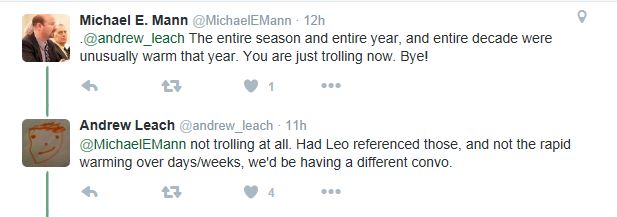
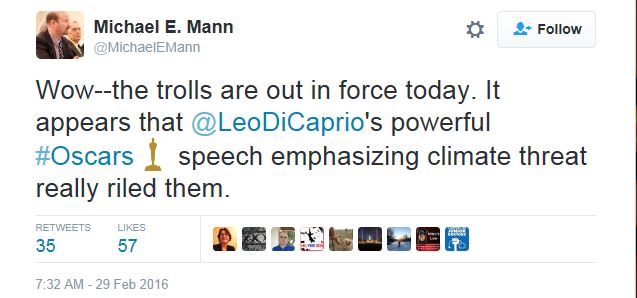
Now Albertans understand this and so when Dr. Michael Mann posted a comment about the Oscars:

trolls

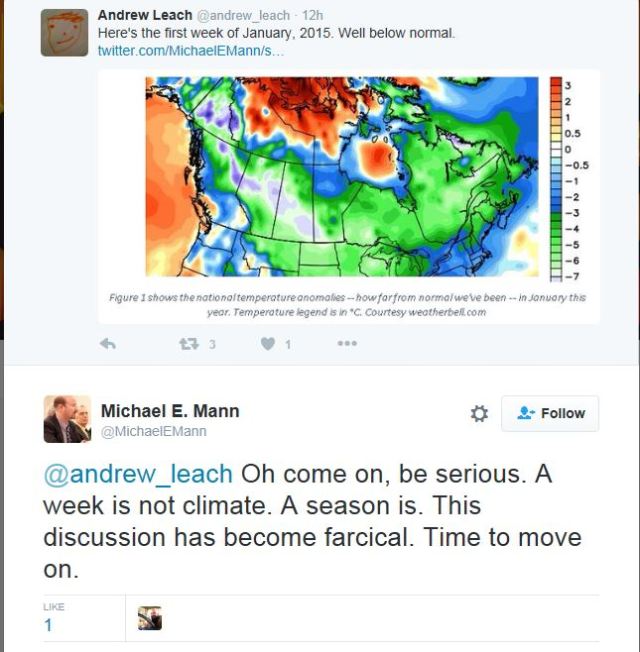
One of the few people not blocked by Dr. Mann, a gentleman by the name of Dr. Andrew Leach, had the temerity to point out that Mr. DiCaprio was mistaken and that the weather after that year’s Chinook was actually quite cold.

week Mann

Needless to say Dr. Mann decided to Mannsplain  Dr. Leach and then insult him

calls Leach a troll

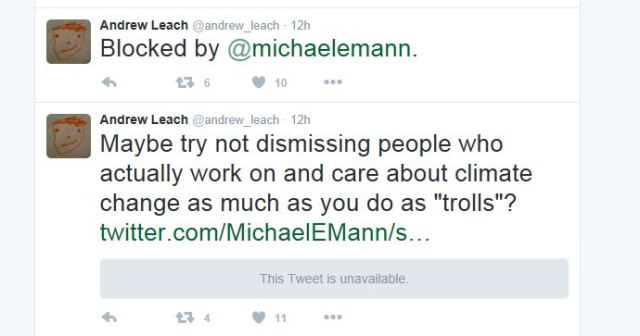
and then, not surprisingly, he decided to block Dr. Leach.

blocked

When it was pointed out to Dr. Mann who he had blocked Dr. Mann, the person who had just called the man a “troll”, subsequently complained that Dr. Leach was often “irritating/rude on social media”.

being rude

Pot meet kettle.

Now many folks have been blocked by Dr. Mann, (myself included) , that is not a big deal. What is a big deal is that Dr. Mann managed to alienate a potential ally. You see, Dr. Leach isn’t just another anonymous commenter on Twitter, Dr. Leach was the Chair of the Province of Alberta’s Climate Change Advisory Panel.

Dr. Leach and his panel produced the Climate Leadership Report (caution large .pdf file) that served as the basis for the Alberta Climate Leadership Plan. Dr. Leach and his panel spent three months of their lives travelling the province doing the consultation necessary to build up the technical support and political and social goodwill necessary to enact the policy. Besides Premier Notley, Dr. Leach is likely the most important reason Alberta is creating a program to put a price on carbon to fight climate change. Can you imagine a more important ally if you are trying to build a consensus for a change in climate policy across North America than the man who helped convince Alberta that it needed to control its carbon emissions? Turning Dr. Leach into your friend should be a no-brainer for climate activists and a couple polite words is all it would have taken to smooth the waters. Instead, out comes the insults and then the block and another potential ally is stomped. Gotta love the climate crew, they pull out their shotguns at the drop of a hat; proceed to point them directly at their own feet; and then let go with both barrels.

Going back to Leo for a moment, I really don’t understand why so many in the climate change community lionize the man? Here is a man whose opulent lifestyle, love of private jets  and carbon profligacy should get him scorned by these same activists. Instead he says the right things every now and again and he is cast as their champion?

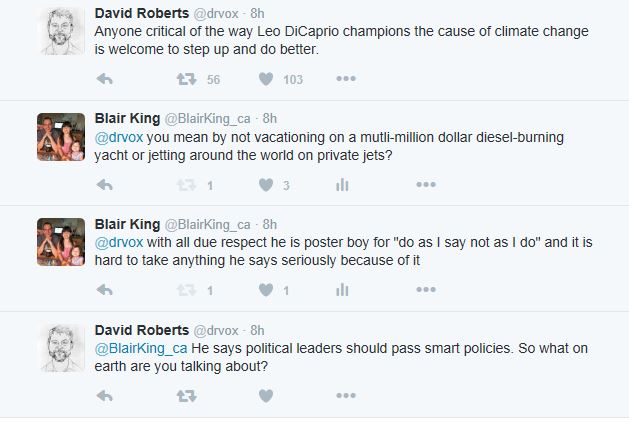
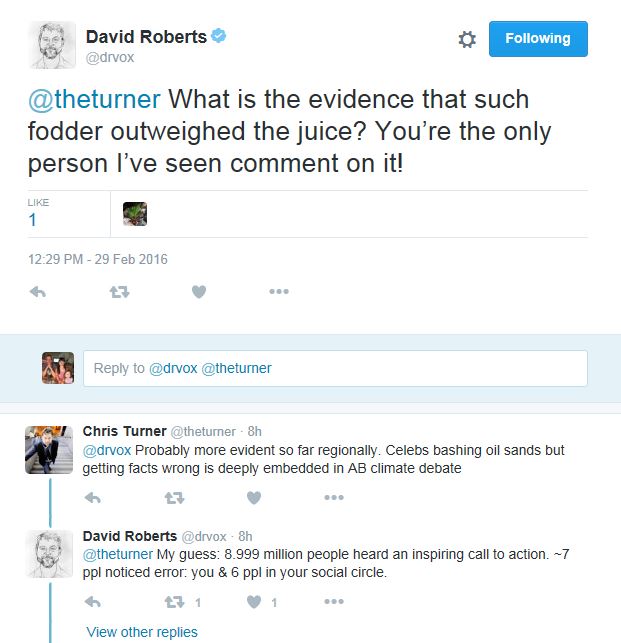
This morning I had a fascinating exchange with Vox writer David Roberts on the topic. Mr. Roberts is a solid writer who, along with Brad Plumer, have written some of the smartest, data-driven pieces on climate change to appear in the mainstream media but on the topic of Leo he has a huge blind-spot and this morning he was taking on all comers:

Dave R 1

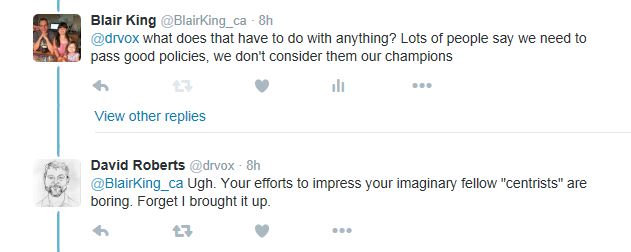
As you can see, the basis for his support of Mr. DiCaprio appears to be that as long as he says the right things in interviews and speeches, then everything he does in his private life should be ignored. I, of course, disagree because unlike most of us Leo flaunts his “private life” for all to see and what we have seen shows his behaviour to be at odds with his words. Our exchange was brief with Mr. Roberts ending with a drive-by insult and then he was off.

smear

What was more interesting was watching Mr. Roberts explaining to climate change activists in Alberta why they should ignore both what Mr. DiCaprio has said and done because only a handful of people would notice the error.

turner 2

The funny thing is this was all derived from a CBC article on the topic.

I’m not sure how familiar Mr. Roberts is with Canadian politics but when you are a progressive and you lose the CBC you have lost whatever battle you were trying to fight. Moreover, as Mr. Turner was trying to explain, Alberta activists tend to care when Leo spews his ignorance on one topic because it has a way of tainting his arguments on every other topic. How can anyone take seriously an activist who, a year after being corrected on the topic of Chinooks, is still making the same ridiculous statements? For activists in Alberta Leo is simply poisoning the well and will make their lives immeasurably harder.

I don’t want to go on too long tonight, but I simply wanted to ask the activists out there a simple question:

why are you making it so hard on yourselves?

Outside of your progressive enclaves there are a lot of people who still need to be convinced about the importance of action and you are not making it easier. How hard would it have been for Dr. Mann to simply have been be civil to an esteemed colleague? A colleague with a lot more green cred than Dr. Mann himself in much of Canada.

Regarding Mr. DiCaprio, why are so many activists lionizing a man who’s carbon footprint really does make him a one-percenter in the field? Sure he has said some nice things but his actions don’t appear to back up his words. There are so many really deserving people out there to carry the flag and instead you rely on celebrities and celebrity-scientists? That is probably why in a recent major study only 44% of Canadians believed that humans were the primary cause of climate change?  You guys have had 25 years doing this and you can’t even convince half of Canadians that humans are the primary cause of climate change? Why do you never learn from your mistakes because, as the polls clearly indicate, your opponents certainly do.

Posted in Climate Change, Climate Change Politics, Uncategorized | 6 Comments

A Jacobsonian 100% Wind Water and Sunlight gallop at UCLA

Tuesday evening I spent a couple hours online listening to a moderated debate hosted by the UCLA Institute of the Environment and Sustainability. The debate was titled POWERING EARTH 2050: Is California’s 100% Renewable Strategy Globally Viable? The reason for my interest was three-fold: As anyone who reads my blog knows I try to follow the comings and goings of the topic of renewable energy and this was a presentation dedicated to the topic. The second reason was because two men I have come to respect via Twitter: (Mike Shellenberger and Ken Caldeira) were two of the featured speakers (it was Mike’s tweet that made me aware of the event). But truth be told, the main reason for tuning in was that it featured a man known well to this blog Stanford Professor Dr. Mark Z Jacobson.

Dr. Jacobson is the godfather of the 100% Wind, Water and Sunlight (100% WWS) series.  He is an advocate for moving our planet to a state where all energy is provided solely by the power of wind, water and sunlight (okay with some geothermal and tides). His work has fascinated me, to the extent that I have an entire section of my blog dedicated to it. Unfortunately, that section consists mostly of criticisms, because as I describe in my blog posts, while I find the concept of 100% WWS incredibly appealing, it appears to fail on any number of fronts. I have posts dedicated to its limitations when considering rare earth metal use, its irrational exclusion of nuclear energy as a low-carbon energy source, its expense (from a Canadian perspective) and the intellectual inconsistencies of the people pushing the plan. I used to follow Dr. Jacobson on Twitter but he has a habit of blocking those who ask him challenging questions, so I was really interested to see him discuss the topic in a public forum.

I have to admit, I was not disappointed by Dr. Jacobson as a speaker. As expected he speaks with an easy evangelical fervour and obviously believes everything he is saying. The problem is that, like many folks with an evangelical world-view, he doesn’t let little challenges get in the way of his bigger message.

I was particularly impressed by his opening statement. In the creationist science debate there is a presentation technique called the “Gish Gallop” it has been described as:

the debating technique of drowning an opponent in such a torrent of small arguments that the opponent cannot possibly answer or address each one in real time. More often than not, these myriad arguments are full of half-truths, lies, and straw-man arguments — the only condition is that there be many of them, not that they be particularly compelling on their own. They may be escape hatches or “gotcha” arguments that are specifically designed to be brief, but take a long time to unravel.

This style can well be attributed to Dr. Jacobson at this event. His initial presentation was only 6-7 minutes long but it was jam-packed with things that would take a dozen blog posts to completely unravel [he reportedly spoke at almost 2.9 words a second]. Lacking the patience of Job, I will address a mere handful of the cornucopia of the Jacobsonisms from his presentation.

Dr. Jacobson comes online at about minute 7:35 of the attached YouTube video (POWERING EARTH 2050: Is California’s 100% Renewable Strategy Globally Viable?). Unfortunately there is no official transcript of the event (yet?) so I have paraphrased the applicable bits and included approximate time stamps [after writing this post I found a good transcription here] Dr. Jacobson starts his presentation at about 7:35 of the video and by 7:55 he has already said something interesting enough for a comment:

We have authored 15 peer reviewed papers…..that have been reviewed by over 35 peer reviewers.

Now this appears to be one of Dr. Jacobson’s go-to argument styles on Twitter. He repeatedly has pointed out that his work is peer reviewed and that none of the people criticizing his work have had their criticisms published in the peer-reviewed press. I go into detail on this gambit in a post titled On blogging and the irrelevance of academic peer review in multi-disciplinary fields.

As I point out in my blog post, a refereed paper is only peer-reviewed by a limited number of people and each reviewer only has so much expertise. So when you have a paper that covers a very broad topic, like discussing the strengths and limitations of a half-dozen different power generation technologies for implementation in 139 Countries; you can virtually guarantee that much of the paper will be outside of the area of expertise of the individual reviewers. As I point out in my blog post, once you leave a peer reviewer’s particular area of expertise they simply become a highly-credentialed copy editor. In a field like renewable energy policy, that is very broad in content/context, it is simply not possible to find reviewers who can do a reasonable job of comprehensively peer reviewing papers of this sort. This has been demonstrated nicely in the case of the 100% Clean and Renewable Wind, Water, and Sunlight (WWS) All-Sector Energy Roadmaps for 139 Countries of the World (called 100% WWS World hereafter) where  It took a Finn to point out that Finland, unlike the rest of Scandinavia, is an exceedingly flat country so the heavy reliance on pumped hydro in that country suggested in 100% WWS World was not topographically doable.

In his presentation, Dr. Jacobson appears to try to nullify that concern by pointing out that the 15 papers had been reviewed by 35 peer-reviewers. Now that sounds like a lot until you carefully unpack that statement; there were 15 papers after all. That is like saying we played 15 soccer games and had a total of 35 officials therefore each individual game must have been well-officiated. The reality is that any single paper had at most three reviewers and by his own numbers it appears that the stable of reviewers was small enough that some reviewers must have reviewed more than one paper or some papers were reviewed by fewer than 3 reviewers. This is not a sufficient cross-section of expertise to address the multi-faceted nature of the field under study as is demonstrated by many online critiques of this work.

His follow-up approach appear to be to point out that none of his critics have had those criticisms published in the peer-reviewed literature but there is a simple answer for that. As I discuss in my blog post there is no incentive to writing up a critique for peer-review when you can have the same information made available where it can be viewed and critiqued globally on the web. Only academics, who need to keep score for their C.V.s, would wish to get such a paper published. Dr. Jacobson’s discussion continues until minute 8:40 where he begins discussing end-use power demand in 100% WWS World:

End use power demand…is 12.5 Terawatts (TW). If we go to 2050 that goes up to about 19.5 TW. [He then discusses conversion efficiency associated with conversion to electricity] we reduce power demand, first 32% by the efficiency of electricity over combustion without even changing your habits…and then another 7% that we try to squeeze out due to end use energy efficiency improvements, which is very conservative compared to a business as usual case…. So we have about almost 12 terawatts to satisfy, in 2050, of end use power.

Now let’s be clear here, as described by the International Energy Agency:

Modern energy services are crucial to human well-being and to a country’s economic development; and yet globally over 1.3 billion people are without access to electricity and 2.6 billion people are without clean cooking facilities. More than 95% of these people are either in sub-Saharan African or developing Asia and 84% are in rural areas.

In India 44.7 % of the rural population has no access to electricity, that represents about 80.7 million households. All the energy efficiency in the world is not going to decrease these people’s energy demands since they aren’t using any electricity right now. Yet in the 100% WWS World paper they have projected energy use for residential purposes in India dropping from 241 GW in 2012 to 164 GW in 2030 before bouncing all the way up to 277 GW in 2050. The Indian government recently set a simple, but ambitious goal that every citizen will have reliable electricity by 2022. Unfortunately for the 100% WWS team, when these people are finally connected to the grid they will increase the demand, not reduce it in these regions. As a consequence, the numbers underlying the 2030 and 2050 assumptions of 100% WWS World are simply out to lunch. There is no way that the population of India will be using less energy in 2030 than they do today following the addition of 80.7 million households to the grid. Most interestingly, according to the 100% WWS World spreadsheets, in 2050 the scheme calculated that 388 million US residential users will use approximately the same amount of energy (276.46 GW) as the 277.05 assigned to the projected 1.7 billion Indians in 2050. How is that for Western exceptionalism? We are going to give ourselves 4+ times the per capita energy that we allocate to the Indians. I somehow doubt the Indians are going to go along happily with that approach.

By 9:40 he was really doing his thing

We can eliminate global warming as we know it…and get CO2 down to 350 ppm by 2100.

Dr. Jacobson has repeated this statement before and as a man who stresses the value of peer review it is interesting to note that, to the best of my knowledge, this statement has not appeared in any of his published work. It has appeared in the supplementary material associated with the 100% WWS World paper but the actual calculations and assumptions behind this incredibly important statement do not appear to be in the peer-reviewed literature. The original reference is to a textbook he authored but which I have no plans on purchasing.

By 9:56 he was really rolling:

We would create 22 million net jobs over lost worldwide by such conversions

Now this goes back to a complaint I have repeated about this program. It has not been fully costed out. As I point out at my blog, using Dr. Jacobson’s discounted rate for the wind component of the 100% WWS World in Canada would cost $273 billion. We haven’t even considered the necessary grid upgrades, all those solar panels and all the storage necessary to make 100% WWS World work. But don’t worry, this is doable as his acolytes continue to assert.

Going back to his direct statement, I can now understand how you can create so many millions of theoretical jobs, because they are using imaginary money. It is amazing how many jobs you can theoretically “create” when you don’t need to find the financing to pay for any of them.

By 10:50 of the video he was “reducing global conflict” (because the Middle East has only seen war since oil was discovered there, as long as you ignore all those religious wars since the times of the Hittites) and later he notes how his program will reduce poverty…presumably with more of that magic money he has lying around.

Now you can see how he does it, this blog post has almost surpassed 2000 words and I have not even run through his introductory comments. I would like to end it here, but I have one issue that really gets my goat about the 100% WWS series. Now I’m a bit old-fashioned in that when new research comes out I try to consider it in my subsequent work. This is not necessarily the case in the 100% WWS series. It is like a Jenga tower always pulling out parts of old papers to build the new ones.

In his discussions Dr. Jacobson repeatedly refers to the cost of wind power which he claims is much cheaper than nuclear. I was confused by this Tuesday night so I went searching to see where he got his numbers. It appears that he derived that number in his 2009 paper (Review of solutions to global warming, air pollution, and energy security) using a single Danish reference from 1997 (Krohn, The energy Balance of Modern Wind Turbines). He appears to extrapolate the life-cycle energy costs for a 5 MW turbine from a “modern” 600 kW Danish wind turbine” [modern for 1997 I suppose?] and uses that to calculate a national number. The resulting emissions from the wind turbines are reported as 2.8–7.4 g CO2 per kWh. Now a lot of science has been done since 1997. As an example Turconi, Boldrin and Astrup (2013 Life cycle assessment (LCA) of electricity generation technologies: Overview, comparability and limitations) produced a meta-analysis of life cycle analyses for wind installations. They came up with a range of 3–28  kgCO2-eq/MWh. They also point out one particular study that is particularly apt in that it includes storage which is a feature of the 100% WWS series (35–41kgCO2-eq/MWh). They also make note of emission factors reported in previous review studies were in the range of 5–35 kgCO2-eq/MWh. Now we have a range derived in 2009 from a single report produced in 1997 or we can use a range that incorporates 22 of the best recent studies. Anyone care to guess which number gets used in discussions around 100% WWS?

Well I have officially run out of gas, but if you have not had enough I suggest you mosey on over to Rod Adam’s post: Mark Jacobson condenses 6 years of wind, water, solar research to 6.5 minute barrage at Atomic Insights. Rod looked at the same talk and had a whole different bunch of comments. I would also like to thank Rod for his partial transcript of the talk. Sadly I didn’t see his blog post until I had spent far too long trying to transcribe the work, but his transcription helped me figure out what Dr. Jacobson was saying at times. I am also looking forward to when PassiiviIdentiteetti takes a run at the talk, which I certainly hope he chooses to do.

Posted in Fossil Fuel Free Future, Uncategorized | 11 Comments

Cap and Trade: a well-intentioned system that can hurt the virtuous

This week a very interesting study came out about Canadian’s views on climate change. I will blog a bit more on that topic later as I am still drilling through the data supplied by the authors but one feature of the article really stood out, it was the fact that so many people in the survey supported a cap and trade system for addressing climate change. The question asked in the survey was:

There is a proposed system called cap and trade where the government issues permits limiting the amount of greenhouse gases companies can put out. If a company exceeds their limit, they will have to buy more permits. If they don’t use all of their permits, they will be able to sell or trade them to others who exceed their cap. The idea is that companies will find ways to put out less greenhouse gases because that would be cheaper than buying permits.

Now I have made it clear in this blog that I believe that putting a price on carbon is the best way to reduce out national carbon footprint. I have not written a lot about the other methods of addressing the issue and, for the most part, have avoided discussions on cap and trade systems. Personally, I am not a fan of cap and trade nor their kin: carbon offsets (about which I have written a post Carbon Offsets: a Basilica to Bad Policy). I see both as being too prone to being gamed. Unfortunately any system invented and run by regulators is subject to being gamed by intelligent and unscrupulous operators and I foresee the headlines 10 years hence where the next generation’s Enron is discovered to have made millions because they found a loop-hole to exploit.

On a moralistic level, I also have a strong dislike of the cap and trade system for carbon emissions that has nothing to do with gaming the system and everything to do with how the system is typically implemented in our modern era. There is an old saying that “the road to hell is paved with good intentions” and nowhere is that saying more true than in the case of carbon cap and trade systems. The reason for this is simple, cap and trade is an excellent theoretical model if implemented when a problem is initially identified (like with acid rain) so that all players arrive at the starting line at the same time. Unfortunately, that is not the case in Canada with respect to carbon pollution. When implemented in an existing marketplace cap and trade can have the ironic outcome of punishing the virtuous and enriching the slow-adopters. To explain how this occurs let me provide an incredibly simplistic example.

Imagine there are two companies that both make a widget: Virtuous Inc. and Gluttony Ltd. Both companies have the same underlying total cost to produce the widget (say $100) however the two companies go about producing the widget by substantially different means. Virtuous Inc., as its name suggests, is a forward thinking company that recognized the threat of global warming years ago and has spent the last decade optimizing their system. They invested heavily in the newest clean-energy technologies and have a plant to produce a widget using only 100 units of (our unitless) carbon dioxide equivalents. To achieve this laudable goal they borrowed from the bank and have a huge loan outstanding so the unit cost of their widget is broken down to be 50% financing costs, 40% input and materials and 10% energy (carbon dioxide equivalents).

Gluttony Ltd., on the other hand, has always made widgets the same way. They pump huge amounts of energy into the process, but because they have been around for a long time they have no debt, their equipment is paid for. Their unit costs for the widget are 40% inputs and materials and 60% energy (carbon dioxide equivalents).

Now all things being equal we have two virtually identical widgets, one which takes 10 carbon dioxide equivalents to produce and the second 60 carbon dioxide units to produce. From a climate change perspective we would want to minimize the number of units produced using the high-energy pathway and maximize the amount using the low-energy pathway, but that is not how cap and trade works. Instead, using the method that the cap and trade systems have been implemented to date, on the day the cap and trade system comes into place Virtuous Inc. is initially only allocated 10 carbon dioxide units (their historic average) while Gluttony Ltd. is allocated 60 carbon dioxide units (their historic average). So right off the bat Virtuous Inc. has been put at a disadvantage. Their competition has just been allocated an allowance (that will have a value in the coming years) based almost entirely on their historic bad business practices.

Now how cap and trade actually reduces emissions is that on a year-by-year basis each person who has obtained an allowance will lose a fixed percentage of it and will have to improve their efficiency or go out into the public market and buy someone else’s allowance to continue to operate. Happily for Gluttony Ltd. when you are ultra-inefficient it is amazingly easy to improve efficiency. Even better for them, they will be able to sell some of their allowance to get the money to pay for that efficiency increase. Ironically enough, one of the people in the market for their excess allowance will be their more efficient competitors.

In our sample case a 1% efficiency gain by Gluttony Ltd. will reduce their emissions at the same level as a 6% efficiency gain for Virtuous Inc. Now sadly for Virtuous Inc., they already did the heavy lifting to get efficient (and have a huge mortgage to show for it). In order to continue to operate they will have to buy further units and in our simple model the easiest person to buy from is Gluttony Ltd. Gluttony Ltd. meanwhile can then take the money provided to them by Virtuous Inc. and invest it in efficiency gains. This results in them improving efficiency. Now in isolation this seems like the system has worked. Average emissions per widget produced are down and the inefficient users are being forced to become more efficient but look what happened to the previous high-achievers? They have just been pushed off a cliff. Virtuous Inc. still has a huge mortgage and now has to pay a less efficient competitor for their quota which allows the less efficient competitor to improve their production without the need of a mortgage. Virtuous Inc.’s cost per widget is now more than Gluttony Ltd….and the process is additive. Every year the amount of carbon is going to decrease and Gluttony Ltd.’s initial advantage (being awarded a huge free allowance from the government) will likely allow it to kill its now over-leveraged competitor. The best of intentions ended up with the worst of outcomes.

Now to be clear, this is a very simplistic scenario. Some will argue it is too simplistic. Unfortunately, it is not an unfair one. Every system in place for cap and trade acknowledges the issues raised by my scenario and each model tries to help the virtuous members of the community, but unfortunately, none do a very good job of it. In Ontario and Quebec the government will allow Virtuous Inc. to bid on outstanding carbon units so that Virtuous Inc. does not have to directly subsidize their competition, but even that is a band-aid since Gluttony Ltd. can always sell their quota to someone else. Ultimately, the inequity of the system was established the day the allowances were issued.

The simplest approach to addressing this issue would appear to be performance benchmarking carbon quotas except that process has not been used very often as it is “administratively and technically complex and can create challenges for regulators”. Established industries have lots of money and lots of clout and they have, to date, been pretty good at ensuring that on day one of implementation they get more than their fair share.

Consider the Quebec example, in an attempt to avoid “leakage” Quebec basically gave Gluttony Ltd. all it could have hoped for

During the first few years of the cap-and-trade system, Quebec took measures to avoid “carbon leakage”—i.e., the relocation of industry to jurisdictions that do not have a cap-and-trade system—by granting emitters the maximum emissions allowances required to comply with the system free of charge; however, the system provides for a gradual reduction in the number free allowances granted annually.

The most even-handed way of addressing the problem is to ensure that all emissions are sold under an auction system. However, even in an auction system you have an unfair competition, because the early adopters typically don’t have the financial wherewithal (due to their debt to modernize) to compete with the big boys.

The reality is that virtually every cap and trade system implemented to date has had serious consequences for the Virtuous Incs. of the world. The reason for this is simple, cap and trade is an excellent model when implemented when a problem is initially identified (like with acid rain) so that all players arrive at the starting line at the same time. Unfortunately, that is not the case in Canada with respect to carbon pollution where the virtuous have long since started the transitions to a low-carbon future.

Alternatively, the argument goes that you have to break a few eggs to make an omelet. This is also true, but it sure is a shame that the eggs in this analogy happen to be the most virtuous of the players in the game. It is too bad as the business theory goes “the early bird does not necessarily get the worm”.

This brings us back to my preferred policy, putting a price on carbon. Putting a price on carbon provides an initial boost to the most efficient energy users and rewards the early adopters. As well since it is not controlled by regulators there are fewer opportunities for the unscrupulous to game the system. For this reason I will continue to support BC’s approach to addressing climate change over Ontario and Quebec’s. That being said, I welcome arguments to the contrary. I am always learning in this field and hope we can come up with a tool-kit of means by which we can achieve a low-carbon future.

Author’s Note: I recognize I have simplified the system tremendously in my example. I did so because the vast majority of my readers are not policy wonks. They are the same people who answered “yes” in the survey described in the first two paragraphs. Moreover, I have read countless articles on the pros and cons of cap and trade and I have yet to see one that explicitly looks at how the virtuous early-adopters are favourably treated under a newly implemented trading regime.

Posted in Uncategorized | 2 Comments

On raising respectful and aware kids in the modern era

I’m going to change up the pace a bit. Over the last year I have written about topics such as renewable energy and climate change but today I am going to address a topic even closer to my heart: how we are raising our kids in the modern era.

As many of my readers know, I am the father of three children, a son (age 8) and two daughters (ages 6 and 4). As an involved parent, I have been coaching kids in various sports for a long time. Starting with my niece and nephew, in 1990, I have coached over 50 kid’s sports teams so far. My wife, meanwhile, has been a school teacher teaching children in classes ranging from Kindergarten to Grade 7 over the last 15 years. Since my wife is a teacher, I have also spent countless hours with teachers listening to their stories. All this information has caused me to recognize some things I would like to share with my fellow parents. We are doing our kids a huge disservice. We are raising a generation of kids who are incapable of succeeding in the modern era. They are being taught to be egocentric and to give up, often before even trying. In this post, I want to recount a number of lessons I have gleaned over these last years.

Parents, you are not your child’s best friend, you are their parent

If I only get one point across to my fellow parents it is that your first job is that of a parent. Too many parents I meet think that they are supposed to be their kid’s best friend first and parent second. That is a mistake. A best friend is a person who supports you in good times and bad but does not hold you accountable for your actions or discipline you. That is why we have parents.

Parents are there to instill good behaviours and morals and enforce the rules. That sometimes means being the bad guy who deprives them of dessert when they have misbehaved and shows them how to treat others. This also means not giving them what they want all the time. A parent should not need to bribe a child to follow instructions. That may make it easier once, but sets a precedent that is impossible to keep up. Moreover, other’s, like teachers, are not going to be willing to bribe them in the future. I can’t say it enough, you are not your child’s friend, you are their parent. You can love spending time with them, but at all times you are the parent and they are your child.

Parents, learned helplessness is your fault not your kid’s

If there is one true failing that we as parents have instilled in our kids it is learned helplessness. Now a lot of parents may not understand the term but what it means is a state where a child learns that if they say “I can’t do something” their parent will complete the task for them. Some have never even been given the chance to try. We have raised a generation of kids who either give up after one try or don’t even try in the first place.

Failure is part of growing up and kids need to learn to fail, then pick themselves up, brush themselves off and try again. They need to figure out how to follow instructions and they need to figure out what steps to take when they are not given instructions but simply a task to accomplish.

Show your kids how to do something (or give them the instructions), then step back and let them try themselves. Sure they will do it less efficiently than you might, but that is part of growing up. They will get better if given the chance, but if they are never given the chance they will never learn. There is nothing a teacher hates more than a child who won’t even try to complete a task, yet that is what they see every day because too many helicopter parents do all the hard things for their kids leaving the child incapable or unwilling to try and figure out how to accomplish tasks on their own.

Parents, you are your kid’s biggest influence and your bad behaviours will be reflected in your kids

I have coached more sports teams than I would care to admit. In the last 12 months I have coached 6 different kids’ sports teams and one common feature I see is the parent who behaves in a manner that they would never allow in their children. We have one dad, in boys baseball, who when asked to umpire was happily willing to cheat in favour of his child’s team. What sort of example do you set for your kid when he sees his dad make clearly incorrect calls to ensure his kid’s team wins? Does he expect his child will follow the rules the next time when his hero (his dad) is so cavalier with the rules?

Parents, sure you must advocate for your kids but you must also support your child’s teacher

A lot of parents have been taught that it is their job to advocate for their kids. That is absolutely true. No one cares more about the well-being of your kids than you do. But remember, advocating for your kids should not take away from your responsibility to support your child’s teacher. Certainly your child’s teacher is going to treat your child differently than you would. Academic discipline is different than parental discipline as so when your child’s teacher punishes your child stop and think to yourself about why they are doing it. Sure they may not do it the same way you do, but is what they are doing so wrong? Probably not.

Supporting your child’s teacher also means listening to them and acknowledging what they say about your child. Teachers are professionals, after all, and have gone to school for many years in order to be a teacher. When you contradict or question your child’s teacher in front of your child, you are telling your child that the teacher’s authority is not to be respected. Just because everyone has gone to school, doesn’t mean everyone is an expert in teaching. If that were true, everyone would be a teacher. Believe it or not, but your darling child may behave differently out of your presence than they do in it. So when a teacher tells you about something don’t turn to your child and ask “is what your teacher saying true?” You may think you are involving your child in the discussion, but what you have actually done is to inadvertently question your child’s teacher’s reliability to their face. Think of it from the teacher’s perspective, you have essentially said: “I won’t believe what your teacher just told me until you confirm it.”

Parent, teach your kids to look at someone’s face when you say “please, thank-you and sorry”.

Kids, especially young kids, do not always feel comfortable looking into an adult’s face, but looking at someone when you are asking for something is a big part of being a civilized human being. There appears to be a generation of kids who have been taught that it is okay to say thank-you while walking away and to say “sorry” while looking at the ground. If your child can’t quite look someone in the eyes teach them to look at the space between someone’s eyes or the center of their glasses. Eye contact means a lot in our society and if you teach them early to make eye contact you can really avoid a lot of problems later in life.

Parents, your child’s teacher cannot replace your role in your child’s education

A lot of parents have been incorrectly led to believe that teachers can teach their kids all the life lessons they need in school. The role of teacher is different from that of parent. A parent is responsible for instilling good behaviours and respectful behaviour out of your kids. The teacher is there to teach your kids about academic subjects. I know of one parent who wants the teacher to write down in their child’s agenda what was learned and what is needed every day? Consider that my wife’s class has 30 children. If my wife spent 5 minutes writing in each child’s agenda that would translate to 2.5 hours-a-day writing in agendas? Do you honestly think that a teacher can teach their students the curriculum if they spend half their day writing in kid’s agendas? It is the parent’s job to ensure their kids get their work done, not the teacher’s.

A lot of parents also say “I’ll leave that for my kid’s teacher to cover”. Well think of the numbers. Your child’s teacher is with them for about 7 hours a day, 5 days a week for about 30 weeks a year. Believe it or not that is not enough time to teach them how to behave as well as teaching them the curriculum. Your job as a parent is to set the example and teach your kids the important lessons of life. Your kid’s teachers can supplement your lessons, but you are the ones who your kids will imitate, so give them something good to imitate.

 Parents, admit it when you are wrong and make sure your kids hear you apologize

Going back to being your kid’s best example, there are times when you are going to be wrong or make a mistake. That is a teachable moment. Make sure your kids hear you admit to being wrong and making amends. You will always be your kid’s biggest hero but even heroes are not perfect and how you respond to your own imperfections is just as important as how you do when you succeed. I, unfortunately, did not learn how to say “I was wrong” until far too late in my life. Happily a friend taught me the importance of saying “I was wrong” and “I don’t know” as a young adult and it has served me well ever since.

I was also taught an incredibly important other rule on the same subject. If you correct someone (say they are wrong) in front of a group of people then it is not sufficient to say “I’m sorry, I was wrong” later in private. If you correct someone in public you have to apologize in public, preferably in front of the same people who heard your first correction.

As well, remember you don’t know everything and it is healthy for kids to understand  that their parents have limitations. So when you don’t know something simply say so. My typical response is to say “I don’t know, but why don’t we look it up together then we will both learn something”. I’ve found a variation of the theme works really well at work. Instead of bluffing or faking it I simply say, “I don’t know, but I will find out and get back to you”. My clients appreciate my candor and more importantly they won’t make important decisions based on bad information.

Parents, I have never seen a coach get angry when you take the time to control your child at a sports practice

As I noted previously, I have coached many, many sports teams in the last 25 years. For the last 5 years I have been coaching teams of younger children. These children are necessarily accompanied by their parents as they are too young to be left unaccompanied. What I can never understand is when a parent just sits back and watches as their child misbehaves in practice. The coach is there to teach skills not to be the parent. If your child is misbehaving in a practice, call them aside and get them under control. It will help the coach and be appreciated by all the other parents as well.

Now I realize that for many of you, this blog post only reinforces the things you already do at home. However, based on my experience and those of all the teachers I socialize with, there are a lot of parents out there who need to read these words and take them to heart.

Posted in Uncategorized | 1 Comment

Debunking some myths about private sector scientists

I had a discouraging interaction this week with an academic, who in another lifetime I might have described as a colleague. The academic and I disagree on the importance of pipelines in our modern society. That is not unexpected; we are different people, with different backgrounds and have differing priorities. What disappointed me was her behaviour during the exchange. Over the course of our discussion this relatively young academic accused me of being on the take and threw out a number of classic, uninformed myths about private sector scientists. I’m sure she thought she was making some strong points, but for those of us outside the bubble of academia all she was doing was demonstrating her ignorance of what professional scientists actually do.

To be clear, her opinions are understandable. As I’ve written before about teachers, most academics have never really left the education system. They will have progressed from high-school, through undergrad, to graduate school, maybe a post-doc or two and finally to an academic job; without ever spending significant time in the private sector. Her sheltered life in academia has not exposed her to how scientists in the private sector conduct themselves and so it is understandable that she gets a lot of things wrong. As a consequence, I have prepared this little primer for academics, like her, debunking common myths about their professional brethren.

 Myth: All private sector scientists are on the take

Her first utterance in our discussion thread set the tone for the entire exchange. In reply to my post she wrote:

Who pays you for spreading such misinformation?

Reading that line there are a lot of accusations built into those seven words. First and foremost there was no assumption of innocence or fair dealing on my part. The question wasn’t posed in the form “were you paid to write this” it started with the declaration that I was guilty of being on the take, the only question was about how much I was being paid to spread my “misinformation” (I will go into the whole “misinformation” later). It was cut-and-dried libel and were I a vindictive man I could have done something about it. Instead, I just replied that I was not a shill. She then demanded to know my employer’s name which I viewed as a veiled threat to go after me via my employment. I interpreted it that way because any half-way competent academic can do a Google search and my employment profile comes up pretty high on any search about me.

What I immediately inferred from our initial exchange is that she viewed me as an unethical person, it later became clear that she thought this solely because we disagreed and I work in the private sector. Now, I think if I could only relay one fact to my academic colleagues, it would be that it is possible to work in the private sector and still be an ethical person. Getting paid by a client does not make you beholden to that client. As I wrote in my post The implication of “Professionalism” in Climate Change discussions I am a professional. I am governed by the ethical standards of my registering professional organizations.

What academics may not recognize is that being a “Professional” means I am accountable for my actions as an R.P.Bio, P.Chem and CSAP. I am also accountable for the actions of my fellow professionals. This positive obligation recognizes the fact that as an organization our reputation is only as good as the reputation of our ethically weakest members. A failure to maintain the highest ethical standards of the organization hurts not only the individual involved but every individual certified by the organization. As such a single ethical lapse can be enough to cause the loss of one’s professional designation and often one’s ability to earn a living. This is consistent with the expression: a chain is only as strong as its weakest link.

Certainly some consultants will cross the line and advocate for their clients, and those consultants don’t tend to work for any length of time. If the regulator cannot trust you to maintain your objectivity then you are done. But then academics have bad apples too. The only difference is that the professional peer group actively seeks to exclude unethical practitioners. We have a vested interest in protecting our organization’s reputation.

Myth: You can’t accept an industrial salary and not be beholden to your clients and paychecks

Later is our conversation my academic friend thought she had a “gotcha” moment. She wrote:

You’re right. I should have asked him “has your private company received $ from oil and gas sector”?

Talk about a ridiculous line of reasoning: since my company had been paid by an oil company to clean up contaminated sites, I am somehow tainted by a scarlet letter whenever I speak on the topic of oil. Now anyone with half a lick of sense would recognize that the oil and gas sector represents a huge percentage of Canada’s gross domestic product and working for one company doesn’t mean you are beholden to all companies in the industry.

Here’s a thought experiment, if you worked as a consultant for MacDonald’s would you consider yourself beholden to Earl’s or the Keg? Now this academic holds a Chair funded by the Canadian government. Using her logic she is beholden to that government and should remain silent on all topics relating to government, including pipelines. Similarly her university has any number of sponsors. I’m guessing that her disclosure statement doesn’t include all the companies that sponsor her university? I would even bet that her university has also received an endowment from some company with dealings in the oil and gas sector. By her logic she, too, is tainted and should not speak on the topic.

The simple truth is that while I work to clean up contaminated sites, I am hired because I represent an objective third party. Both my clients and the regulators agree to accept my findings because both parties know I can do my work objectively and free from undue influence. My clients, meanwhile, know full well that any attempt to influence my findings would require me to report them to their superiors. Were I to fail to do so, I would, once again, risk revocation of my professional designation.

 Myth: Private sector scientists don’t do peer review

Having failed in her initial attempts to discredit me my tormentor decided to claim that all she was doing was some informal form of peer review. This goes back to her whole “misinformation” thing in her first tweet. Now over the course of our discussion I continually asked her to identify the “misinformation” in my article. It took a long time to draw her out but eventually she admitted that the only factual error she could identify was a minor issue about the location of a rail bridge with respect to Montreal’s water intake. Humorously enough, this academic is one of “those” peer reviewers, you know the kind, they speak first then check references second. In our case when I asked for a citation to demonstrate my error she promptly provided me with one that supported my position.

 It ends up her “misinformation” smear was simply me coming to a different conclusion than her while looking at the same data set. I call that a difference of opinion, she feels it represents me spreading “misinformation”.

Having failed to embarrass me she hit me with that oh so common myth that private sector scientists:

“I see you’re not accustomed to peer review”.

As I wrote in my post on blogging and the irrelevance of academic peer review in multi-disciplinary fields the peer review process is not restricted to the academic field. As I discussed above, professionals have a vested interest in ensuring that their output is of the highest caliber. As a result no report going out of our office does so without a full internal peer review. As for our professional organization, the CSAP process includes a detailed auditing process to ensure the quality of the output before it goes to the regulator.

Moreover, unlike my peers in the academic community, when I prepare a technical report all the data associated with the work goes into the report. I don’t get to hide source code. Anything that is necessary to ensure the repeatability of my work goes with the report and is made public.

Going back to the peer review process, one might argue that private sector peer review is far more intrusive than that of the academic community. If an academic makes a mistake in a report submitted for peer review, the reviewer sends it back and suggests a correction. If I send in a report with an error I risk the loss of my credentials and the end my career. So when an academic brags about the quality of their peer-reviewed while belittling the work of professionals, consider how many academics would still be practicing if rejection of a paper resulted in a disciplinary hearing?

Myth: You aren’t a real scientist without academic publications

Now the biggest myth thrown out by this academic was that I couldn’t be a very good scientist because I lack peer-reviewed academic publications.

All right, here’s my explanation of why Blair King’s article on #EnergyEast is garbage

It’s disconcerting that Blair King never reveals his job title, but only that he is a ‘professional chemist’ and a lukewarmer

Reply from another

what is BK’s job title? (I thought he was enviro scientist) and what’s a lukewarmer? (guessing someone skeptical of CC)

Reply back

enviro scientist is not a job title. especially if he doesn’t publish any scientific articles

That is like a basketball player arguing that a soccer player is not an athlete because he hasn’t scored any baskets in the NBA. In academia peer-reviewed academic articles are the way they keep score. In the private sector we have different incentives and deliverables. My professional status and the almost-weekly calls from head-hunters represent all the reassurance I need that I am doing a reasonable job.

As for academic publications, as I have written previously, my graduate work was interdisciplinary in nature and involved developing systems to allow data collected by governmental scientists to be evaluated for its reliability and quality; stored in information systems; and made available for subsequent re-use by other researchers. Upon graduation I went immediately to the private sector and saw no real value in writing up my research since the output of my research was already being used on a daily basis as a component of the information systems used by our provincial and federal governments and was being widely shared by those governments (including through workshops that I was asked to moderate).

As for the practical applications of my research, well it was almost immediately applied at my current employer and has become a standard in our industry for the last decade. I cannot imagine a better demonstration of the value of my research than the fact that our clients insisted that our competitors conduct data analysis in the manner suggested by my research and in doing so our clients have done more to publicize my research than any academic publication might ever have done. As for the future, I don’t plan to submit my writing to a peer-reviewed academic journal anytime soon as I do not see any particular value in doing so.

I must admit, the funniest comment  came at the end of that exchange above when the academic insisted that “Environmental Scientist” is not a job title. I find it amusing that the academic can’t accept that job titles exist that are not directly reflected by a department in a university. Perhaps the academic should explain her view to Eco Canada or any of the hundreds of other organizations that both hire and train Environmental Scientists.

Looking back at our conversation on Twitter, I remain amazed that a scientist of such obvious repute would behave so poorly. I suppose it comes down to what I suggested right at the top of this article. Often academics live such a sheltered existence that really don’t know how the rest of us live. I suppose there really is truth to that old expression about academics living in ivory towers.

As for the pièce de résistance, I will leave you with this gem:

is @BlairKing_ca a paid troll to disrupt the #EnergyEast debate in Quebec?

Shortly after posting this, the academic blocked me on Twitter while engaging in a run of subtweets (some of which were forwarded to me by interested others). Gotta love those high-minded academics.

Author’s note: an earlier version of this post included the actual tweets which identified the academic. However, since I am going for a general post with general lessons rather than a hit piece I have removed all identifying information.

Posted in Canadian Politics, Uncategorized | 13 Comments

On the empty platitudes of the anti-pipeline advocates

This week was a busy one in the Energy East pipeline debate with Denis Coderre and his merry band of municipal politicians stepping out of their jurisdictional depth to come out against the pipeline and our Prime Minister saying he will be a referee in a process where he ultimately has to be the decision-maker. I’ve written several posts on the subject (“A Chemist in Langley’s take on Energy East” and “Debunking more Myths and Fables about the Energy East Pipeline” and a short-take at the Huffington Post I Support The Energy East Pipeline As A Pragmatic Environmentalist). As well this week comedian Rick Mercer had his say on the topic in his weekly rant. All week I have been reading criticisms of both my writing and Mr. Mercer’s rant. The most popular response to Rick Mercer’s rant was a counter-rant by another comedian Scott Vrooman. This counter-rant was almost humorous in its lack of depth. Jen Gerson of the National Post had the best description I have read to date:

Vrooman has presented a superficially compelling argument for people who have a childlike understanding of the pipeline issue.

To which Mr. Vrooman replied “Know your place, children” implying that Ms. Gerson was treating him like a child.

Now the problem with Twitter is it does not allow for detailed discussions so I will use this blog posting to expand on my criticisms of the empty platitudes expressed by Mr. Vrooman (and the similar ones directed my way, by other activists) in the last week.

Let’s innovate our way out of the problem:

One of the first lines in Mr. Vrooman’s rant to catch my ear is one I hear every day from anti-pipeline activists. As Mr. Vrooman put it:

“so maybe it is time to innovate our energy system beyond just digging up a bunch of crap and setting it on fire”

Now it is hard to express how sublimely ridiculous this platitude really is. Apparently Mr. Vrooman and his fellow anti-pipeline kin believe that all the energy scientists in the world have been sitting on their hands for the last 30 years just waiting for their clarion call. They have been waiting for activists like him to get involved so they can “innovate our energy system” and a miraculous breakthrough will somehow occur.

The reality is that alternative and renewable energy has been a research priority for decades now. Ever since the first IPCC report it has been clear that we need to move our economy off fossil fuels and both the private and public sectors have been pouring billions of dollars into energy research. In 2014 Global investment in renewable energy sources rose almost 17 percent year-on-year to $270.2 billion in addition governments around the world have spent billions more in basic research and we still have a world economy dominated by fossil fuels. Literally tens of thousands of the best minds in our world have been dedicating their lives working on this problem. From Elon Musk to the scientists at UBC, dedicated experts have been working tirelessly trying to find energy solutions. So why have we not been able to innovate our way out of this to date? Not because of a lack of funding, that’s for sure, but rather due to the difficulty of the task.

Think of this from a scientific perspective. We need new energy technologies to help lift us out of our dependence on fossil fuels…but what will they be and what do we need to know? It is not like there is a map and by following directions we will get there. To achieve our energy goals we need to do a lot of fundamental research in hopes of further breakthroughs in topics such as novel materials; biological intermediates; and in the interface of electro-chemistry and electronics. There are so many different topics to study and only so many dollars out there. Frankly, if it was as easy as the energy activists say we would have solved the problem several times over by now.

Now consider that even in the most ambitious scenario the research dollars are limited and every research dollar used on the energy problem is a dollar pulled away from other pressing priorities. Also recognize that frankly a lot of those other priorities are pretty compelling in their own right. Climate change is still a hard to understand threat (as I will discuss in a future post) but childhood cancer, well that is a direct threat that affects children in every community, every day. It is pretty hard to convince the public that in order to address climate change we will need to give up on cancer research, but to achieve the goal these activists have set means not funding those other research priorities so we can “innovate our energy system beyond just digging up a bunch of crap and setting it on fire”.

 Getting off fossil fuels is doable

The next of Mr. Vrooman’s points that sounds good as a sound bite but fails in the light of day is the line:

“Re-shaping the economy is difficult, but difficult isn’t impossible and the alternative is morally indefensible“

This is another of the platitudes I have heard countless times in the last week. My response has been to suggest that the speaker actually try running the numbers. Mr. Vrooman indicates on his profile that he used to be an economist so maybe he will do a better job than me because when I ran the numbers for Canada the result was sobering. As I wrote in my post More on 100% Wind, Water and Sunlight and the Council of Canadians “100% Clean economy” by 2050 goal the costs to transition off fossil fuels will be in the billions and billions. Let’s look at the 100% Wind Water and Sunlight approach (which I discuss in detail at these blog posts) which the activists keep pointing me to. Just to achieve the wind part of 100% WWS in Canada will cost 2.4% of Canada’s GDP for the next 16 years. That is before we figure out how to pay to adapt the electricity transmission system, the millions of solar panels needed or any of the energy storage technologies necessary to make the technology work.

The simple lesson from my assignment in applied economics is that it is easy to say that something is “doable” is an absolute sense but the task suggested is doable only under the condition that we essentially abandon all non-energy infrastructure and research for the next 16 years or so.

Humorously, the activists tout the job gains associated with the development but it is easy to create millions of hypothetical jobs when you have trillions of hypothetical dollars to pay for them. The only problem is that in the real world we don’t have trillions of dollars to dedicate to this task.

Activists claim that by getting rid of “fossil fuel subsidies” we will be able to pay for the transition away from fossil fuels, but that is a mugs game. While the IMF pegged fossil fuel subsidies at $1.9 trillion, the problem is that only $480 billion of that represents real subsidies and those aren’t the types of subsidies the activists think they are. That $480 billion is not money going to the big oil companies; it is developing countries subsidizing the price of fuels to cushion energy prices for the poorest of their citizens. The other $1.4 trillion, meanwhile, is not really a subsidy in the traditional sense. As Brad Plumer explains:

The IMF report argues that governments should be taxing fossil fuels appropriately in order to take account of the air pollution and climate damage they cause. Earlier economic modeling has pegged these “externalities” at around $25 per ton of carbon dioxide. So, the IMF estimates, the failure to price these fossil fuels correctly amounts to a subsidy of some $1.4 trillion worldwide.

As Mr. Plumer points out, any attempt to eliminate those “subsidies” without protection of the poor, will be socially unacceptable. What this means to you and me is that if the government stops “subsidizing” fossil fuels that money will not be available for renewable energy technologies, but rather will be needed to protect the poorest of the poor from the huge price spikes in energy and food related to the removal of those “subsidies”. What this means is that there is not some magic pot of money out there that can be used to develop renewable energy technologies. That money will have to come out of existing funding sources and will necessarily push out lower priority research topics.

Unfortunately for the activists, there are other priorities out there as well. As I note above, I’m pretty sure that if you told all the cancer researchers out there that for the next 20 years or so we were going to give up on cancer research in order to address climate change, well they might have something to say about it. We also can’t afford to ignore critical infrastructure for two decades while we concentrate solely on energy infrastructure. Now add elimination of mental health research, vaccines research, research on crop improvements…these are the things that will need to be re-prioritized in a world where energy research and infrastructure represent priorities one through 10.

Montreal’s crude oil supply

My final point will address one of the most frustratingly inane topics I have had to address these last week: the repeated argument by activists that the Energy East pipeline poses too much of a risk to Montreal and its water supply. Now if you knew nothing about the City of Montreal this might make sense, but those who know the City know that Montreal is currently home to three large oil refineries with a combined capacity of 386,000 barrels per day (bpd). These refineries receive crude oil on a regular basis via an existing pipeline: the 74 year old Portland-Montreal pipeline (PMPL) as well as by rail. The Montreal lateral of Energy East, that Dennis Coderre is fighting so valiantly to stop, represents a modern pipeline designed to replace a 74 year old pipeline (the PMPL) and the rail system that gave us  GogamasGalenas and Lac Megantic and which crosses the St. Lawrence River immediately upriver from Montreal’s biggest drinking water intake. So on one hand you have a brand new pipeline with all the most recent anti-corrosion and leak detection/prevention technologies and on the other hand you have a 74 year old pipeline combined with a rail link that has already caused more than one disaster….and the activists (and Denis Coderre) are pushing for the former over the latter…I find this almost too absurd to say much more.

Conclusion

This post is getting a bit long so let’s end it with a few words about the activists who we keep seeing on the news. You will notice that they aren’t made up of working moms and dads but mostly of professional activists, university students, university professors and well-to-do retirees. Most of the activists are in occupations that are protected (or incorrectly think they are protected) from the actions they want us to take. It is really easy for a millionaire author or a tenured university professor to say “leap and the net will appear” because they already have a soft landing place ready for them. As for the rest of us, the folks who live paycheck to paycheck, that type of leap is more likely to result in a painful, and possibly terminal, landing.

Posted in Canadian Politics, Energy East, Oil Sands, Pipelines, Trans Mountain, Uncategorized | 10 Comments