
Life is very busy right now so I don’t have a lot of time to blog. As such tonight’s installment is simply a quick-take to address a “Policy Note” from the Canadian Centre for Policy Alternatives (CCPA) about the LNG Canada project. The “Policy Note” is titled: LNG Canada: Short-term politics trumps long-term climate responsibility and makes claims that are inconsistent with the current state of science but keeps popping up on my Twitter feed. I’ve written before about CCPA reports on gasoline prices and on 100% renewables) and in both cases I was not been impressed by the rigour of the analyses. This new analysis doesn’t improve my opinion of them whatsoever.
The analysis starts with inflammatory rhetoric including calling LNG Canada a “carbon bomb” and calling support for the project a “form of climate change denial“. This type of rhetoric is unnecessary; it is harmful; but most importantly it is wrong. It is based on the false assumption, the CCPA keeps peddling, that “natural gas is not a “clean” fuel—it is just as carbon-polluting as coal.” It takes some digging to figure out how the CCPA managed to come to this incorrect conclusion but it appears the basis of the CCPA argument is a “Reality Check” called A Clear Look at BC LNG Energy security, environmental implications and economic potential written by David Hughes.
Ultimately, I could end this blog pretty quickly by pointing out that the CCPA analysis has been overtaken by real researchers. Since the report was prepared, a team of actual experts in this discipline produced a comprehensive peer-reviewed article on the topic Country-Level Life Cycle Assessment of Greenhouse Gas Emissions from Liquefied Natural Gas Trade for Electricity Generation. The article, by Kasumu et al., completely obliterates the CCPA argument and shows that BC LNG can help reduce global carbon emissions. But given the prestige of the CCPA, I think it is necessary to do the next step of explaining how the CCPA came to its incorrect conclusion.
The CCPA argument can be traced back to Part 8 (page 38) of the Reality Check titled Life-cycle greenhouse gas emissions. In this section the author takes the results of a US National Energy Technology Laboratory (NETL) study Life Cycle Greenhouse Gas Perspective on Exporting Liquefied Natural Gas from the United States and adapts it for the Canadian context.
The issues with the CCPA report start right at the beginning of the section. The author apparently isn’t willing to invest the time to research Canadian data (like Kasumu et al. do). Instead he simply takes the numbers prepared by the NETL, for export from New Orleans (???) to Shanghai, and uses them, holus bolus, for a Canadian project from Prince Rupert to Shanghai. The only adaptation he makes is to adjust for tanker shipping distance. As presented in the supplementary information for Kasumu et al., the CCPA report overstates the emissions for LNG regasification, for power plant operations and for transportation. But even using all these overstated values the CCPA assessment comes up with the conclusion (in Table 11) that BC LNG has substantially lower emissions than Chinese coal. An inconvenient conclusion for a CCPA report, which explains why the author doesn’t stop there.
Failing to prove that LNG is worse than coal using slightly souped up data, the author makes a couple of truly interesting assumptions to create Table 12. Table 12 is the one the CCPA apparently uses as the basis for their argument that LNG is no better than coal. Since the Table 11 LNG emission numbers were so much lower than the coal, the author first addresses the coal numbers. Coal represents the lion’s share of primary electricity consumption in China (graphic from Dr. Wenran Jiang’s incredible presentation at @Resource_Works – link https://www.resourceworks.com/sharing-science.

and they burn a LOT of coal
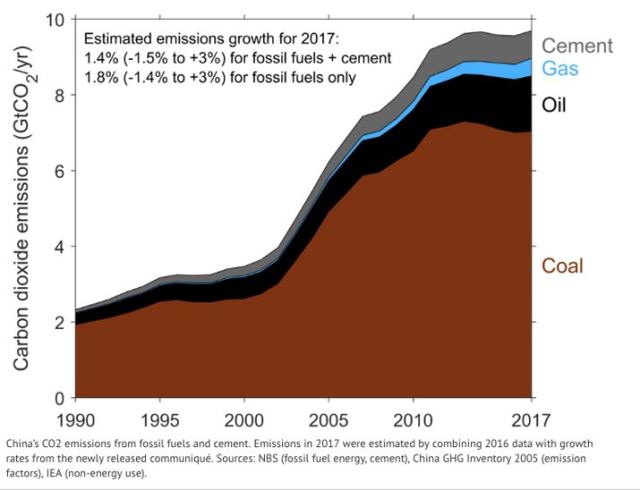
In the last several years China has been building some ultra-modern, high-efficiency coal plants which produce substantially lower emissions than the vast majority of their facilities. In Table 12, the author compares LNG solely to these new plants. The unstated assumption is that the Chinese will eliminate those ultra-modern plants to replace them with LNG. Or put another way, the unstated assumption is that China will close its newest and most efficient plants while retaining the hundreds of old, low-efficiency plants they have in their system. By doing so he is able to cut the differential between Chinese coal and BC LNG down by 300 Kg CO2/MWh.
You would think that this ridiculous change would be enough to make BC LNG less clean than coal, but you would be wrong. Even comparing BC LNG (with his inflated New Orleans production values) versus best-in-class coal, the BC LNG is still 20% lower in CO2/MWh. What is a CCPA author to do? How about figure out some way to inflate the Canadian numbers even more.
The author’s second “adjustment” involves adding a fudge-factor for fugitive emissions. Understand that the original number in Table 11 included the standard NETL correction for fugitive emissions. For Table 12 the author decided to go to the classic anti-LNG activist playbook and pulls out a report by Robert Howarth of Cornell University.
Robert Howarth is legendary in the anti-LNG camp for his 2011 paper with Santoro and Ingraffea titled: Methane and the greenhouse-gas footprint of natural gas from shale formations where they estimated fugitive emissions from natural gas production. As for the rest of the scientific community, they were much less impressed. His colleagues at Cornell published a scathing rebuttal of the Howarth paper then a follow-up. The Cornell group was not alone. Other commentators pointed out that paper incorrectly attributed to venting, gas that was actually burnt to run production equipment. While others had additional concerns. Here is a link to a well-written summary of the issues with the paper and the various information sources debunking most of its findings. Needless to say the only people who still believe the Howarth, Santoro and Ingraffea work are activists who are uninterested in the science.
Howarth subsequently prepared another paper: A bridge to nowhere: methane emissions and the greenhouse gas footprint of natural gas. It acts as a sequel to his earlier work and like every horror sequel the original beast, once thought slain, is revived to attack again. The new Howarth study asserts that unconventional wells have a leakage rate of 3.3%. This is more than double the value used by NETL in their analysis. By adjusting the NETL values with a boost based on 3.3% leakage rate the CCPA author is able to raise the LNG number over the Chinese ultra-clean coal number.
Needless to say, the scientific community has very little time for Howarth’s assumptions especially in the context of the BC natural gas industry. Howarth assumes that all unconventional well are vented and flared during installation and development. This would be a human health disaster in North-Eastern BC where venting those concentrations of sour gas would kill off drill crews. Rather, modern wells are generally “green-completed”, (they are connected to a pipeline in the pre-initial phase) and routine flaring and venting goes against BC Oil and Gas Commission Guidelines. While statistics for Canadian venting are not easily available, in the US only 3% of studied wells vented methane into the atmosphere. Just a reminder Howarth assumes 100% are vented. A study by the US Department of Energy showed very low methane leakage (roughly 0.4% of production) while other studies found unconventional wells with numbers up to 1.65% with the general numbers being closer to 1.4%. Coincidentally, the number used by NETL in their studies. Thus, the CCPA “correction” is both unnecessary and not supported by the science.
Now a topic I won’t discuss in detail in this blog post is the additional consideration that LNG Canada intends to electrify some of the critical steps in their LNG production/supply chain. By electrifying some processing, pipeline transport and liquifaction steps LNG Canada will have the lowest GHG LNG on the planet. Had the CCPA author included the electrification of these steps even with all his other fudge-factors he couldn’t make the Chinese coal more efficient than BC LNG.
So let’s summarize. In order for the CCPA to create conditions where “natural gas is not a “clean” fuel—it is just as carbon-polluting as coal” they had to use numbers from the US that overstate basic operational conditions; they had to ignore the electrification of critical steps in the LNG production pathway; they had to use thoroughly discredited fugitive emission values; and then they had to make the assumption that the Chinese would only use BC LNG to replace their most modern state-of-the-art coal facilities, presumably while leaving decade-old inefficient facilities in operation. I ask is that the sand on which anyone wants to build an intellectual construct? For most policy types that would be a no, but when your goal is to fight LNG, come hell or high water, I suppose the answer is yes.


 A Chemist in Langley